
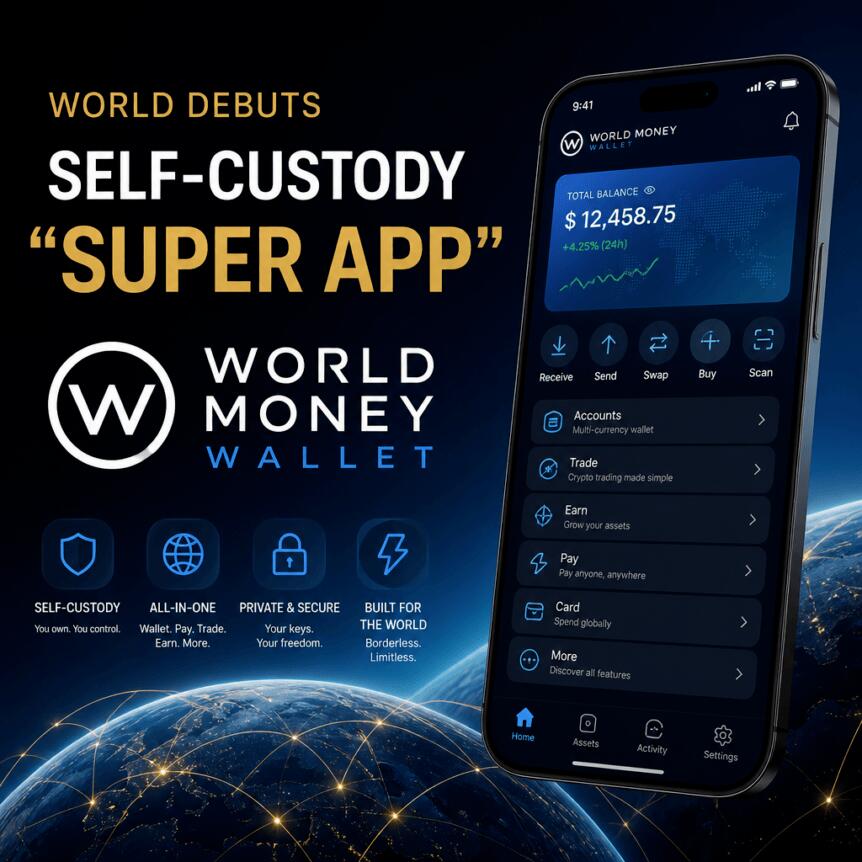
World has rolled out “World Money,” a new self-custody financial super app that combines stablecoin payments, digital asset rewards and in-app trading. The launch began Thursday in more than 150 countries, with some functions varying by region, according to World’s announcement on its website (https://world.org/blog/announcements/world-money).
The app is designed to let users move supported digital assets—such as stablecoins—to recipients using a World username, deposit eligible assets to earn rewards, and buy or sell digital assets via built-in exchange access. World is also positioning the product around its broader ecosystem, including “Mini Apps” that bring third-party services into the same interface.
Key takeaways
- World Money launches in 150+ countries, with feature availability tailored by location.
- Self-custody wallet functions include stablecoin transfers to a World username, rewards for eligible deposits, and trading access.
- Mini Apps extend functionality through third-party integrations such as Kalshi, Credit and Morpho.
- Stripe integration enables funding and stablecoin purchases via Apple Pay initially for users in the US.
- World is splitting responsibilities across apps: World ID App for identity, and World Money for wallet and financial services.
What World Money adds for users
World Money brings together several functions that are typically distributed across different financial apps. World says users can send supported assets—including stablecoins—to another person’s World username. That approach aims to simplify transfers by avoiding traditional address-sharing workflows, while still keeping the process connected to the app’s self-custody wallet experience.
Beyond transfers, the platform includes a rewards mechanism. World states that users can deposit eligible assets to earn rewards, though the specific reward parameters are not detailed in the rollout description. The app also provides access to buy and sell digital assets through exchanges, positioning World Money as more than a payments layer.
World further emphasizes an app-to-app experience through its “Mini Apps.” These third-party modules—named by World as Kalshi, Credit and Morpho—are meant to expand the range of financial actions available without requiring users to leave the World Money interface.
Funding and stablecoin onboarding via Stripe
A key part of any stablecoin “super app” strategy is removing friction from onboarding and account funding. World says it partnered with Stripe to let users fund their accounts and buy stablecoins using Apple Pay, starting with users in the US.
In practice, that means eligible users can convert fiat purchasing power into stablecoins without switching to a separate exchange app for initial funding. For traders and everyday users alike, this can reduce the steps needed to go from payment rails to on-chain asset usage—particularly important for stablecoin payments where timing and convenience matter.
Splitting identity and financial services into two apps
With the introduction of World Money, World says its identity and financial stack is now split across two dedicated applications. The World ID App handles identity verification and credentials, while World Money provides the wallet, payments, trading and other financial capabilities.
World also says existing World App and World ID App users can use their existing accounts for World Money. That matters because it keeps the onboarding path consistent for users who already hold identity credentials or have previously engaged with World’s wallet and trading features under the prior unified app experience.
How this fits World’s “super app” roadmap
World has been steadily expanding the World App concept since its launch in May 2023, when it combined World ID with a crypto wallet, stablecoin transfers and token trading.
In October 2024, World introduced “World App 3.0” as a “super app for humans,” adding third-party Mini Apps and a Vault feature aimed at earning on assets. Then, in November 2025, the company piloted virtual bank accounts in the US—before rolling them out more widely a month later—allowing paychecks and bank deposits to be converted into USDC.
Against that timeline, World Money appears to be both a product expansion and a structural change. Functionally, it continues the super app direction: wallet + payments + rewards + trading access. Strategically, it clarifies the user journey by separating identity tooling from financial operations, which can make the ecosystem easier to understand and maintain as more services are added.
World Money is operated by Tools for Humanity, the company co-founded by Sam Altman and Alex Blania that builds technology for the World network. The rollout therefore links the app’s financial features directly back to the organization behind World ID and the infrastructure underneath World’s ecosystem.
What to watch next
For users, the immediate open questions are how rewards are structured and which specific digital assets and exchanges are available in each region. For builders and investors, the bigger signal is whether World Money can sustain a seamless onboarding funnel—especially via Apple Pay and Stripe—while keeping self-custody and identity credentials tightly integrated as the app expands beyond its initial US-focused funding path.
https://www.cryptobreaking.com/world-debuts-self-custody-super/?utm_source=blogger%20&utm_medium=social_auto&utm_campaign=World%20Debuts%20Self-Custody%20“Super%20App”%20World%20Money%20Wallet%20
Comments
Post a Comment