
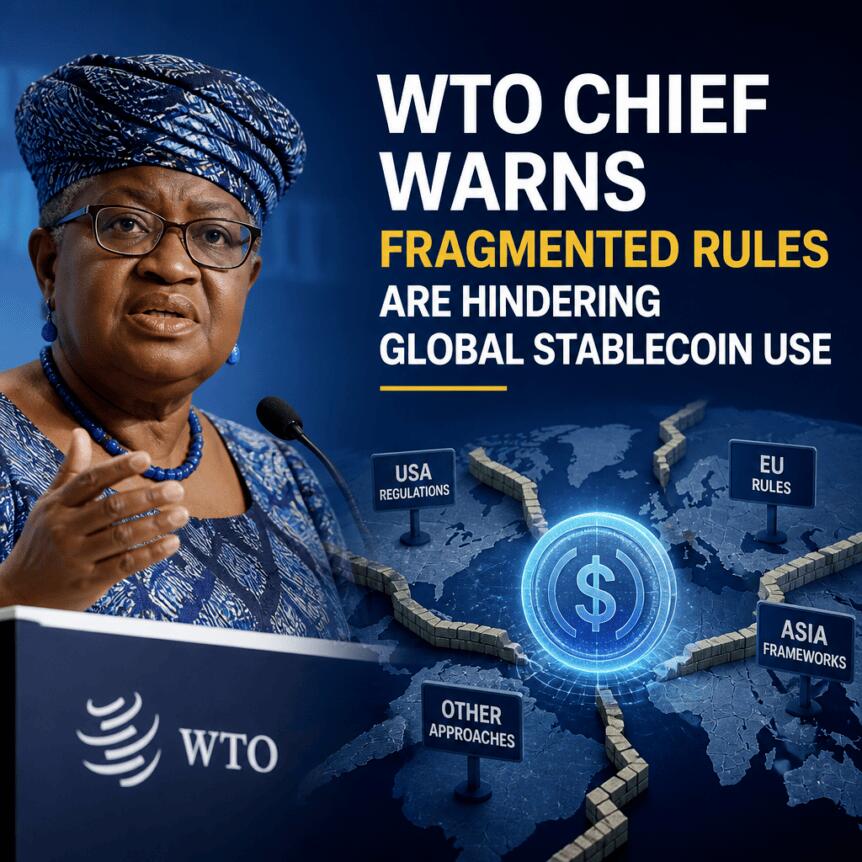
The World Trade Organization says stablecoins could meaningfully reduce frictions in international trade and trade finance, but adoption remains constrained less by underlying technology and more by regulation.
Speaking in Geneva at the launch of a WTO study on stablecoins in world trade, Juan Marchetti, director of the WTO’s trade in services and investment division, argued that regulatory gaps across countries are the central bottleneck. He pointed to a Financial Stability Board (FSB) assessment showing that most jurisdictions have not yet completed the stablecoin rules needed for broader cross-border usage.
Key takeaways
- The WTO frames regulation and regulatory convergence—not blockchain capabilities—as the main barrier to stablecoin use in international trade.
- According to the FSB, only 39% of surveyed jurisdictions had finalized stablecoin regulatory frameworks as of the cited October 2025 report.
- Stablecoins are still a small share of overall international payments, standing at about 3%, despite growing interest.
- The WTO highlights five persistent trade-payment frictions stablecoins may help address: cost, speed, access, transparency, and foreign exchange constraints.
- Cross-border stablecoin payments increased sharply, with the WTO citing a 35-fold rise between 2020 and mid-2024.
Regulation, not infrastructure, is the adoption limiter
Marchetti emphasized that stablecoin adoption does not hinge on whether the systems can move value quickly; it hinges on whether governments and financial authorities have built consistent frameworks that allow compliant cross-border flows. In his remarks, he said the constraint is “actually regulation and the lack of development of regulatory frameworks.”
To support that claim, Marchetti referred to an October 2025 Financial Stability Board report. The FSB analysis found that only 39%—11 out of 28 surveyed jurisdictions—had finalized regulatory frameworks for stablecoins. That figure matters because cross-border settlement often depends on the weakest link: if counterparties, payment rails, or custodians cannot operate under clear rules, scaling beyond pilot programs becomes difficult.
Where stablecoins could ease trade-payment frictions
The WTO study identifies specific friction points that stablecoin adoption may help reduce in global payments used for trade. The report highlights five areas: high costs, low speed, limited access, insufficient transparency, and foreign exchange limitations.
For investors and industry participants, this list helps clarify what “improved settlement” could realistically mean in practice. Stablecoins are often discussed as a faster alternative to certain correspondent banking pathways, but the WTO frames potential value more broadly—covering the operational costs and visibility that can affect trade finance providers, exporters, and importers.
Even with those potential advantages, Marchetti said stablecoins currently account for only 3% of total international payments. That gap between capability and usage underscores how regulatory fragmentation can slow scaling: faster transfer mechanics do not automatically translate into larger volumes if compliance requirements and approvals vary by country.
Cross-border growth is real—but still early
While the WTO argues regulation is the decisive hurdle, it also acknowledges momentum in stablecoin payments. The report states that stablecoin payments in cross-border transfers grew 35-fold between 2020 and mid-2024.
This growth suggests adoption is not stagnant; however, the WTO’s 3% share of international payments indicates that even rapid expansion from a low base has not yet translated into mainstream trade-payment dominance. For market participants, the implication is that growth is concentrated where regulatory certainty is higher or where pilots can be structured within existing rules—rather than reflecting a fully interoperable, global-ready payment layer.
Developing economies face both the biggest potential and the toughest constraints
Marchetti said developing and emerging economies could stand to gain most if stablecoins were integrated into international payment systems, particularly because reduced remittance fees can improve household and business liquidity. Yet he also stressed a trade-off: many countries with the greatest need have less developed regulatory regimes, making adoption harder.
In his remarks, he tied future impact to policy alignment rather than technical compatibility, saying that contribution to trade would depend “far less on the technology than on regulatory convergence, interoperability and the surrounding financial infrastructure, especially in developing economies that stand to gain.”
That framing points to a key asymmetry. Regions most likely to benefit from lower cross-border costs are not always the ones best positioned to implement the regulatory and infrastructure requirements that would make stablecoin-based trade settlement dependable at scale.
Industry experiments show where the market is heading
Although the WTO highlights regulatory fragmentation, multiple payment and remittance-related firms have been exploring stablecoin-related infrastructure, suggesting that demand is pushing companies toward workable compliance paths.
Marchetti’s remarks come alongside developments highlighted in the broader reporting ecosystem. In August, Mastercard partnered with stablecoin orchestration network Borderless to pilot trust-enhancing mechanisms for cross-border stablecoin transfers using Mastercard’s Crypto Credential framework. Earlier in the year, Mastercard also announced plans to expand settlement capabilities to include intraday, weekend, and holiday card settlement, including through stablecoins.
Separately, Western Union said it partnered with stablecoin infrastructure provider Rain to launch a digital wallet and Visa-branded card enabling users to hold and spend US dollar-backed stablecoins in 37 markets, with plans to expand to more than 60 markets by the end of the year.
These examples do not resolve the WTO’s core regulatory challenge, but they illustrate how real-world use cases are being shaped: companies are testing pathways that can introduce stablecoins into mainstream user experiences while attempting to align with available oversight mechanisms.
Next, the key variable for whether stablecoins move beyond pilots in international trade will be whether regulatory convergence accelerates across major jurisdictions—especially in countries where the potential payoff is largest. Until more stablecoin frameworks are finalized and interoperable, the WTO’s data suggests adoption may keep growing quickly in pockets while overall international payment share remains limited.
https://www.cryptobreaking.com/wto-chief-warns-fragmented-rules/?utm_source=blogger%20&utm_medium=social_auto&utm_campaign=WTO%20Chief%20Warns%20Fragmented%20Rules%20Are%20Hindering%20Global%20Stablecoin%20Use%20
Comments
Post a Comment