
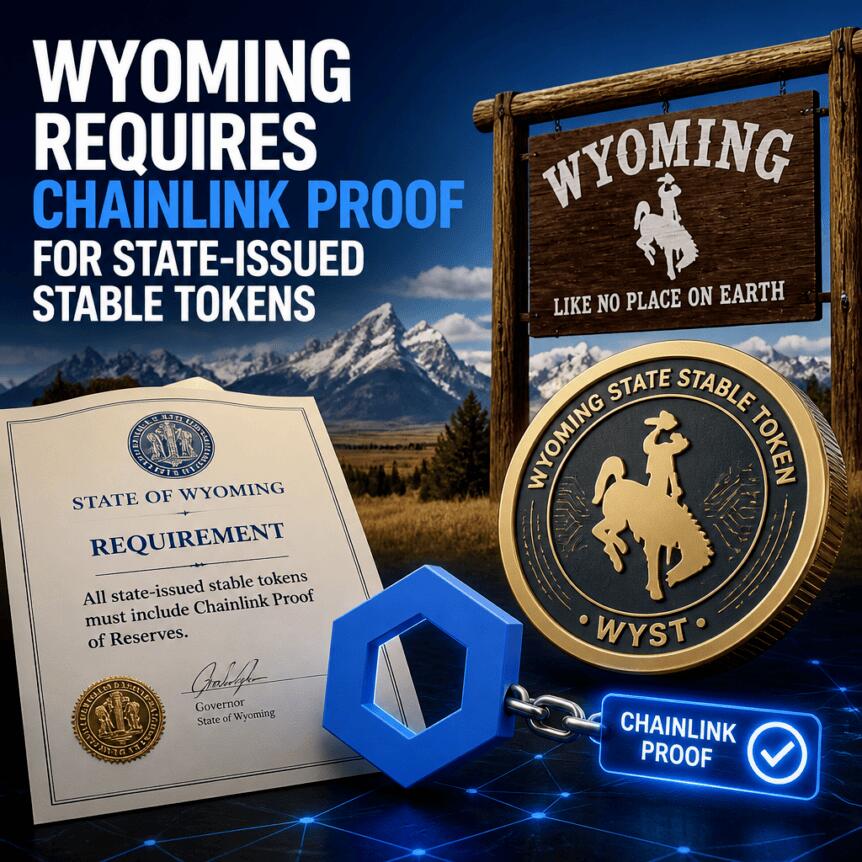
Wyoming has moved Frontier Stable Token (FRNT) reserve reporting closer to real time, expanding its use of Chainlink infrastructure for onchain proof of reserves. The Wyoming Stable Token Commission said it adopted Chainlink Proof of Reserve to publish verified information about FRNT’s reserves and token supply on the blockchain.
Under the update, verified reserve data will be made available onchain using a setup that combines independent examinations by The Network Firm with Chainlink’s Proof of Reserve tooling, aiming to improve how quickly users can see changes in backing between reporting cycles.
Key takeaways
- Wyoming’s commission adopted Chainlink Proof of Reserve to publish verified FRNT reserve and supply data onchain in near real time.
- FRNT already had daily reserve attestations; the integration is designed to make changes in backing visible faster than periodic disclosures alone.
- Wyoming’s GENIUS Act framework still includes monthly disclosure requirements for reserve composition and outstanding supply.
- The commission is also working on Chainlink Secure Mint, which would gate new FRNT minting on verified reserves being at least equal to total supply.
From daily attestations to near-real-time proof
The Frontier Stable Token’s reserve transparency framework has been evolving alongside Wyoming’s regulatory requirements. The Wyoming Stable Token Commission said it already publishes daily reserve attestations for FRNT, while the GENIUS Act requires monthly disclosures covering reserve composition and outstanding stablecoin supply.
The new Chainlink Proof of Reserve integration is meant to tighten that feedback loop. By publishing verified reserve and supply information via Chainlink infrastructure, the commission expects more timely visibility into when the composition and size of FRNT’s backing changes between formal disclosure windows.
In the model described by the commission, independent examinations by The Network Firm are incorporated into the onchain reporting process through Chainlink’s system—an architecture intended to increase confidence that the onchain figures reflect underlying reserve verification rather than relying solely on issuer-provided updates.
Secure Mint on the roadmap
Beyond reporting, the commission also flagged a further step it is working toward: adopting Chainlink’s Secure Mint feature. In its described form, Secure Mint would require verified reserves to equal or exceed FRNT’s total supply before additional tokens can be minted.
For investors and integrators, that matters because it shifts reserve coverage from being an after-the-fact disclosure exercise toward a mechanism that can constrain issuance in real time. While Wyoming did not state a specific timeline for when Secure Mint would be activated for FRNT, the direction is clear: make reserve adequacy a condition for minting rather than only a periodic compliance metric.
How FRNT is backed—and what income supports
FRNT, launched in January, is described as being backed by US dollars and short-term US Treasurys. The commission also said interest income generated from the reserves is deposited into Wyoming’s School Foundation Program.
That structure is relevant to why “proof of reserve” is particularly consequential for this token: the backing is intended to be held in highly liquid instruments, and near-real-time visibility into reserve levels and supply can help stakeholders assess whether the backing remains aligned with outstanding FRNT as it changes.
Wyoming’s broader Chainlink rollout
This Proof of Reserve expansion arrives shortly after Wyoming completed FRNT’s migration from LayerZero to Chainlink’s Cross-Chain Interoperability Protocol (CCIP), with CCIP becoming FRNT’s exclusive cross-chain infrastructure.
According to the commission, the cross-chain infrastructure switch took place roughly two weeks before the Proof of Reserve announcement. Together, the changes point to a broader consolidation of FRNT’s operational stack around Chainlink—both for transparency (reserve verification onchain) and for interoperability (cross-chain messaging via CCIP).
Chainlink’s institutional momentum
The update also fits into a broader pattern of Chainlink integrations across tokenized assets and regulated market infrastructure. In recent months, Chainlink has been used as a pricing-data provider for tokenized equities, participated in banking-group initiatives focused on stablecoin-based atomic foreign exchange settlement, and been referenced in plans for tokenized collateral management platforms.
The article cited several examples of Chainlink involvement, including that Chainlink became a pricing-data provider for Coinbase’s B20 tokenized equities on Base after their August launch, and that Chainlink joined Project Pangea—an initiative involving European and South Korean banking groups exploring euro- and won-denominated stablecoins for atomic FX settlement.
In addition, the report referenced work connected to the Depository Trust and Clearing Corporation (DTCC) for a planned 24/7 platform to manage tokenized collateral, and noted a tokenized liquidity fund launched by Fidelity International using Chainlink and Sygnum infrastructure with daily net asset value data provided by JPMorgan for pricing.
Market participants are also watching LINK, the native token of the Chainlink network. CoinGecko data referenced in the source indicates LINK gained more than 34% over the past month, trading around $11.07 as of Wednesday.
Next, FRNT holders and integrators will likely look for whether Wyoming proceeds with Chainlink Secure Mint in practice and how quickly Proof of Reserve data updates compared with the existing daily attestations and monthly GENIUS Act disclosures. The key question is whether the “near-real-time” verification meaningfully reduces the gap between reserve changes and public visibility—especially during periods of rapid minting or redemption.
Related reading: Charles Schwab adda Solana, Avalanche and Chainlink to nascent crypto platform.
https://www.cryptobreaking.com/wyoming-requires-chainlink-proof-for/?utm_source=blogger%20&utm_medium=social_auto&utm_campaign=Wyoming%20Requires%20Chainlink%20Proof%20for%20State-Issued%20Stable%20Tokens%20
Comments
Post a Comment