
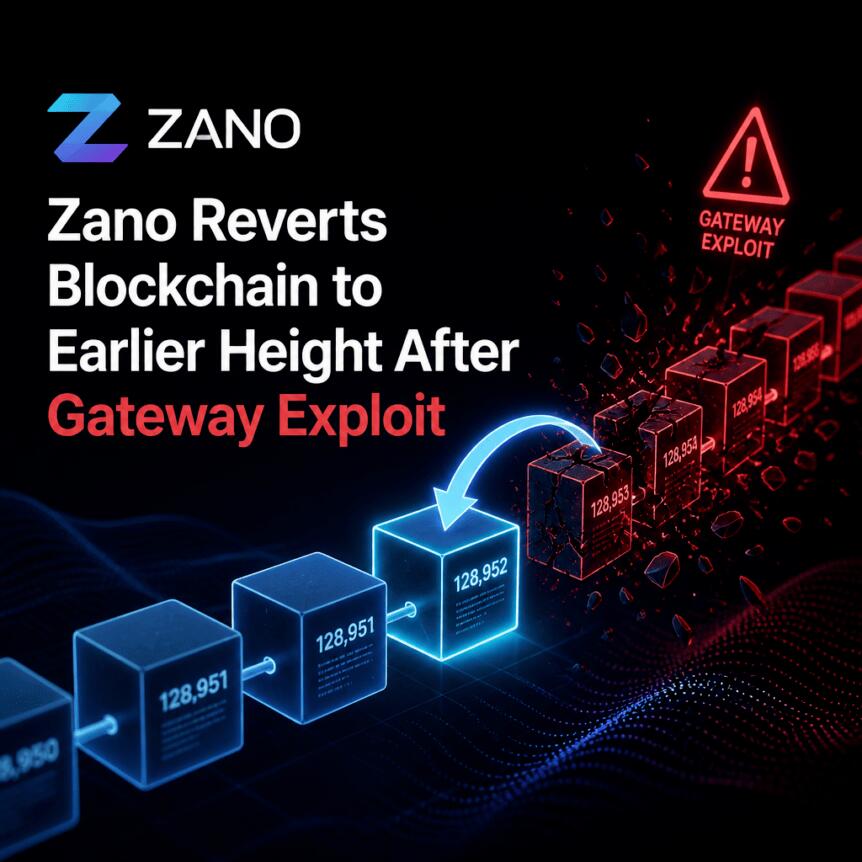
Zano’s core team has restarted the Zano blockchain to undo roughly a month of activity after it identified a vulnerability tied to “Gateway Addresses” that allowed unauthorized ZANO and Freedom Dollar (fUSD) tokens to enter circulation. The restart reverts the chain to block 3,833,000—immediately before Hard Fork 6 introduced the affected feature.
According to the project’s leadership, the recovery will only take full effect once participating nodes, miners, stakers, exchanges, and other services adopt the updated software. The team says transactions and token activity that occurred during the compromised period will no longer appear on the recovered chain. However, it also warns that the rollback cannot reverse payments that were already settled on other blockchains.
Key takeaways
- Zano restarted the chain at block 3,833,000, rolling back about a month of history linked to an exploit affecting Gateway Addresses.
- The reset targets activity after the Hard Fork 6 feature deployment, meaning compromised transactions won’t show on the restored chain.
- Participating nodes, miners, stakers, exchanges, and other infrastructure providers must upgrade to complete the recovery.
- Zano says it will publish a reimbursement and claims process to address losses, though cross-chain settlements cannot be undone.
Rollback mechanics: what changed and what can’t be reversed
The project says the vulnerability’s impact is limited to the period after Hard Fork 6, when Gateway Addresses were introduced. By restarting the network from block 3,833,000, Zano invalidates both legitimate transactions included after that block and any unauthorized ZANO and fUSD that the exploit minted or introduced.
That matters for users and service operators because it effectively resets the on-chain record for that interval. Anyone who relied on transactions during the rolled-back window—whether for balances, accounting, or automated workflows—will need to reprocess those events against the restored chain state.
At the same time, the team draws a clear boundary around what is feasible. While the rollback can change what is recognized on Zano itself, it cannot undo transactions already finalized elsewhere. For users who moved value through cross-chain transfers or other external systems, the project’s update implies that losses tied to already-settled external payments may not be recoverable via the chain restart alone.
What are “Gateway Addresses,” and why they became a target
Zano says it has not published a full post-mortem yet, but it confirmed the exploit originated with Gateway Addresses. The feature was created to make integrations easier for bridges, exchanges, and payment services by allowing them to manage funds through a single account-style balance model.
Before Gateway Addresses, Zano wallets tracked funds as separate transaction outputs (UTXOs), rather than as one consolidated account balance. That difference influences how exchanges and payment processors work: services had to scan the blockchain to identify incoming payments, track which outputs corresponded to customer deposits, and select appropriate outputs when users requested withdrawals.
By contrast, an account-style abstraction can streamline integration logic—especially for services that want a unified view of balances. The Zano team’s decision to revert the network “immediately before Hard Fork 6,” however, suggests the abstraction layer introduced new attack surface that was not sufficiently contained.
Zano’s public explorer shows the rollback taking place on Sunday, reflecting the chain reset and the shift back to the pre–Hard Fork 6 state. The project did not provide additional technical details in the excerpted information, but the explicit identification of Gateway Addresses helps narrow the likely root cause to the feature rather than to core transaction privacy itself.
Token supply, trust, and the case for restarting
The Zano leadership framed the restart as a tradeoff between immediate disruption and long-term credibility. Quinten van Welzen, head of marketing and growth, argued that “doing nothing” would have meant unauthorized ZANO and fUSD remaining in circulation indefinitely—diluting holders and undermining the idea of a fixed supply.
Van Welzen also suggested that allowing the compromised supply to stand would signal to future attackers that they could retain value after an exploit. In that view, the most damaging outcome would not just be the technical breach, but the precedent it sets for adversaries.
Restarting from an earlier block, he said, comes with real costs: it eliminates about a month of blockchain history and requires the community to rebuild trust. Still, the team’s position is that restoring the intended supply and restarting from a clean state offers a path back that justifies the disruption.
Why exchanges and validators are central to the fix
Zano’s recovery depends on adoption. The team said participating nodes, miners, stakers, exchanges, and other services must adopt the update so the network stabilizes on the recovered chain state. This requirement is especially important for institutional and high-throughput operators, where delayed upgrades can lead to inconsistent balances, duplicate processing, or mismatched transaction histories.
For traders and users, the implication is straightforward: infrastructure readiness will determine how quickly services converge on the restored ledger. For exchanges in particular, the rollback also affects deposit and withdrawal accounting—so operators may need to re-sync transaction histories and ensure customer records match the post-recovery state.
In parallel, Zano says it is working to account for losses. The team indicated that it will publish a reimbursement and claims process, which should become a key reference for affected parties once the details are released. Until then, the only fully reliable takeaway for users is that transactions from the compromised period are expected to disappear from the restored chain, while any already-settled activity outside Zano may not be reversible through the rollback.
Going forward, readers should watch for the promised reimbursement/claims instructions and any technical follow-up that clarifies exactly how Gateway Addresses were exploited, because those details will likely determine how integrators adjust their systems and how quickly confidence can be rebuilt after the Hard Fork 6 rollback.
https://www.cryptobreaking.com/zano-reverts-blockchain-to-earlier/?utm_source=blogger%20&utm_medium=social_auto&utm_campaign=Zano%20Reverts%20Blockchain%20to%20Earlier%20Height%20After%20Gateway%20Exploit%20
Comments
Post a Comment