
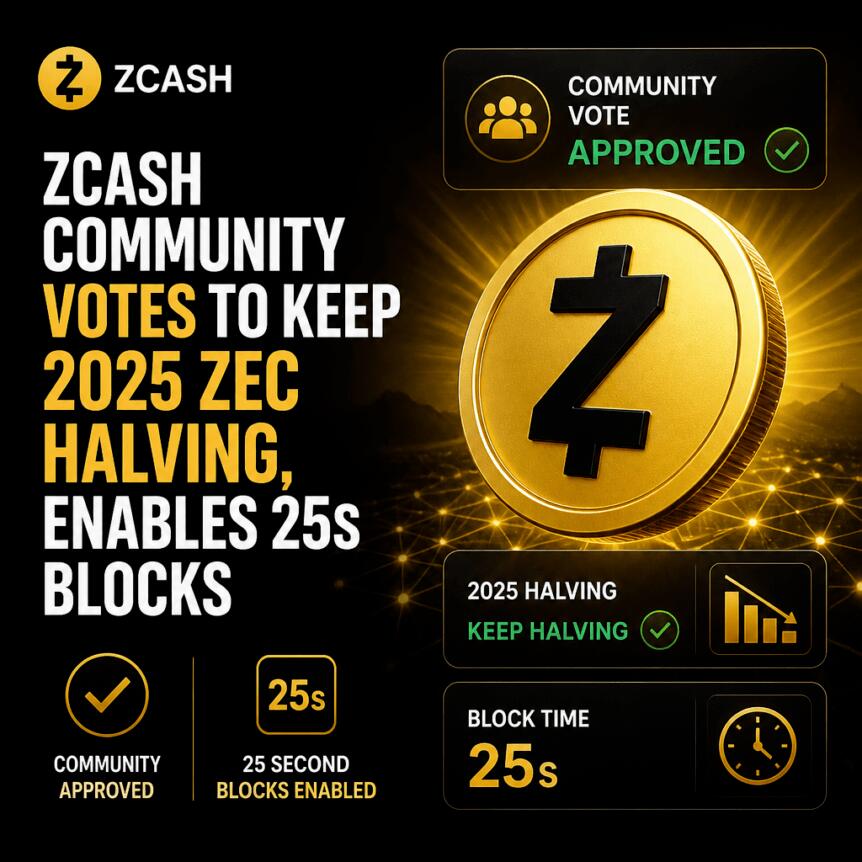
Zcash’s next major network upgrade, NU7, is drawing strong support from token holders—specifically for a faster block cadence while keeping the protocol’s existing halving schedule intact. In a coinholder poll released Monday, ZEC-weighted voters backed reducing the target block time to 25 seconds from 75 seconds with overwhelming approval, and also chose to preserve scheduled issuance cuts.
At the same time, the broader NU7 discussion shows a community divided on how Zcash should handle economic changes beyond block rewards. Separate sentiment polling involving different governance groups pointed to a narrower split over whether to replace halvings with an alternative issuance curve.
Key takeaways
- Coinholder vote results show 99.9% ZEC-weighted support for reducing NU7’s target block time to 25 seconds from 75 seconds.
- Halving preservation also won, with 98.9% ZEC-weighted support for keeping the existing halving schedule.
- The NU7 upgrade activation date remains undetermined, though developers have flagged a Sept. 30 cut-off for final items.
- A separate community advisory-panel vote shows a close decision on whether to keep halvings versus shifting to a gradual issuance curve.
- Token holders strongly preferred delaying the Network Sustainability Mechanism (NSM) reissuance until February 2031.
Coinholders endorse a faster block target for NU7
The coinholder-backed changes center on Zcash’s “target block time,” the timeframe the network uses to aim for block production. Under the proposal supported by voters, the expected wait for a transaction’s first confirmation would be shorter, because blocks would be targeted more frequently.
According to the proposal documentation, the network would adjust block issuance so that scheduled daily issuance remains unchanged even as the block interval decreases. In other words, the amount of new ZEC issued per block would be reduced to compensate for producing more blocks over the same day.
The poll results reflect ZEC-weighted voting power based on eligible holdings, and both approval percentages explicitly include abstentions in the final tallies. The vote was published on the Zcash community forum, where the coinholder results indicate near-universal support for the shorter block interval.
Halvings stay in place, but timing details still hinge on NU7 delivery
Alongside the block-time proposal, voters also backed an option to preserve Zcash’s halving schedule. Halvings are the predefined protocol events that reduce the issuance of new ZEC by half, meaning that maintaining the schedule directly affects how emissions evolve over time.
The coinholder-backed approach would preserve those halving mechanics while allowing funds removed from circulation under a separate proposal to be returned through future block rewards. That matters because it aims to keep long-term issuance predictable while still accommodating other economic design changes being considered for the upgrade.
The NU7 changes are intended to be bundled into a network upgrade whose activation date has not been set. In the forum discussion, developers indicated that the remaining pieces for the upgrade would be finalized by a Sept. 30 deadline, but testnet and mainnet activation timing remains undetermined.
The poll also included a preference regarding scope: token holders favored excluding features that were not implemented by Sept. 30. That suggests the community is pushing for pragmatic delivery—prioritizing what can realistically be completed before the cut-off rather than adding late-stage changes.
How NU7 votes fit into Zcash’s broader governance process
It’s important that the coinholder vote did not happen in isolation. The forum notes that the coinholder poll was separate from sentiment polling conducted by ZecHub, the Zcash Community Advisory Panel, and other community groups.
Eligibility for the coinholder vote was limited to spendable ZEC in the Ironwood shielded pool at the voting snapshot. This is relevant for readers because it means the results reflect a specific portion of ZEC holdings eligible for participation, not the total circulating supply.
Even with the coinholders’ strong preference for keeping halvings, the advisory-panel sentiment results point to a different picture. According to the reported advisory-panel outcomes on the forum, the panel’s split was much closer: 57 members favored a gradual issuance curve that would replace halvings, while 54 supported keeping halvings. The difference between coinholder and advisory-panel results highlights an ongoing tension in how the community balances emission predictability against alternative long-term economic designs.
NSM reissuance: token holders vote to delay until 2031
Beyond block timing and halvings, the NU7 roadmap also includes discussions tied to Zcash’s long-term economic sustainability. One of the most significant proposals in this area is the Network Sustainability Mechanism (NSM), a mechanism intended to recycle a portion of transaction fees back into a pool rather than relying solely on block rewards.
According to the poll figures provided in the source discussion, about 97% of token holders voted to delay NSM reissuance until February 2031. The forum report states that roughly 2.3 million ZEC were cast in favor of delaying the motion, while approximately 70,239 tokens voted to start it as soon as possible.
NSM was reportedly introduced in January as a response to concerns about the network’s long-term security budget. The core issue being addressed is that declining block rewards over time could eventually reduce miner incentives to validate transactions.
As described in the forum materials, the NSM design is framed as a three-part mechanism that would burn and recycle 60% of ZEC transaction fees into future block rewards. At the same time, the proposal aims to avoid exceeding Zcash’s 21 million maximum token supply.
What investors should watch as NU7 approaches
For traders and long-term holders, the most immediate uncertainty is not whether the coinholder vote chose a direction—it did, strongly—but how and when NU7 will be activated. With the activation date still undetermined and testnet/mainnet timing awaiting final implementation details, market participants will likely track developer updates around deployment readiness and whether the final NU7 scope matches the cutoff-driven preferences reflected in the voting.
https://www.cryptobreaking.com/zcash-community-votes-to-keep/?utm_source=blogger%20&utm_medium=social_auto&utm_campaign=Zcash%20Community%20Votes%20to%20Keep%202025%20ZEC%20Halving,%20Enables%2025s%20Blocks%20
Comments
Post a Comment