
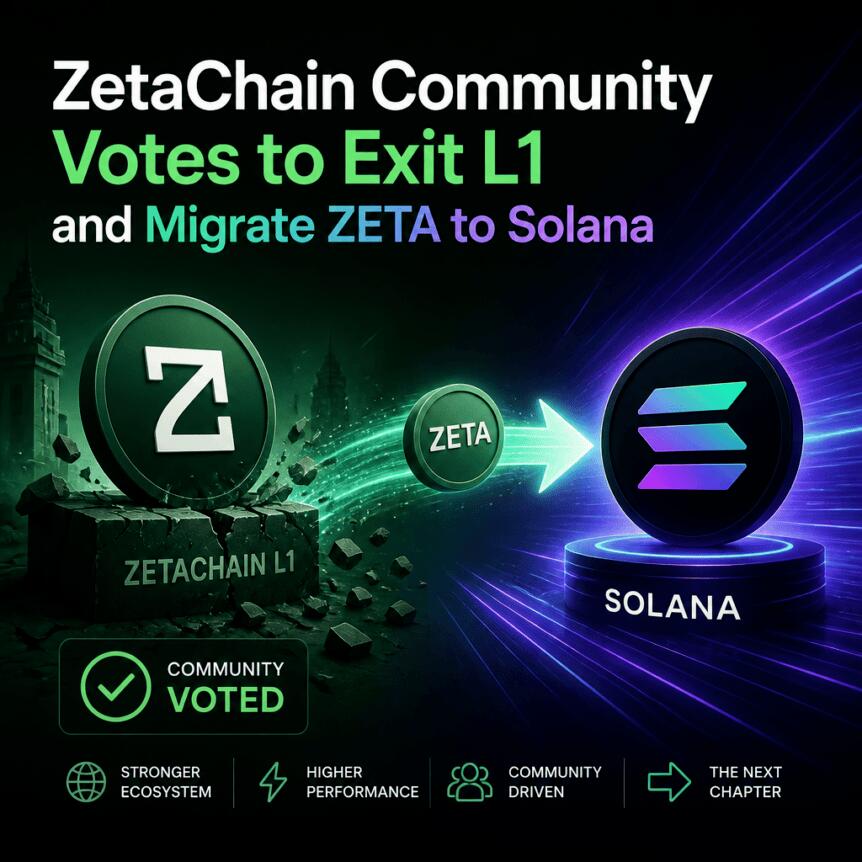
ZetaChain’s token community has voted to wind down its own layer-1 blockchain and migrate its native ZETA token to Solana. The change was approved via governance proposal 68, with 99.4% of votes supporting the plan and participation at 58%, surpassing the network’s 40% quorum requirement.
While the vote clears the way for the transition, ZetaChain said it will not immediately trigger a full shutdown or migration. A second proposal is expected to lay out the practical details—timing, asset withdrawal windows for cross-chain holdings, token snapshot mechanics, and the conversion process duration.
Key takeaways
- Governance proposal 68 passed with 99.4% approval and 58% participation, clearing the first step toward ZetaChain’s layer-1 shutdown.
- ZETA will move to Solana as an SPL token via a 1:1 conversion, keeping the same ticker and total supply.
- The initial vote does not start the shutdown immediately; a follow-up proposal will specify withdrawal and conversion windows.
- Validators are expected to remain operational during the transition, with staking rewards continuing.
- ZetaChain cites a strategic shift toward its Anuma AI application and encrypted “Private Memory Layer,” reducing the need for a standalone Cosmos SDK chain.
Governance approval clears the path to a Solana token migration
According to the terms outlined in proposal 68, ZETA will become an SPL token on Solana through a 1:1 conversion. The migration is designed to preserve continuity for tokenholders: the ticker remains ZETA and the total supply stays unchanged.
The proposal also clarifies what comes next. It does not itself dictate an immediate cessation of ZetaChain’s layer-1 operations or the start of token migration. Instead, core contributors will bring a second proposal that covers operational specifics, including how and when tokenholders can withdraw assets related to other blockchains, the snapshot block height used to determine entitlements, the shutdown timetable, and the claim and exchange conversion period.
ZetaChain also indicated that validators will continue running, and staking rewards will continue through the transition. That matters for holders who rely on staking income, because it suggests there is intended continuity rather than an abrupt end to network participation.
Why ZetaChain is winding down: focus shifts to Anuma and private AI memory
ZetaChain framed the shutdown as a strategic realignment. The project said that maintaining its own layer-1—built on the Cosmos SDK—no longer fits its current priority around Anuma, its private-focused artificial intelligence application.
In the project’s view, moving the ZETA token to Solana will let it redirect resources away from blockchain maintenance and toward Anuma and the “Private Memory Layer.” The Private Memory Layer is positioned as a way for users to carry encrypted context across AI models, which would be difficult to support without dedicated product and infrastructure investment.
For tokenholders, the core question is how the token’s role changes when the layer-1 network is retired. The proposal keeps supply and ticker consistent, but it leaves open—pending the follow-up documentation—how governance, staking, and token utility will function after migration.
A broader pattern: other crypto projects retreat from standalone chains
ZetaChain’s decision aligns with a wider trend in crypto where teams choose to shut down standalone networks and migrate tokens elsewhere. The article notes that BounceBit and Harmony have both announced plans to retire their own layer-1 infrastructure.
BounceBit reportedly decided to retire its standalone blockchain after an authorization flaw was exploited to steal approximately $3 million in BB tokens. Instead of restarting its layer-1, BounceBit migrated its token to BNB Smart Chain at a 1:1 ratio.
Harmony’s approach has also centered on a pivot away from its layer-1. Earlier coverage cited that Harmony proposed shutting down its layer-1 and migrating its ONE token to Ethereum as an ERC-20, as part of a broader pivot toward an AI video initiative. That proposal followed a period of disruption tied to an exploit that created unauthorized ONE tokens and prompted a rollback plan affecting more than 109,000 transactions.
Security history and the settlement mechanics tokenholders should watch
ZetaChain’s migration comes with additional context around security. The project previously faced a $334,000 exploit in April targeting its cross-chain gateway contract, which drained funds from ZetaChain-controlled wallets across multiple networks including Ethereum, Arbitrum, Base, and BNB Smart Chain.
After the incident, ZetaChain acknowledged that it had dismissed an earlier bug bounty report, claiming it was intended behavior. That decision triggered a review of security processes.
In this light, the operational content of the second governance proposal becomes especially important. Tokenholders and users with assets tied to cross-chain functionality will want clarity on several items that proposal 68 did not specify: the precise withdrawal window for assets connected to other blockchains, how the snapshot block height will be determined, and the mechanics and timeline for token claims and conversion to Solana.
Investors and traders will likely also pay close attention to whether the transition period maintains staking participation and rewards as promised, and whether any changes to token administration accompany the migration.
Going forward, the key thing for ZetaChain stakeholders is the follow-up proposal that defines the shutdown and claim details. Until the network publishes the timeline, snapshot parameters, and conversion window, holders should treat the Solana migration as approved in principle—but not operationally complete.
https://www.cryptobreaking.com/zetachain-community-votes-to-exit/?utm_source=blogger%20&utm_medium=social_auto&utm_campaign=ZetaChain%20Community%20Votes%20to%20Exit%20L1%20and%20Migrate%20ZETA%20to%20Solana%20
Comments
Post a Comment