
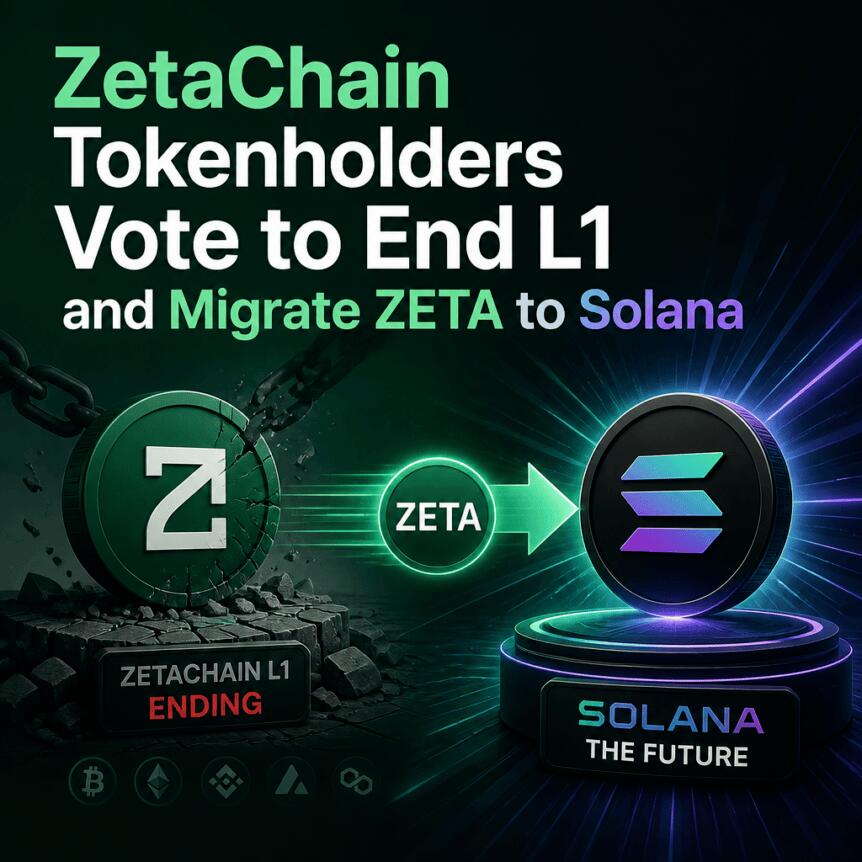
ZetaChain tokenholders have voted to end the project’s layer-1 blockchain and migrate its native ZETA token to Solana. The governance decision, approved via a formal proposal on Sunday, clears the path for ZETA to be represented as a Solana token through a 1:1 conversion—while network operations and staking are expected to continue until a later, separate shutdown and migration plan is finalized.
Governance proposal 68 passed with 99.4% support and 58% participation, comfortably above the network’s 40% quorum requirement. Importantly, the proposal does not immediately trigger a shutdown or token migration timetable; ZetaChain said a second proposal will be submitted to outline the withdrawal window for assets tied to other blockchains, snapshot timing, shutdown scheduling, and the mechanics and duration of the token claim and exchange period.
Key takeaways
- Proposal 68 approved: 99.4% support with 58% participation, exceeding the 40% quorum threshold.
- Token migration approach: ZETA is set to become an SPL token on Solana on a 1:1 basis, keeping the same ticker and total supply.
- No immediate shutdown: ZetaChain indicated validators will keep operating and staking rewards will continue during the transition.
- Next step is a second proposal: details on withdrawal windows, snapshot height, shutdown timing, and conversion/claim periods will be defined later.
What ZetaChain’s governance vote actually changes
Under the approved plan, ZETA will be converted into a Solana Program Library (SPL) token while preserving a 1:1 ratio. The proposal states that the token’s ticker and total supply will remain the same—an operational detail that matters for holders because it clarifies that the change is intended to be a representation/migration rather than a token split or supply adjustment.
However, governance approval is not the same as execution. ZetaChain emphasized that passing proposal 68 does not automatically set a shutdown date. Instead, core contributors must bring forward a subsequent proposal covering the practical steps holders will care about most: how and when assets connected to other chains can be withdrawn, the snapshot block height used for migration calculations, the shutdown timetable, and the process and timeframe for token claims or exchange conversions.
In the interim, validators are expected to keep running. The project also said staking rewards will continue through the transition phase, suggesting the token migration process is being staged rather than rushed—an important distinction for participants who would otherwise be forced to exit staking positions abruptly.
Why ZetaChain wants to shift away from its layer-1
ZetaChain linked its move away from maintaining its own Cosmos SDK-based layer-1 to a strategic repositioning. The project said its standalone chain no longer supports its focus on Anuma, a private-focused artificial intelligence application.
In ZetaChain’s framing, moving to Solana is meant to let the team redirect engineering and operational effort away from base-layer blockchain maintenance and toward Anuma and its “Private Memory Layer,” which the project says helps users carry encrypted context across AI models.
For investors and builders, the key question is not only whether the migration is technically feasible, but whether the funding and talent concentration can deliver measurable progress on the AI-related roadmap. On that front, ZetaChain’s approach is effectively a resource reallocation: the governance vote signals that maintaining a dedicated interoperability layer-1 is being deprioritized in favor of an execution environment closer to the rest of the Solana ecosystem.
A broader pattern of standalone chain wind-downs
ZetaChain’s decision fits a wider trend in crypto: projects that previously operated standalone chains are increasingly opting to shut them down or migrate tokens to other networks. The rationale varies—from security events to cost and strategic focus—but the end result is similar: ecosystems consolidate around fewer chains, while token representations move to more established venues.
Two other examples cited alongside ZetaChain include BounceBit and Harmony. BounceBit previously announced it would retire its standalone blockchain after an authorization flaw was exploited to steal about $3 million in BB tokens. The project chose a migration of its token to BNB Smart Chain at a 1:1 ratio rather than restarting its layer-1—an approach that mirrors ZetaChain’s “representation stays the same” principle.
Harmony also proposed winding down its layer-1 and migrating ONE to Ethereum as an ERC-20. Earlier reporting noted the proposal came after an exploit created unauthorized ONE tokens and led Harmony to plan a rollback of more than 109,000 transactions. In that case, the governance pivot appears tied both to recovery from a security incident and to a broader shift toward an AI video initiative.
While every project’s situation differs, these cases highlight how token migration plans can become governance-led responses to operational and risk realities—especially when maintaining a dedicated chain becomes harder to justify.
Security history adds urgency to migration planning
ZetaChain’s migration plan arrives against a backdrop of security-related issues. The project was previously affected by a $334,000 exploit targeting its cross-chain gateway contract, according to the referenced earlier coverage. The incident reportedly drained funds from ZetaChain-controlled wallets across multiple networks including Ethereum, Arbitrum, Base and BNB Smart Chain.
In response to that broader security discussion, ZetaChain also acknowledged it had dismissed an earlier bug bounty report about a vulnerability, stating it treated the behavior as intended. That decision later prompted a review of its security processes.
None of this history necessarily determines whether a Solana migration will be successful, but it raises the stakes for how ZetaChain designs its transition. The second governance proposal—covering snapshot height, the token claim period, and the exchange conversion window—will likely be where market participants focus on clarity and safeguards. For holders, the worst outcomes in a migration tend to be uncertainty: unclear eligibility rules, poorly timed snapshots, or token claim/exchange mechanics that leave participants unable to complete conversions.
With validators expected to keep operating and staking rewards continuing for now, ZetaChain appears to be attempting to balance continuity with an orderly wind-down. Still, the exact operational details—when withdrawals open, when the chain stops, and how claims are handled—remain unresolved until the next proposal is submitted.
Going forward, tokenholders and observers should watch for the forthcoming governance proposal that lays out the withdrawal window, snapshot block height, shutdown timeline, and conversion/claim mechanics. Those specifics will determine whether the transition preserves holder outcomes cleanly or introduces friction at the moment people need certainty most.
https://www.cryptobreaking.com/zetachain-tokenholders-vote-to-end/?utm_source=blogger%20&utm_medium=social_auto&utm_campaign=ZetaChain%20Tokenholders%20Vote%20to%20End%20L1%20and%20Migrate%20ZETA%20to%20Solana%20
Comments
Post a Comment