
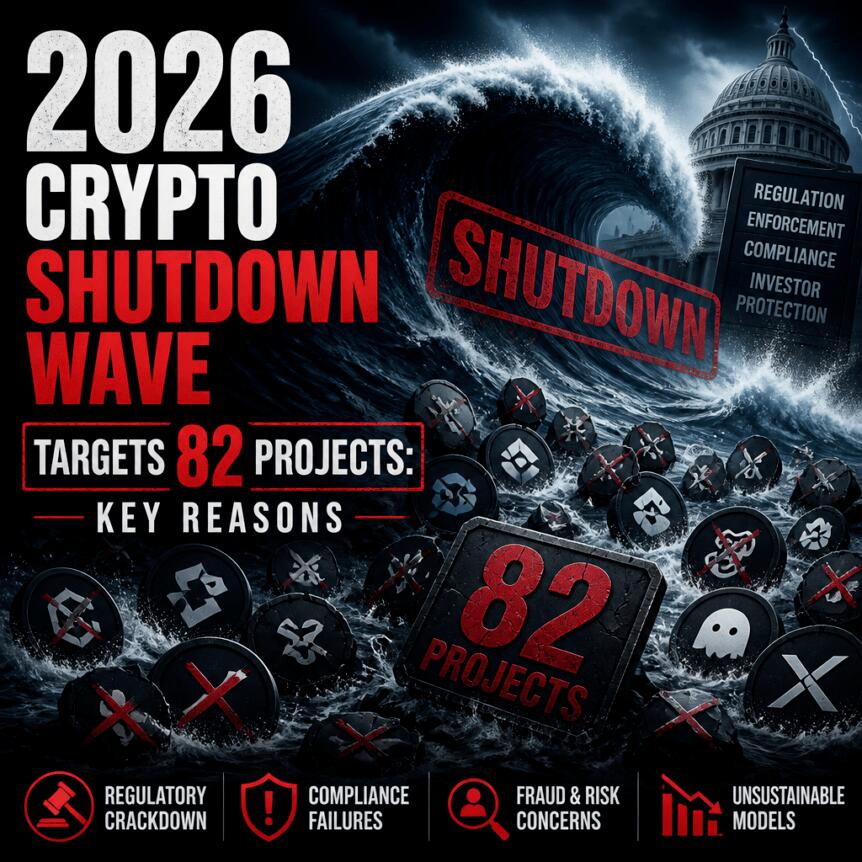
Crypto researcher Stacy Muur says she has documented 82 digital asset projects and protocols that reportedly shut down in 2026, a tally she described as unprecedented. The closures span decentralized finance (DeFi), blockchain infrastructure and Web3 gaming, underscoring how difficult it has become for many businesses to stay solvent amid a prolonged downturn.
Muur’s list—shared on X on Tuesday—includes well-known names such as Balancer, Radiant Capital, Neon EVM and Step Finance. The wave of shutdowns comes as Bitcoin has remained under pressure since its October 2025 record high above $126,000, falling to below $60,000 earlier this year, according to the article’s timeline.
Key takeaways
- Stacy Muur identified 82 crypto projects and protocols that reportedly closed in 2026, calling the number unusually high.
- The failures cut across major sectors, including DeFi and Ethereum-adjacent infrastructure.
- Earlier reporting highlights that some shutdowns were driven by economics—revenue failing to cover costs—while others followed security incidents.
- DeFiLlama research found that product-market fit issues and funding/revenue shortfalls were among the most frequently cited reasons for closures.
- Crypto activity appears to be concentrating through funding and deal-making even as many standalone projects disappear.
Prominent shutdowns illustrate different failure modes
Among the most visible casualties is Blast, an Ethereum layer-2 network. As Cointelegraph reported, Blast announced its shutdown earlier this month, saying it saw no “credible path” to economic viability. Cointelegraph also noted that the network once attracted more than $2 billion in deposits—highlighting the contrast between past growth and the later inability to sustain operations.
Not all closures follow the same script. Step Finance, for example, shut down in February after a major treasury breach, according to earlier reporting by Cointelegraph. Radiant Capital, another prominent DeFi name, said it would wind down in June after failing to recover from a 2024 exploit, as Cointelegraph reported.
The same theme—loss of financial runway—shows up in other accounts as well. Coinbase-backed Satori Finance reportedly ceased operations after concluding that its revenue could no longer support the business.
DeFiLlama research points to economics and fit, not just bad luck
The broader pattern behind the closures has been examined by DeFiLlama. In an August research piece cited in the article, DeFiLlama identified 100 crypto projects that had announced shutdowns in 2026, including 40 in the prior 90 days. The report suggests that the issue was not isolated to a handful of companies, but tied to systemic challenges in sustaining user demand and revenue.
DeFiLlama’s findings point to several repeat factors: lack of product-market fit was the most commonly cited reason, followed by depleted funding, insufficient revenue and decisions to pivot away from existing products. Importantly, the report’s numbers indicate that shutdowns were not confined to underfunded experiments. Collectively, the projects raised about $1 billion and generated $250 million in cumulative fees. DeFiLlama also found that nine projects raised more than $50 million each—suggesting that even significant capital and fundraising momentum could fail to guarantee long-term survival.
Fewer deals, higher concentration: the market is changing
While projects are closing at speed, the ecosystem’s investment picture appears to be shifting rather than simply shrinking. According to DeFiLlama’s research, venture funding rose in the first half of 2026 compared with the prior year, even as the number of deals fell by 80%. The article also references mergers and acquisitions reaching 87 transactions at the time of the report—already 65% higher than the previous year.
That combination—more money, fewer deals, and more consolidation—helps explain why many smaller or mid-sized teams may struggle to remain independent. In practice, when funding and business-building concentrate, investors may prioritize networks and platforms they believe can scale efficiently, leaving others to compete in a tighter demand environment.
What investors and builders should watch next
The current shutdown cycle raises an uncomfortable question: how many protocols can survive when user growth is harder to sustain and revenue can’t consistently cover operating costs—especially after market sentiment deteriorates and competition intensifies. Readers should watch for clearer economic models from surviving projects, signs that deposit-driven growth can translate into durable fee generation, and whether consolidation continues to absorb troubled assets rather than restarting them under new operators.
https://www.cryptobreaking.com/2026-crypto-shutdown-wave-targets/?utm_source=blogger%20&utm_medium=social_auto&utm_campaign=2026%20Crypto%20Shutdown%20Wave%20Targets%2082%20Projects:%20Key%20Reasons%20
Comments
Post a Comment