
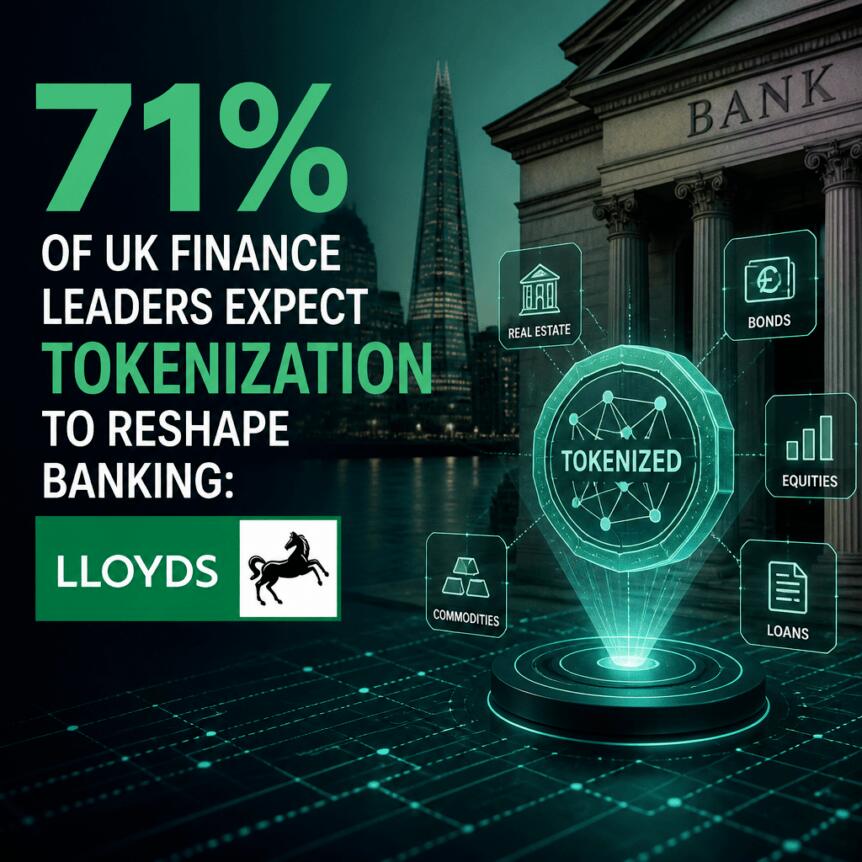
Tokenization is rapidly moving from experimentation to a business priority for Britain’s biggest financial firms. A new survey from Lloyds Banking Group finds that nearly three-quarters of major UK financial institutions believe tokenization will transform core areas of financial services, including payments, settlement, and liquidity management.
The research, released by Lloyds, polled 100 senior decision-makers across banks, insurers, asset managers, and financial sponsors. It highlights which benefits are getting the most attention—and underscores why the next hurdle is turning standalone pilots into interoperable infrastructure that can operate at scale.
Key takeaways
- Nearly 75% of senior decision-makers at major UK institutions expect tokenization to reshape financial services.
- Faster payments and settlement lead the perceived upside, cited by 60% of respondents.
- Collateral and liquidity improvements were a close second, reported by 41% of participants.
- Lloyds links tokenization to capital efficiency, arguing it could reduce liquidity trapped in transaction processes.
- Regulatory and policy momentum in the UK is pushing tokenization toward core market infrastructure rather than pilots.
Why tokenization is gaining board-level momentum
In Lloyds’ survey, the most frequently mentioned advantage is operational speed. Sixty percent of respondents said tokenization could improve payments and settlement performance, reflecting a common expectation that blockchain-based rails can reduce friction in how value moves between parties.
Just as important, 41% pointed to better collateral and liquidity management. That combination—speed plus improved balance-sheet efficiency—is often central to why tokenization is being evaluated beyond technology curiosity and toward implementation roadmaps.
Lloyds also framed tokenization as a potential driver of capital efficiency. The bank said moving assets and payments onto digital infrastructure could free up capital and liquidity tied up in financial transactions, enabling institutions to deploy resources elsewhere.
From use cases to infrastructure at scale
While many firms have explored tokenized assets in limited settings, Lloyds emphasized the transition required next: standardization, interoperability, and scale. Rob Hale, co-head of global markets at Lloyds, said the next phase is about converting individual use cases into infrastructure that can connect digital and traditional markets.
For investors and market participants, that distinction matters. Pilot projects can demonstrate technical feasibility, but they often do not answer the questions that affect adoption—how systems interoperate, what common standards will look like, and how settlement and liquidity should be managed across networks and institutions.
Lloyds’ blockchain test: tokenized deposits to buy tokenized gilts
Lloyds’ survey comes alongside direct testing of tokenized settlement. Earlier in 2026, the bank worked with Archax and Canton Network on what it described as the UK’s first public blockchain transaction using tokenized deposits to purchase a tokenized UK government bond.
The point of the exercise, based on Lloyds’ description, is that tokenization is not only being discussed internally—it is being trialed in structures that resemble real market activity. For the broader market, such demonstrations also feed into how policymakers and regulators think about readiness, governance, and the conditions needed for wider rollout.
UK policy push: near-24/7 settlement and interoperable money
Beyond firms’ internal priorities, the UK policy environment is increasingly focused on moving tokenization closer to financial infrastructure. Lloyds’ survey arrives as UK policymakers aim to move tokenization beyond pilots.
In May, the Bank of England proposed extending its core settlement infrastructure toward near-24/7 availability. Later, a government payments blueprint called for tokenized and traditional forms of money to operate within an interoperable payments system. The underlying theme is the same as Lloyds’ framing: connectivity and interoperability are prerequisites for meaningful change.
In July, a government-backed industry task force estimated that leadership in tokenized finance could add up to 33 billion British pounds (about $44 billion) to the UK’s annual economic output by 2035. That same effort urged the creation of the country’s first tokenized government bond by early 2027, indicating that sovereign instruments may be used as a foundational use case for scaling tokenized markets.
The UK has also sought coordination with the United States. In the same month, the US and UK treasuries recommended establishing a private-sector group to test cross-border uses of tokenized assets. They also urged US regulators and the Bank of England to identify shared approaches to regulation—an acknowledgment that tokenization’s impact will depend not only on domestic infrastructure but also on cross-border alignment.
What to watch next for tokenization in the UK
For now, Lloyds’ survey suggests strong confidence among senior UK decision-makers—but execution risk remains. The next developments to monitor are whether tokenized settlement efforts can achieve interoperable “infrastructure at scale,” and whether regulatory guidance keeps pace with efforts to extend settlement availability and expand tokenized government bond use.
https://www.cryptobreaking.com/71-of-uk-finance-leaders/?utm_source=blogger%20&utm_medium=social_auto&utm_campaign=71%%20of%20UK%20Finance%20Leaders%20Expect%20Tokenization%20to%20Reshape%20Banking:%20Lloyds%20
Comments
Post a Comment