
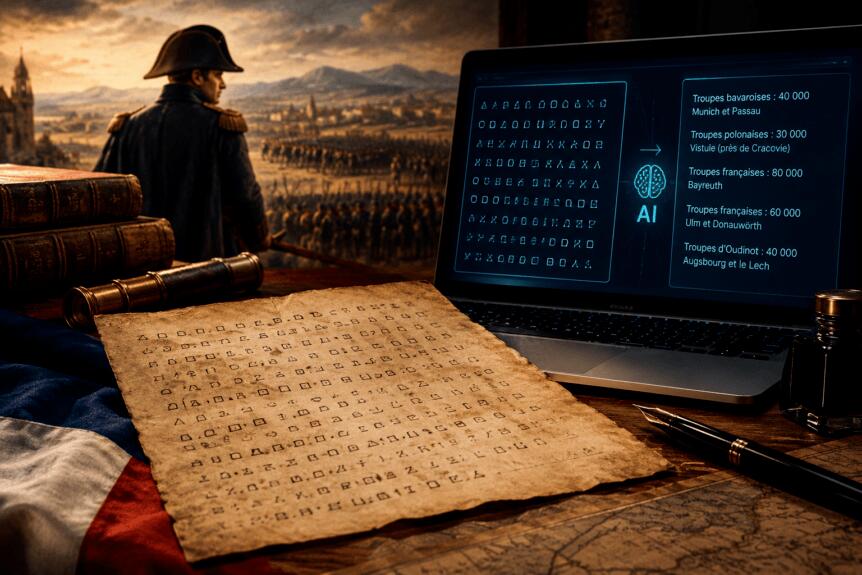
A 217-year-old letter linked to Napoleon’s 1809 military campaign has received a proposed full decipherment with help from artificial intelligence. Carter Church, who published the reconstruction on September 18, 2026, says the work reads a cipher that had remained unsolved since its only known reproduction appeared in a 1969 French military journal.
The letter was addressed to General Auguste de Marmont and contains information about French and allied forces shortly before Austria invaded Bavaria. Church’s reconstruction also places the letter in March 1809, rather than the 1807 date previously associated with the document.
Key Takeaways
- AI helped decipher a 217-year-old Napoleonic cipher letter that had remained unsolved since its reproduction was published in a 1969 French military journal.
- The letter is now proposed to date to March 1809, correcting the previously associated 1807 date.
- The cipher contained about 1,300 units and 155 symbols, using a homophonic system in which multiple symbols could represent the same letter.
- GPT-6 Astra assisted with transcription and cryptanalysis, reportedly processing the cipher and testing possible French readings in about six hours.
- Simulated annealing helped identify possible symbol values, while linguistic patterns were used to evaluate potential French plaintext.
- The proposed decipherment identifies French and allied military positions, including troop numbers around Munich, Passau, Bayreuth, Ulm, Donauwörth, Augsburg and the Lech.
- Historical documents provide supporting evidence for the reconstruction, particularly Napoleon’s March 16, 1809 instructions to Eugène de Beauharnais.
- The solution remains a proposed reconstruction, rather than a confirmed historical cipher key recovered from the original archive.
- Church published the reconstruction and supporting script, allowing other researchers to examine and attempt to reproduce the proposed decipherment.
Ai Assists With a Complex Historical Cipher
The encrypted section contains about 1,300 cipher units and 155 distinct signs. Church describes the system as a homophonic cipher, meaning several different symbols could represent the same letter. That design makes simple frequency analysis less useful because common letters can appear in many forms.
Church used GPT-6 Astra to assist with both transcription and cryptanalysis. The system first examined the scanned image, separated the cipher into rows and identified recurring marks. It then tested possible symbol values against the French text. The process reportedly took about six hours of model execution.
Researchers Reconstruct the Cipher Key
A partial cipher table supplied 33 known letter values. According to Church, those values accounted for 435 of the 1,300 cipher units. The remaining symbols required further analysis using the letter itself.
The reconstruction used simulated annealing, a search technique that tests many possible solutions while gradually narrowing toward stronger results. The system scored candidate French text using three-, four- and five-character patterns. It also identified 29 symbols that represented complete French words rather than individual letters.
Decoded Letter Lists French and Allied Forces
The proposed plaintext describes the positions of several armies. It mentions 40,000 Bavarian troops around Munich and Passau and 30,000 Polish troops along the Vistula near Cracow.
It also lists 80,000 French troops around Bayreuth and 60,000 troops around Ulm and Donauwörth. Another force of 40,000 troops under General Oudinot appears around Augsburg and the Lech. The letter also refers to Russian forces moving against Austria.
Historical Records Support the Proposed Reading
Church compared the reconstructed letter with Napoleon’s March 16, 1809 instructions to his stepson Eugène de Beauharnais. That document ordered Eugène to send Marmont information about French and allied army positions through a ciphered letter.
The force names, troop numbers and locations in the proposed decipherment match the corresponding details in Napoleon’s instructions. Church therefore dates the encrypted letter to late March 1809, after Eugène’s letters of March 8, 14 and 20 and before Austria crossed the Inn on April 10.
The reconstruction remains a proposed reading rather than a historical cipher key recovered from the original archives. Church has published the reconstruction and a script intended to reproduce the result, allowing further examination of the proposed solution.
https://www.cryptobreaking.com/ai-helps-decode-217-year/?utm_source=blogger%20&utm_medium=social_auto&utm_campaign=Ai%20Helps%20Decode%20217-Year-Old%20Napoleonic%20Cipher%20Letter%20
Comments
Post a Comment