
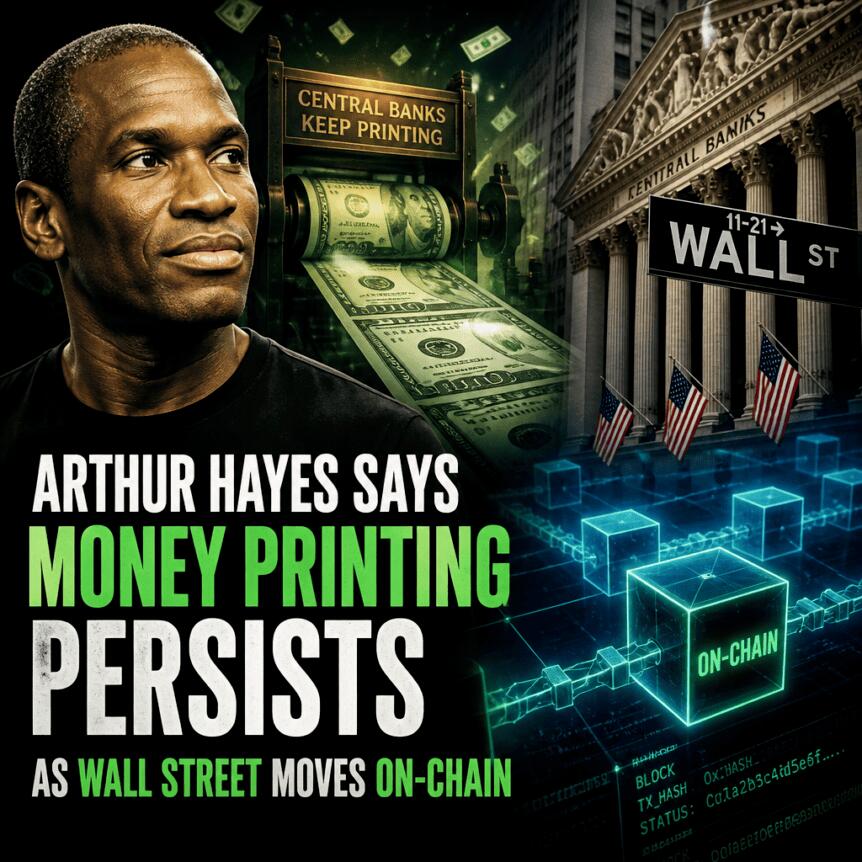
Arthur Hayes, chief investment officer at Maelstrom, argued at Cointelegraph’s CONNECT by Cointelegraph: Seoul Edition during Korea Blockchain Week that US policymakers may ultimately have to rely on additional money creation to support AI-driven infrastructure spending and to absorb the strain of mounting government debt.
Hayes’ remarks tied crypto valuations to macro policy choices, warning that the “money printing” he expects could function like a slow-moving crisis rather than an immediate catalyst. The event also featured discussions on how traditional Wall Street and financial institutions are moving deeper into blockchain markets, why intermediaries are still likely to play a role, and how stablecoin adoption and crypto treasury management are evolving.
Key takeaways
- Arthur Hayes said AI and finance-related spending pressures may push US policymakers toward more monetary support, which he believes can benefit risk assets including crypto.
- Speakers at CONNECT argued that incumbents’ access to existing customer relationships may give blockchain entrants a structural advantage—despite crypto’s original promise to reduce “middlemen.”
- Franklin Templeton does not plan to issue its own stablecoin, instead positioning tokenized money market funds as the “yield layer” behind payment tokens.
- Stablecoin payments are expanding along trade corridors, but the market’s next bottleneck may be who supplies yield and how widely token-to-fund access is offered.
- Crypto treasury strategies were framed as a liquidity problem: companies need excess liquidity for longer commitments before taking on onchain exposure.
Hayes: monetary support may be the hidden variable for crypto
In a fireside conversation, Arthur Hayes linked AI’s financing needs to broader economic constraints. He said AI companies require large sums to build and operate the data centers needed to run the next wave of services, even as the prices of those services tend to fall over time.
That mismatch, in Hayes’ view, leaves policymakers with limited options beyond expanding the money supply. “They’ve not really given themselves a lot of options other than print money and make it less bad,” he said.
Hayes also suggested that China could shift away from what he described as “austerity lite” toward more substantial stimulus. If that policy change materializes, he argued it could revive demand for scarce assets—an outcome that investors often look for across cycles when liquidity expands.
From there, Hayes zoomed out to Europe, noting he was watching financial stress indicators in France, including credit-default swaps tied to BNP Paribas and the spreads on French government bonds. In his framing, these signals reflect underlying tensions that may take time to surface, even if near-term policy action is delayed.
I think the money printing will essentially happen at some point, but that’s sort of a slow motion train wreck happening underneath the surface.
CONNECT’s Seoul agenda placed these comments alongside industry panels on tokenized finance and stablecoins, underscoring how closely many builders and investors are now connecting crypto markets to macro liquidity dynamics rather than treating them as isolated technology stories.
Wall Street’s onchain push still runs through customer relationships
Another panel focused on why traditional finance’s entry into blockchain markets may be strategically advantaged. According to Catrina Wang, general partner at Portal Ventures, banks and asset managers can bring an established customer base into tokenized products, giving them a head start over firms that must persuade investors from zero.
Wang’s argument echoed an “aggregation” lens drawn from tech analyst Ben Thompson, where whoever owns the relationship can capture more of the economics of the ecosystem. In practice, the panel suggested that distribution can matter as much as protocol design.
R3 co-founder Todd McDonald added that public blockchains can widen reach beyond a firm’s own networks. R3 previously built its business around private financial networks using its Corda platform, but announced in May 2025 a collaboration aimed at connecting institutions and their assets to Solana’s public chain.
You need to really go to where the customers are and where they will be in the future.
Even once capital reaches onchain markets, the panelists said investors still face decisions about where to allocate funds and how much risk to take. Justin Kugel, executive vice president of growth at World Liberty Financial, argued that these tradeoffs can create demand for intermediaries—even in environments where the original promise of crypto was to reduce reliance on them.
Many users, Kugel said, prefer not to manage assets themselves or evaluate every investment and instead value the “protection” associated with centralized exchanges. His comment reframed crypto’s relationship with middlemen as less of an all-or-nothing outcome and more of an ecosystem question: who decides, who manages, and who absorbs complexity.
Maybe there’s a reason why there are so many middlemen in TradFi.
Stablecoins: payments are growing, but yield distribution is still the question
Stablecoin infrastructure and tokenized money market products were another major theme. Franklin Templeton’s Chetan Karkhanis said the firm has no plans to issue its own stablecoin. Instead, he described tokenized money market funds as a way to provide investment income alongside payment functionality—positioning the company’s role as the “yield layer.”
“Let us be the yield layer,” Karkhanis said.
He also noted that fund subscriptions and redemptions typically still require fiat currency. While some stablecoin-to-fund routes already exist, he argued that these options need to become more widely available across the industry so token holders can move between payment tokens and yield-generating funds with less friction.
As an example of that direction, Franklin Templeton announced a partnership with MoonPay in June, enabling eligible institutional investors to move between supported stablecoins and its tokenized money market funds through onchain transactions.
Meanwhile, Haonan Li, co-founder and CEO of stablecoin foreign-exchange platform Codex, pointed to growing demand for stablecoin payments across trade lanes connecting Latin America and sub-Saharan Africa with Asia. In his description, manufactured goods flow from east to west while funds move from west to east.
For investors and product teams, the takeaway is that stablecoins are increasingly useful for moving value, but the economic incentives may depend on who can reliably source and distribute yield—especially if payment rails expand faster than the tokenized investment layers behind them.
Crypto treasuries need a liquidity plan, not a copy-paste strategy
The event’s crypto treasury panel shifted attention from macro or product design to operational risk. Ilya Podoynitsyn, co-founder and CEO of FinHarbor (a partner of CONNECT), emphasized that companies evaluating crypto treasury strategies need cash that can be committed over longer periods without disrupting day-to-day operations.
If you don’t have that excess liquidity for doing that, you need to think very carefully before entering the market.
He cautioned against copying another company’s approach without aligning it to differences in balance sheets, liquidity needs, and risk tolerance. Podoynitsyn also said that even experienced finance teams may lack specific expertise in onchain liquidity management and transaction approvals—areas that can directly affect how well a treasury strategy performs under real operational constraints.
The panel also examined a corporate question facing listed treasury companies: when there is spare cash, should the firm buy more crypto or repurchase shares trading below net asset value? Michael Camarda, chief development officer at Ethereum treasury company SharpLink, said both actions can increase the amount of Ether per share, but through different mechanisms.
Using cash to repurchase shares effectively spreads existing Ether holdings across fewer shares, while purchasing additional Ether increases the company’s holdings directly. Camarda explained that SharpLink’s institutional investors tended to focus on ETH holdings per share, which he suggested made buybacks an attractive tool for that group. Retail investors, by contrast, may react more strongly to visible numbers such as large Ether purchases, he said.
SharpLink reportedly pursued both approaches—buying Ether and its own shares—to appeal to the different motivations of those audiences.
What to watch next
CONNECT’s discussions suggest that crypto’s next bottlenecks may be less about whether tokenized finance can work, and more about how liquidity is funded, where customers are routed, and how yield is delivered reliably. Hayes’ macro framing also implies investors should keep monitoring monetary and credit stress signals—because, as several speakers stressed in different ways, timing and liquidity determine which strategies endure.
https://www.cryptobreaking.com/arthur-hayes-says-money-printing/?utm_source=blogger%20&utm_medium=social_auto&utm_campaign=Arthur%20Hayes%20Says%20Money%20Printing%20Persists%20as%20Wall%20Street%20Moves%20On-Chain%20
Comments
Post a Comment