
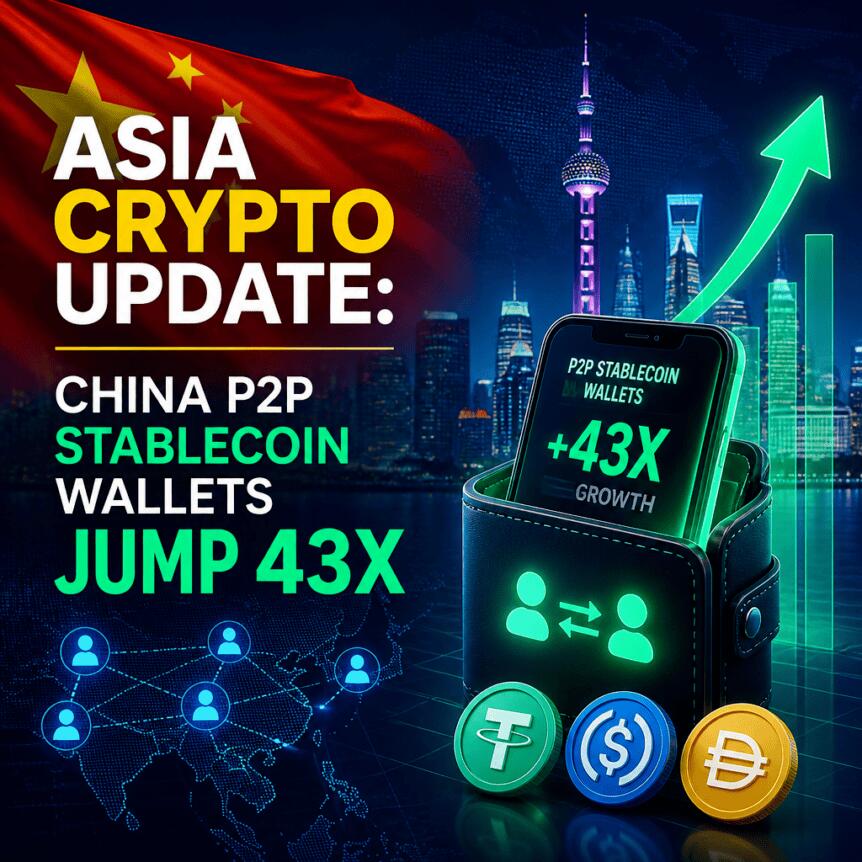
Crypto activity across East Asia is expanding in uneven ways: regulators tighten the rails for exchanges and services, while on-chain demand for stablecoin use and tokenized infrastructure continues to grow. A new Chainalysis report highlights rapid scaling of China-linked peer-to-peer stablecoin wallets, alongside country-by-country shifts that show where liquidity is moving and what institutions are preparing next.
Beyond stablecoins, the same research and accompanying regulatory updates point to a broader theme for the region—crypto adoption is increasingly shaped by compliance frameworks, institutional partnerships, and payment rails rather than retail momentum alone.
Key takeaways
- Chainalysis says unique China-based wallets sending peer-to-peer stablecoin transfers grew 43x between Q1 2024 and Q2 2026, despite ongoing restrictions on crypto.
- In Chainalysis’s reporting, China’s self-custodied stablecoin transfers totaled $104.1 billion across 18.1 million transfers during the July 2025–June 2026 window.
- Chainalysis estimates China’s crypto economy is at least $176 billion, with domestic P2P activity representing 59.1% of the total.
- South Korea remains East Asia’s largest crypto economy in Chainalysis’s ranking, but exchange operating profits fell 78% in the first half of 2026, according to Korea Financial Intelligence Unit data.
- Hong Kong’s government reiterated its plan to submit an amendment bill before the end of 2026 for broader licensing covering digital asset trading, custody, and advisory.
China’s stablecoin usage accelerates on P2P rails
Chainalysis’s findings suggest stablecoins are being used actively as a transaction tool in China even as the environment for crypto remains tightly constrained. The analytics firm reports that the number of unique wallets involved in peer-to-peer stablecoin transactions grew 43-fold from the first quarter of 2024 to the second quarter of 2026.
During the 2026 reporting period—defined as July 2025 through June 2026—Chainalysis recorded $104.1 billion across 18.1 million transfers tied to China’s self-custodied stablecoin holdings.
Turnover rate and “working capital” framing
One of the most revealing metrics in Chainalysis’s report is how quickly stablecoin balances appear to be moving. Chainalysis said stablecoin holdings turned over 33.2 times per year—more than three times the global average of 9.3. In the firm’s interpretation, that pattern is consistent with users treating stablecoins as working capital rather than holding them for long-term exposure.
Investors and builders often look to turnover to gauge whether assets are being used for payments and settlement, or primarily for speculative positioning. If stablecoins are repeatedly cycled rather than parked, it can indicate stronger demand for compliant, reliable transfer mechanisms—especially for cross-party commerce where instant settlement matters.
How Chainalysis values the regional market—and what stands out
Chainalysis estimates China’s crypto economy is at least $176 billion, with domestic P2P activity making up 59.1% of the total. Importantly, Chainalysis notes that domestic P2P activity accounted for about 3.5 times its share versus the 2025 reporting period. That shift implies that local stablecoin transfer behavior is becoming a larger component of the overall activity mix.
Chainalysis also pointed to monthly growth signals in its breakdown—identifying March 2026 as the largest monthly increase among the months shown in its chart, adding $4.9 billion in domestic stablecoin transfer volume.
South Korea: top East Asia market, but exchange profits shrink
While China’s stablecoin activity appears to be rising through P2P networks, South Korea is still positioned as the region’s largest crypto economy in Chainalysis’s ranking. The report places South Korea at $449.1 billion and says overall activity increased 12.3% year-over-year to June 2026.
Chainalysis also reports that retail traders show a preference for AI-linked tokens. That kind of retail positioning can support trading volumes even when macro conditions weaken, but financial performance at exchanges can still deteriorate if valuations soften or customer deposits fall.
That is consistent with results seen by South Korean exchanges in 2026: earlier coverage cited a 78% fall in operating profits. According to a statement referenced from the Korea Financial Intelligence Unit (KoFIU), average daily trading volume at domestic virtual asset exchanges fell 44% over the previous six months, market capitalization declined 33%, and won-denominated deposits dropped 35%. Exchange sales declined 41% over the same period, even though the number of accounts eligible to trade rose slightly by 0.4%.
The tension here is clear: broader ecosystem size may remain strong, but exchange revenue can compress quickly when trading intensity and deposits decline.
Tokenization push and custody plans across the region
Institutional activity continues to find traction in parallel with retail volatility and regulatory tightening. In South Korea, tokenization platform Securitize surged on the news of a partnership with LG CNS. The companies signed a memorandum of understanding to develop tokenized assets and digital asset infrastructure for South Korean financial institutions, with Securitize described in earlier coverage as seeking an early foothold ahead of a new tokenized securities framework.
That framework is tied to rulemaking by the Financial Services Commission, which proposed regulations for the issuance and circulation of tokenized stocks, bonds, funds, and other securities, with implementation targeted for February 2027.
In Singapore, Standard Chartered announced plans to launch digital asset custody services for institutional and eligible corporate clients. The firm said it will custody selected cryptocurrencies, stablecoins, and tokenized real-world assets, positioning Singapore as part of its global strategy.
Operationally, licensed exchange Independent Reserve added cross-border payment tools enabling business fiat and stablecoin payouts in more than 20 currencies, with USDC and USDT included. It also launched crypto derivatives trading for sophisticated investors through its subsidiary ReserveX. In another settlement-focused development, Payward (the parent of Kraken) partnered with Singapore Gulf Bank to enable round-the-clock institutional crypto settlement.
Hong Kong and Japan: licensing progress and evolving market structure
Hong Kong remains focused on creating a broader regulatory framework rather than leaving digital asset services in a patchwork. According to a government statement, the administration reaffirmed its plan to submit an amendment bill before the end of 2026 covering licensing regimes for digital asset trading, custody, advisory, and management services.
In Chainalysis’s geography reporting, Hong Kong also stands out for institutional activity. The firm said institutional platforms accounted for 16% of service inflows—nearly three times the share in any regional neighbor—and reported almost $24 billion in inbound business-to-business flows. Hong Kong also previously issued its first stablecoin licenses in April, aligning licensing milestones with measurable institutional usage.
Japan’s report metrics further show how market structure can evolve: Chainalysis said decentralized exchanges account for nearly 35% of service activity, the highest share among mature East Asian markets, and reported that DEX activity has risen more than 200% since 2022. The same Chainalysis coverage notes that Japanese lawmakers passed revisions in July to bring digital assets under the country’s financial-markets framework. Japan has also expanded sanctions by adding Russian exchange Garantex to its list, citing the ongoing war in Ukraine, based on a joint statement by relevant ministries.
Watch next: compliance timelines meet on-chain demand
The next signal to track is whether regulatory milestones—tokenized securities rules in South Korea, licensing amendments in Hong Kong, and evolving financial-market frameworks in Japan—translate into more institutional volume without shrinking usage channels that traders and users rely on. Meanwhile, the China data raises a key question for the broader market: if stablecoins keep turning over rapidly as working capital, demand may persist even when the surrounding crypto ecosystem faces tighter constraints.
https://www.cryptobreaking.com/asia-crypto-update-china-p2p/?utm_source=blogger%20&utm_medium=social_auto&utm_campaign=Asia%20Crypto%20Update:%20China%20P2P%20Stablecoin%20Wallets%20Jump%2043x%20
Comments
Post a Comment