
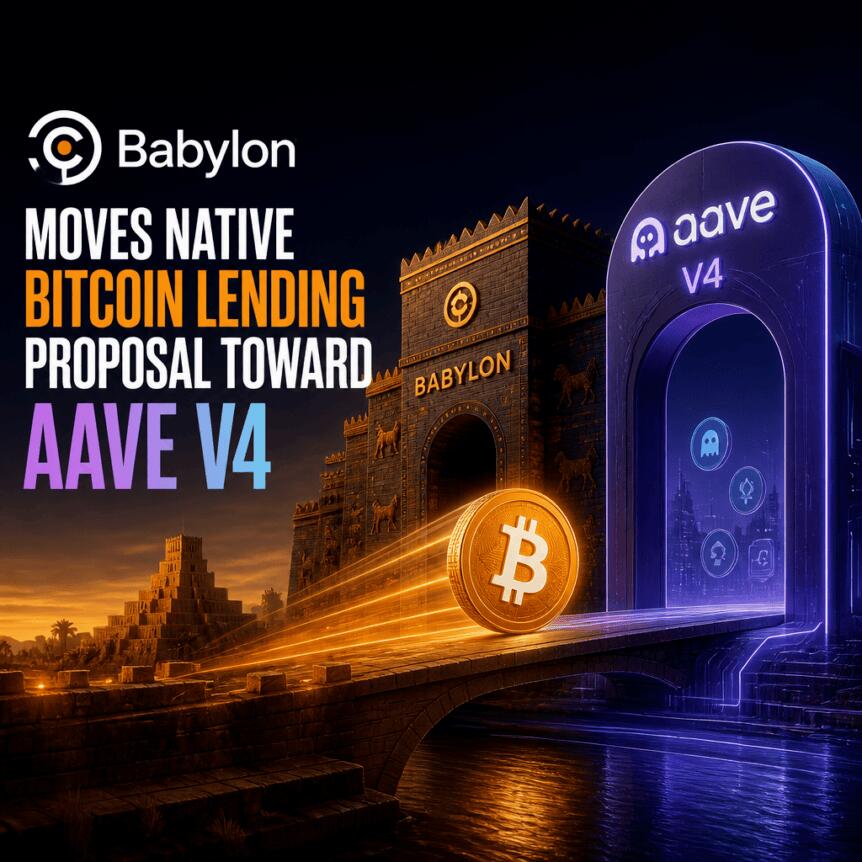
Bitcoin-focused developer Babylon Labs has filed a new proposal with Aave DAO aimed at enabling users to borrow stablecoins on Aave using native BTC as collateral. The core idea is to avoid the common pattern of bridging or wrapping Bitcoin into Ethereum-compatible tokens, instead using Bitcoin vaults and a non-transferable Ethereum representation of the collateral.
The initiative is currently still in Aave’s Request for Comment (ARFC) phase, where community members evaluate the risks and practicality of the integration. If the proposal clears the feedback stage, it would move to an offchain Snapshot vote and then—if the vote thresholds are met—an eventual onchain decision.
Key takeaways
- Babylon Labs’ proposal targets borrowing stablecoins on Aave against native BTC held in Bitcoin-network vaults.
- Collateral on Ethereum would be represented via a non-transferable token, with BTC remaining on its native chain.
- The ARFC stage is meant for community feedback and risk analysis before any formal governance vote.
- Aave’s DAO would receive the first $500,000 in qualifying annual revenue if the integration proceeds.
- Aave already supports tokenized Bitcoin collateral through wrapped assets, but Babylon’s approach is designed to reduce reliance on custodians.
Native Bitcoin collateral, without bridging or wrapping
According to the proposal posted to Aave governance, users would lock their BTC in vaults on the Bitcoin network. Against that locked BTC, borrowers would take out stablecoin loans on Aave.
Crucially, the design seeks to keep BTC on Bitcoin rather than moving it to Ethereum via bridging or by minting wrapped versions. On Ethereum, the collateral would be represented by a non-transferable token that signals the borrowing capacity derived from the vault position on Bitcoin.
This separation matters for risk management. Wrapped Bitcoin tokens have historically required an external custodian or custody mechanism to hold the underlying BTC, which creates counterparty exposure beyond onchain smart contract risk. By contrast, Babylon’s approach is positioned as “trustless” in the sense that the vaulting and representation are intended to work without transferring BTC ownership into a custodian model.
How the proposal fits into Aave governance
The submission builds on an earlier step that Babylon Labs described as a preliminary track of community discussion. The proposal referenced in the governance forum follows an initial submission on May 25 and a preliminary community vote that, per Babylon Labs, passed on June 10—while the current filing continues through the formal Aave lifecycle.
As of Thursday, the integration remains at the ARFC stage. During ARFC, Aave community members typically focus on technical feasibility, security assumptions, and the specific risk tradeoffs introduced by the new collateral path. That means the current state is not a guarantee of progress—only that the idea is now being actively reviewed.
If consensus forms during ARFC, the proposal could then proceed to a three-day offchain Snapshot vote. Aave’s governance rules state that the Snapshot vote requires at least 320,000 AAVE-equivalent votes in favor to advance. After that, the integration would still need to meet the quorum and approval requirements of a subsequent formal onchain vote.
Revenue sharing: $500,000 in qualifying annual revenue
The proposal also includes an incentive mechanism for Aave DAO. The filing states that the DAO would receive the first $500,000 in qualifying annual revenue generated by the integration.
For market participants, such revenue-sharing provisions can be an important signal about how protocols think about new collateral rails: integrations that expand lending capacity—especially for capital-constrained collateral—often come with operational and security costs that governance may need to justify over time. Readers should watch whether the final terms or scope of “qualifying” revenue end up affecting how the integration is evaluated during ARFC and voting.
What changes compared with Aave’s current wrapped-BTC options
Aave already supports borrowing against tokenized Bitcoin, including Wrapped Bitcoin (WBTC) and Coinbase Wrapped Bitcoin (cbBTC). Those assets allow BTC exposure to be used within Ethereum-based DeFi markets without requiring each lender to implement Bitcoin-native logic.
However, the proposal highlights a key limitation of wrapped-token collateral: wrapped BTC relies on custodians to hold the underlying Bitcoin. In practice, that means borrowers and lenders inherit not only smart contract risk but also custody and redemption-process risk—factors that are outside the typical boundary of onchain protocol assumptions.
Babylon’s proposal attempts to address that tradeoff by using native vaulting on Bitcoin and a non-transferable Ethereum token to represent the locked BTC position. If successful, the outcome would be an additional collateral pathway for Aave that aims to reduce dependence on custodial wrapped assets.
Why borrowers and liquidity providers should care
If Aave governance approves the integration, it could broaden the practical set of collateral that can support stablecoin borrowing while changing the risk profile associated with BTC collateral. For borrowers, that may translate into more direct access to Bitcoin-backed credit without the additional operational layer introduced by wrapped token custody. For liquidity providers, it could affect how collateral quality is assessed and how systemic risk is distributed across Aave’s lending ecosystem.
That said, the proposal is not yet approved, and it remains subject to community feedback and formal governance voting. Investors and builders should pay close attention to the ARFC discussion for details around security assumptions, failure modes for vault representation, and how the system handles edge cases.
For now, the next milestone is Aave’s ARFC review: if the community finds the design sufficiently robust and aligned with Aave’s governance standards, the proposal could advance to Snapshot and then onchain voting—an outcome that would determine whether native BTC collateral becomes a new ingredient in Aave’s tokenized credit framework.
https://www.cryptobreaking.com/babylon-moves-native-bitcoin-lending/?utm_source=blogger%20&utm_medium=social_auto&utm_campaign=Babylon%20Moves%20Native%20Bitcoin%20Lending%20Proposal%20Toward%20Aave%20V4%20
Comments
Post a Comment