
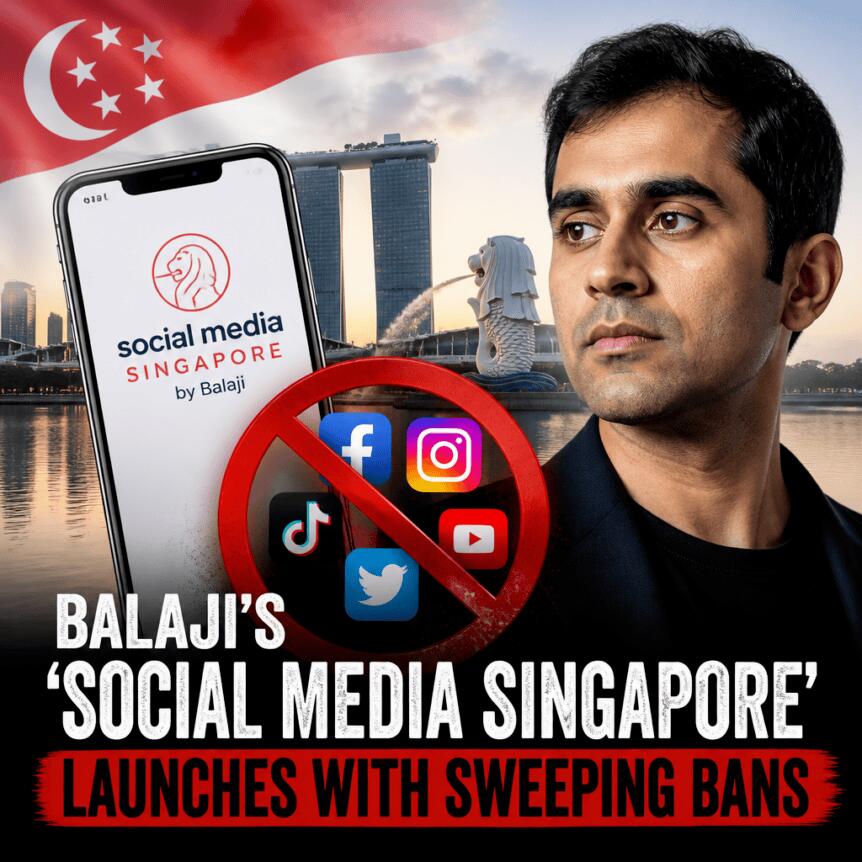
Balaji Srinivasan’s Network School has taken control of Farcaster, announcing the acquisition and a rebrand of the social app as the Network State Protocol. The shift immediately triggered complaints from parts of the Farcaster community after some users reported their accounts were restricted to “read-only,” allegedly due to violations of the new reference app’s code.
According to Network School, the Network State Protocol aims to create a “positive-sum” community with enforceable standards—backed by what it calls “social smart contracts.” But critics argue that retroactively restricting accounts for past posts conflicts with the ethos of decentralized social.
Key takeaways
- Network School says it acquired Farcaster from Neynar and is relaunching it as the Network State Protocol.
- Several Farcaster users reported account restrictions to “read-only” tied to earlier posts they believe violate new rules.
- Network School’s model centers on an opt-in “social smart contract” that lets its core team set app rules for a reference client.
- The underlying Farcaster protocol is described as staying open, with opt-out users retaining keys, funds, followers, and post history.
- Network School frames enforcement as “law and order” and says appeals exist for users affected by moderation decisions.
Acquisition and a swift rules overhaul
Network School announced on Thursday that it had acquired Farcaster from Neynar and rebranded it as the Network State Protocol. The same day, users on X said their Farcaster accounts had been restricted to “read-only,” suggesting enforcement actions were applied after review of prior activity rather than only new posts.
Kunal Gandhi—former India ecosystem lead at Eigen Labs—publicly criticized the approach, arguing that removing access based on historical posts undermines decentralized social principles. As he wrote on X, “Obliterating accounts from the get-go for past posts is pretty silly,” and noted that it runs counter to the idea of decentralization.
Network School leadership also provided broader context for the move. Co-founder Dan Romero said Farcaster had 250,000 monthly active users in December 2025, underscoring that the platform had grown enough to warrant a major shift in how its reference client operates.
Srinivasan’s “Singapore of social media” vision
Balaji Srinivasan said the bans were intended as part of a plan to turn the reference app into “the Singapore of social media”—a community governed by a shared code of conduct and designed around “techno-optimists.” In his Farcaster post, Srinivasan argued that restoring norms of “law and order” could reduce harassment by treating abusive behavior as unacceptable in a social setting.
He compared the approach to real-world strategies for reducing repeat offending, describing moderation that removes a “small fraction” of repeat offenders that get muted or blocked by many users. Srinivasan also said both humans and AI were used to review millions of posts to identify accounts subject to restrictions, and that there is an appeals process.
“Much like how President Bukele jailed a small fraction of repeat offenders to essentially eliminate crime in El Salvador, we’ve moderated out the small fraction of repeat offenders that have been muted or blocked by many accounts to stop random attacks within this Farcaster reference client.”
The key point for Farcaster users is that, in this rollout, the rules appear to have been applied not only prospectively but to past content as well—an element that drew immediate pushback from those who felt their earlier posting history should not trigger new penalties.
How Network State Protocol plans to enforce its rules
Network School’s Network State Protocol is built around an opt-in structure. Users can authorize a “social smart contract” that allows Network School’s core team to set the app’s rules for the reference client.
Under the “Network Code,” violations are categorized as digital felonies, misdemeanors, or infractions, with penalties ranging from warnings and suspensions to bans. The rules, Network School says, apply to past posts as well as new ones. The company also claims the code includes rewards for “pro-social behavior,” such as teaching others, sharing projects, and disagreeing civilly, though it does not outline what those rewards would be or how they would be delivered.
Network School said an open-weight AI model would help apply the rules, with some manual judgment calls. It also suggested that the system may eventually warn users of potential violations before they post, but details of how that warning stage would work were not specified in the announcement.
Importantly, Network School framed the enforcement system as compatible with decentralization at the protocol layer. The underlying Farcaster protocol remains open, it said. Users who decline the contract would receive read-only access to the main app while retaining their keys, funds, followers, and post history—meaning they can move to another client.
Srinivasan described this ability to join, leave, or build competing clients as “decentralized democracy,” emphasizing that users should be able to choose whether their activity participates in the reference-client governance model.
Broader context: Network School’s shifting geography
Network School’s takeover arrives after a period of regulatory friction around Srinivasan’s earlier real-world plans. Earlier coverage by Cointelegraph noted that Malaysian authorities revoked the Forest City business license and ordered it to cease operations, citing alleged licensing and premises-use violations. Srinivasan later announced an agreement to establish a campus in Kazakhstan.
While that earlier dispute is separate from Farcaster’s technical governance, it helps explain why Network School is positioning itself around the concept of “network states” and physical community-building beyond software. In Thursday’s announcement, Network School said it wants online community structures to take physical form through meetups and pop-up events, with the long-term ambition of developing into startup cities and network states.
For Farcaster participants, the practical question is whether this expansive vision translates into better social safety without sacrificing the neutrality that many users expect from a decentralized platform—especially when enforcement appears to reach back into prior posts.
Going forward, the most important things for readers to watch are how the appeals process functions in practice, whether users who opt out of the contract can freely move between clients after restrictions, and what moderation patterns emerge once the reference app’s “law and order” model is fully running.
https://www.cryptobreaking.com/balajis-social-media-singapore-launches/?utm_source=blogger%20&utm_medium=social_auto&utm_campaign=Balaji’s%20‘social%20media%20Singapore’%20launches%20with%20sweeping%20bans%20
Comments
Post a Comment