
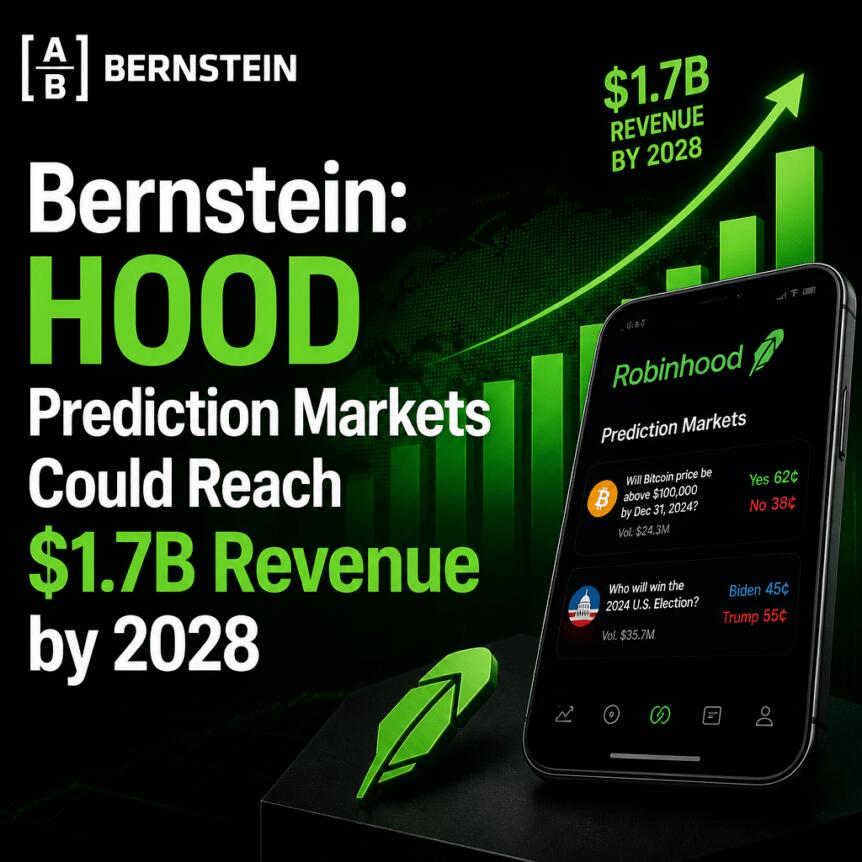
Prediction markets are starting to look less like a side project and more like a potential earnings engine for Robinhood Markets. In a note discussed with Cointelegraph, Bernstein analysts forecast that prediction market revenue could climb to as much as $1.7 billion by 2028—an amount they estimate could overtake revenue Robinhood earns from crypto trading in the same year.
The projection arrives just days before Robinhood is expected to report results for the third quarter of 2026. Bernstein also expects the broader business to expand, pointing to momentum across equities, options, and event contracts, alongside a rebound in crypto activity.
Key takeaways
- Bernstein forecasts Robinhood prediction market revenue reaching $1.7 billion by 2028, up from roughly $650 million in 2026.
- The firm estimates prediction market revenue could surpass projected crypto-derived revenue of $1.6 billion in 2028.
- Bernstein expects Robinhood’s total revenue for 2028 to be about $9.4 billion, with prediction markets contributing roughly 18%.
- For the upcoming third-quarter report, Bernstein projects quarter-over-quarter revenue growth of about 13% to around $1.5 billion.
- The price target of $160 was kept unchanged, while revenue estimates were raised for 2026–2028 based on updated equities and crypto assumptions.
Why prediction markets matter for Robinhood’s revenue mix
Robinhood has long been associated with retail trading—especially around equities and crypto exposure. Bernstein’s view shifts that narrative by suggesting prediction markets could become one of the platform’s incremental earnings drivers. The key data point is the scale of growth: prediction market revenue is expected to rise to approximately $1.7 billion in 2028 from about $650 million this year.
Just as important is the relative comparison. Bernstein’s model projects crypto-based revenues of about $1.6 billion for Robinhood in 2028, meaning prediction markets could become the larger contributor between the two categories. For investors, this matters because it reframes where growth could come from as the company looks to diversify revenue sources beyond traditional crypto trading.
Bernstein’s estimate also places prediction markets as a meaningful share of overall income—about 18% of Robinhood’s projected $9.4 billion in total revenue for 2028—suggesting the segment is not merely incremental, but potentially material to the company’s long-term earnings composition.
What Bernstein expects ahead of Robinhood’s Q3 report
In addition to the longer-range prediction market outlook, Bernstein outlined a near-term growth expectation for Robinhood’s third quarter of 2026. The firm anticipates revenue increasing 13% quarter-over-quarter to around $1.5 billion.
According to the note shared with Cointelegraph, that expected improvement would be supported by multiple product lines: growing equity notional volumes, options volumes, and event contract volumes. On the crypto side, Bernstein also pointed to a recovery in crypto trading volume, indicating that the firm expects weakness earlier in the cycle to ease.
For readers tracking Robinhood’s results, the mix implied by the forecast is notable. It suggests the next quarter’s headline growth is not dependent on one category alone. Instead, the model ties growth to a combination of core retail trading activity (equities), derivatives engagement (options), and the company’s prediction/event contract offerings—while still factoring in crypto’s role as the segment that can help turn a partial recovery into a broader uptick.
Updated revenue estimates, unchanged price target
Bernstein adjusted its financial expectations alongside the prediction market thesis. The firm raised its revenue estimates by 3% for 2026, 4% for 2027, and 3% for 2028, citing higher assumptions for equities and crypto revenue.
Despite the increases to the company’s projected top line, Bernstein kept its $160 price target unchanged. The combination of a steady target with upward revisions typically signals that—at least in the firm’s base case—improvements in certain revenue drivers may not be sufficient to warrant a higher valuation multiple, or that offsetting factors remain part of the underlying framework.
For market participants, the key watch point is how the upcoming third-quarter report validates or challenges these assumptions. If Robinhood’s actual performance aligns with the anticipated strength in equities, options, event contracts, and crypto volumes, it could lend credibility to Bernstein’s path toward larger prediction market revenue contribution. If not, investors may be forced to reassess how quickly prediction markets scale relative to crypto.
Stock performance as investors await new data
As investors look toward Robinhood’s next earnings release, the stock’s recent trading context remains cautious. According to Yahoo Finance data, the Nasdaq-listed shares were poised to open lower on Monday, with premarket activity bringing the price down to $93.60. Over the past 12 months, the stock is down more than 29%.
That backdrop helps explain why Bernstein’s forecast is being treated as more than an abstract long-term projection. When a stock has underperformed over a year, investors often look closely for identifiable catalysts that could alter the growth narrative. A credible shift in revenue mix—such as prediction markets growing into a potentially larger contributor than crypto by 2028—could offer one such catalyst, but it will still need to be supported by quarterly results and user/activity data over time.
Going forward, the most important items to watch are how much of Bernstein’s expected Q3 revenue growth materializes across equities, options, and event contracts, and whether the “recovery in crypto trading volume” shows up in reported figures. The pace at which prediction markets contribute to revenue will likely be the next major test of Bernstein’s forecast—and of how real this diversification into prediction contracts becomes for Robinhood’s earnings power.
https://www.cryptobreaking.com/bernstein-hood-prediction-markets-could/?utm_source=blogger%20&utm_medium=social_auto&utm_campaign=Bernstein:%20HOOD%20Prediction%20Markets%20Could%20Reach%20$1.7B%20Revenue%20by%202028%20
Comments
Post a Comment