
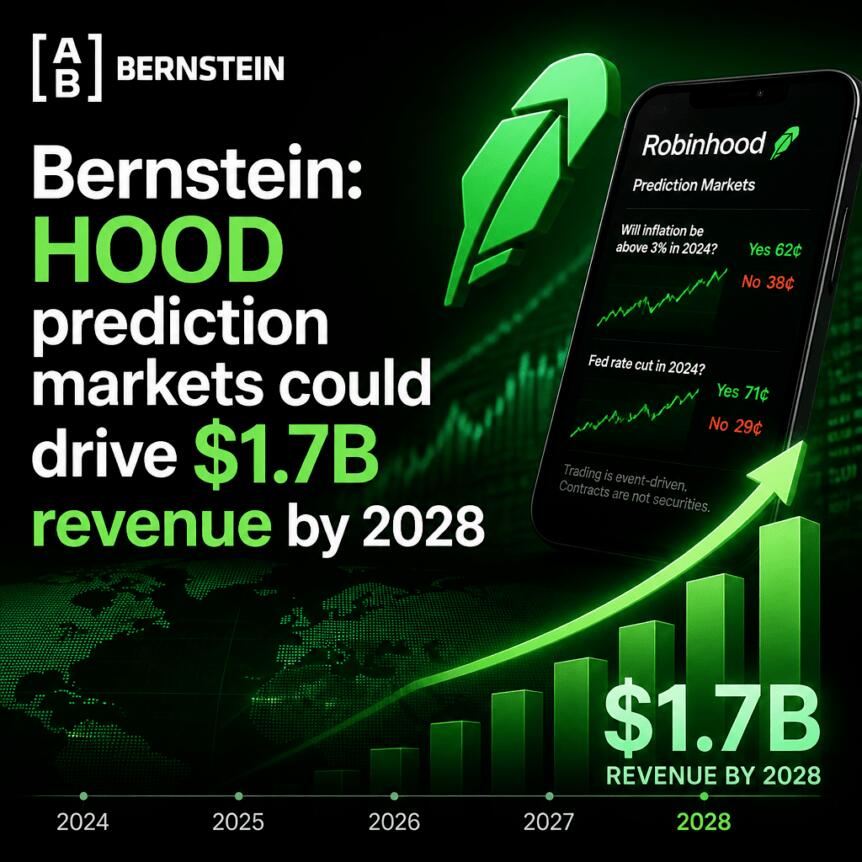
Bernstein analysts believe Robinhood Markets’ prediction-market business could become a meaningful earnings contributor—and, importantly, may eventually eclipse revenue generated from crypto. In a forecast shared with Cointelegraph, the investment firm projects prediction markets could contribute up to $1.7 billion in business for Robinhood by 2028.
The analysts’ outlook contrasts two growing revenue streams for the Nasdaq-listed retail trading platform: prediction markets versus crypto. Bernstein expects crypto-based revenues to reach $1.6 billion in 2028, slightly below the contribution anticipated from prediction markets, suggesting a shift in what investors should watch as Robinhood’s product mix expands.
Key takeaways
- Prediction markets could drive up to $1.7B in Robinhood business by 2028, according to a Bernstein forecast shared with Cointelegraph.
- Bernstein expects prediction-market revenue to rise from about $650M this year to $1.7B by 2028.
- In 2028, prediction-market revenue would represent roughly 18% of projected $9.4B total revenue, per Bernstein.
- The firm raised Robinhood’s revenue estimates for 2026–2028 while leaving its $160 price target unchanged.
- For the upcoming Q3 2026 report, Bernstein projects revenue growth of 13% quarter-over-quarter to around $1.5B.
Prediction markets move closer to a core revenue role
Bernstein’s forecast frames prediction markets not as a side feature, but as a potential structural driver of Robinhood’s revenue growth. The firm expects Robinhood’s prediction-market revenue to climb to approximately $1.7 billion in 2028 from about $650 million in the current year.
Crucially, the analysts also quantify how much of Robinhood’s broader growth this implies. They estimate prediction markets could account for about 18% of Robinhood’s projected $9.4 billion in total revenue by 2028. For investors, that share matters because it signals durability: a larger proportion of revenue tied to a single category typically increases the market’s sensitivity to user adoption, product performance, and regulatory or competitive developments in that segment.
The same forecast positions crypto as slightly smaller than prediction markets over the same horizon. Bernstein projects crypto-derived revenues to reach $1.6 billion by 2028—close, but still below the prediction-market figure—highlighting that Robinhood may see growing economic importance in markets beyond digital assets.
What Bernstein expects for Robinhood’s near-term results
While the longer-term implication is that prediction markets could become a bigger earnings driver, Bernstein also pointed to catalysts closer to the company’s next quarterly update. The firm’s model anticipates Robinhood’s Q3 revenue rising 13% quarter-over-quarter to around $1.5 billion.
According to Bernstein, that growth would be supported by multiple trading activity components, including equity notional volumes, options volumes, and event contract volumes. The analysts also cite a recovery in crypto trading volume, indicating that—despite the prediction-market narrative—crypto trading performance remains part of the company’s short-term operating picture.
The forecast arrives just ahead of Robinhood’s third-quarter 2026 report, which is scheduled for the near term relative to the Monday referenced in Cointelegraph’s coverage.
Raised estimates, unchanged price target
Alongside its prediction-market projections, Bernstein adjusted its revenue assumptions. The firm raised Robinhood’s revenue estimates by 3% for 2026, 4% for 2027, and 3% for 2028. Despite these upward revisions, the analysts kept their price target at $160.
In Bernstein’s explanation, the estimate changes were driven by higher assumptions for both equities and crypto revenue. The decision to maintain the same price target suggests the analysts believed the valuation framework already accounted for much of the improved outlook—or that other offsetting factors limited the need for an upward adjustment.
Investors, meanwhile, are likely to focus not only on the direction of revenue estimates but also on whether management can translate category growth—particularly in prediction markets—into sustained profitability over multiple quarters. While Bernstein provided top-line projections, questions remain around margins, customer engagement, and the scalability of the product as it grows.
Stock reaction and what investors should watch next
At the time of Cointelegraph’s report, Robinhood shares were set to open lower on Monday, with Yahoo Finance indicating premarket activity had pared the stock price down to $93.60. The stock was also down more than 29% over the past 12 months, according to the same reference.
As Robinhood approaches its Q3 2026 earnings report, the Bernstein forecast places prediction markets at the center of the narrative investors may bring into the quarter. The key question for readers is whether company-reported results and user activity can validate the ramp implied by Bernstein’s projections—especially the expectation that prediction-market revenue grows from roughly $650 million this year to $1.7 billion by 2028.
Beyond the next earnings release, investors should watch for updates on trading volumes across equities, options, event contracts, and crypto, because Bernstein’s near-term outlook ties revenue growth to a broad set of activity metrics. The interplay between these segments—plus whether prediction markets continue to gain share—may ultimately determine whether Bernstein’s view of an earnings shift comes to pass.
https://www.cryptobreaking.com/bernstein-hood-prediction-markets-could-2/?utm_source=blogger%20&utm_medium=social_auto&utm_campaign=Bernstein:%20HOOD%20prediction%20markets%20could%20drive%20$1.7B%20revenue%20by%202028%20
Comments
Post a Comment