
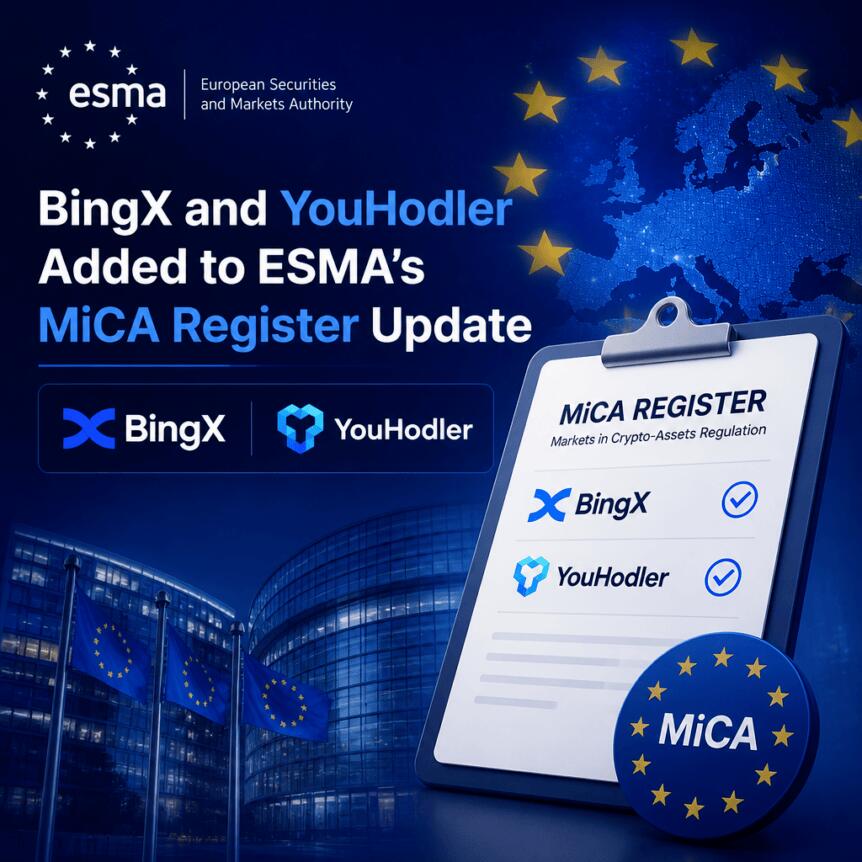
The EU’s Markets in Crypto-Assets Regulation (MiCA) continues to expand its footprint as ESMA’s official register update added nine new crypto-asset service providers (CASPs). With the latest additions, the total count now stands at 375 unique providers listed under MiCA.
According to the European Securities and Markets Authority (ESMA), Friday’s update included new entities from multiple countries, reflecting how firms across Europe are positioning their operations for MiCA-compliant services—particularly exchanges, custody, and transfer-related activities.
Key takeaways
- ESMA added nine CASPs to its MiCA register, bringing the total to 375 unique crypto-asset service providers.
- BingX’s Austrian entity was listed, while YouHodler’s Italian subsidiary received multiple MiCA authorizations covering custody, exchange, order execution, and transfers.
- Spain, Germany, and Denmark also saw changes, including new listings in Spain and Germany.
- Denmark’s Penning Financial Services disappeared from the CASP register despite its claims that its MiCA authorization status has not changed.
- ESMA’s EMT and NCASPs registers moved minimally, while the ART register remained empty.
BingX and YouHodler expand MiCA coverage
ESMA’s register update listed BingX’s Austrian entity, MEGE zweite, as part of the new CASP additions. In a statement shared after the authorization was announced, BingX said the approval gives it a clearer regulatory pathway as it prepares to roll out services across the European Economic Area.
The update also captured YouHodler’s Italian operations. ESMA listed the Italian subsidiary of the crypto lending platform and showed authorizations spanning several MiCA activities: custody, crypto exchanges, order execution, and transfers. YouHodler announced its Italy authorization last week, positioning it for compliant offering of regulated services within Italy under the MiCA framework.
The practical significance for users and counterparties is that these listings correspond to firms operating within defined regulatory permissions, rather than relying solely on transitional or pre-MiCA operating models. For investors and market participants, the register serves as a quick reference for which entities are officially recognized for specific crypto-asset activities.
Other country-level additions: Spain and Germany
Beyond Austria and Italy, the ESMA update recorded new activity in other EU jurisdictions.
In Spain, ESMA listed Prakma Markets, which is connected to the Goin crypto app and operates a savings and investment platform. The new listing underscores how MiCA authorizations are not limited to trading venues; they also extend to firms operating within broader investment and savings-related models.
Germany’s additions included Openbank Deutschland, a subsidiary of Banco Santander. ESMA also listed cooperative lenders VR-Bank Alb-Blau-Donau and VR Bank im südlichen Franken. The presence of established banking-linked entities highlights how traditional financial groups are increasingly treating MiCA compliance as a prerequisite for entering or expanding crypto services in EU markets.
Penning Financial Services removed from the register—company disputes change
One of the most notable developments in the update concerns Denmark’s Penning Financial Services. ESMA’s latest CASP register update no longer lists Penning, despite the company having appeared in register updates dating back to July 3.
In response to the discrepancy, a spokesperson for Penning told Cointelegraph that its MiCA authorization “remains unchanged” and that the firm had received no communication from Denmark’s financial regulator about any changes. Cointelegraph reported that it contacted ESMA and Denmark’s Financial Supervisory Authority for clarification, but had not received a response at the time of publication.
For market participants, this raises a question worth watching: whether the removal reflects an administrative correction, an update process issue, a status change not yet communicated, or a classification adjustment. Until regulators clarify, readers should treat the register as informative but not infallible—especially when entries appear to disappear between updates.
EMT, ART, and NCASPs registers show limited movement
ESMA’s update also covered other parts of its crypto-related regulatory registry ecosystem.
- EMT (e-money token) register: unchanged at 50 entries representing 25 unique entities.
- ART (asset-referenced token) register: remained empty.
- NCASPs (non-compliant crypto-asset service providers) register: increased by five entries to 178.
While the EMT and ART figures show steady conditions—at least in this specific snapshot—the growth in the NCASPs list serves as a reminder that regulators are still tracking non-compliant activity alongside the transition toward MiCA-licensed operations. For traders and integrators, the divergence between licensed CASPs and NCASPs can matter, particularly when assessing counterparties for custody, execution, or exchange-related services.
The update also appears alongside broader regulatory developments in Europe’s token ecosystem, including earlier reporting about Qivalis receiving a Dutch e-money license for a euro stablecoin, which reflects the continued maturation of supervised digital-asset frameworks.
Looking ahead, investors, builders, and compliance teams should monitor two things: the pace at which more CASPs are added across member states, and whether Penning’s removal is resolved through official clarification—especially since sudden register changes can affect counterparties’ perceived operational status in real time.
https://www.cryptobreaking.com/bingx-and-youhodler-added-to/?utm_source=blogger%20&utm_medium=social_auto&utm_campaign=BingX%20and%20YouHodler%20Added%20to%20ESMA’s%20MiCA%20Register%20Update%20
Comments
Post a Comment