
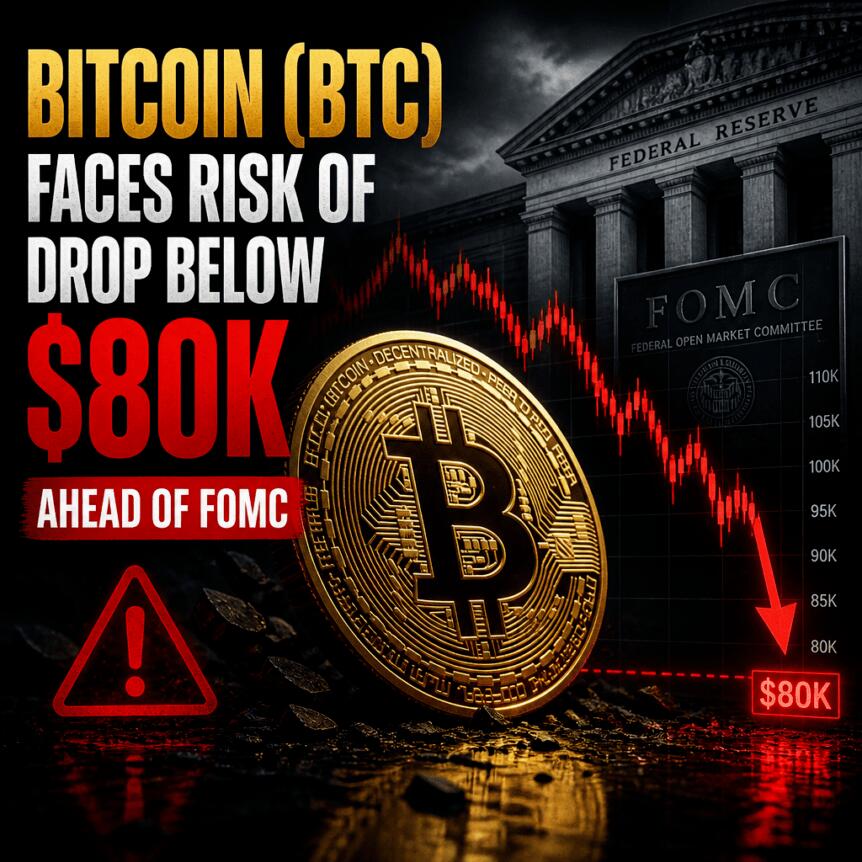
Bitcoin is entering the final stretch of October under pressure, with the market trying to defend the $80,000 area as investors look ahead to a dense schedule of US macro data and corporate earnings. The month’s performance is already trending negative: BTC is on track to end October down roughly 4% if prices remain near current levels around $80,000.
Outside crypto, broader risk sentiment is also being tested. The coming week’s US Federal Reserve decision and oil price moves sit alongside renewed weakness in South Korea’s KOSPI and a slate of major US tech earnings, factors that can quickly change liquidity conditions for both equities and digital assets.
Key takeaways
- Traders are positioning for the Fed to keep its federal funds target range at 3.75%–4.00% after CME FedWatch pricing shows over 90% odds of no rate change.
- Brent crude has cooled from about $117 per barrel to around $110, but remains above $100—keeping macro uncertainty elevated for markets sensitive to inflation and growth expectations.
- KOSPI Composite slid again on Monday, falling 1.5% to 5,469, as foreign investors reduced exposure amid AI-related caution.
- Bitcoin’s “Uptober” pattern is not holding this year or last, according to CoinGlass monthly return data—while the $80,000 level has struggled to provide stable support.
- CoinGlass liquidation data shows nearly $150 million in long positions wiped out after BTC dipped toward $79,145 over the weekend.
Fed decision and oil cooling set the tone for risk assets
The Federal Open Market Committee meeting on Wednesday is the focal point for macro traders. Markets will be watching not only the rate decision itself, but also the tone in comments from Fed chair Kevin Warsh at the post-meeting press conference.
According to CME Group’s FedWatch tool, investors are pricing in a pause with more than 90% odds that the federal funds target range will remain in the current 3.75%–4.00% band. While that expectation dominates, traders are still assessing how the Fed might react to evolving inflation pressures and financial conditions going into December.
Economist Robin Brooks argued that the market’s low probability of a rate hike gives Warsh room to avoid a fight with external expectations. In his write-up, Brooks characterized the week’s meeting as having “zero interest in markets,” contrasting it with earlier contentious Fed gatherings in 2026 when markets were more aggressively trying to influence policy direction.
Oil is a key variable because it can affect inflation expectations and growth fears. Brent crude reached about $117 per barrel on Friday—its highest level since March 19—before easing to roughly $110 on Monday. Brooks also suggested that even a further move to around $125 would not necessarily compel the Fed to change course, warning instead that financial stress and equity weakness could lead to tightening conditions that would argue against hikes.
Investors will also receive fresh inflation signals before the Fed vote. On Thursday, the US Personal Consumption Expenditures (PCE) index—described in the source material as the Fed’s preferred inflation gauge—is scheduled for release. In the prior month’s reading, PCE came in lower than expected at 3.4% year-on-year, though analysts linked the drop to changes in how certain components are calculated rather than a clean improvement in underlying inflation momentum.
Equities struggle as investors brace for earnings and AI scrutiny
While macro headlines dominate, crypto traders are not trading in isolation. Monday’s moves in global equities reflect a cautious stance that can spill over into risk assets like BTC.
South Korea’s KOSPI Composite Index resumed its decline, closing down 1.5% at 5,469 points. The index earlier traded as low as 5,308 on Friday—an intraday level not seen since late July—after renewed selling in tech stocks. The source attributes the pressure partly to foreign capital seeking safety ahead of major Wall Street earnings catalysts.
On the US side, the Nasdaq Composite Index finished Friday at 25,955, marking its lowest daily close since Aug. 3. Attention has been focused on how AI-related enthusiasm is translating into corporate capital expenditure decisions. One example cited was Tesla’s reduced Q3 capital expenditure, which failed to lift sentiment last week even after some stronger-than-expected US earnings prints.
Still, not everyone is convinced that the broader AI theme is breaking. JPMorgan Asset Management’s Raisah Rasid told CNBC on Monday that investor thinking is shifting away from “capex” as the central metric, emphasizing instead return on capital—an adjustment that could influence how markets interpret future AI investment cycles.
Corporate results and growth indicators are scheduled to arrive in quick succession. The source notes that Microsoft and Alphabet report after the market close on Wednesday, with Amazon and Intel following on Thursday. It also cites that roughly 20% of S&P 500 companies are expected to report during the week, while Thursday includes the release of US Q3 GDP numbers—another potential catalyst for volatility across markets.
BTC targets $80,000 as “Uptober” loses its historical edge
The question for Bitcoin heading into November is whether the market can stabilize above $80,000 or whether the level is proving more psychological than structural. The article indicates that BTC is on pace for a monthly drop of about 4% if the month closes near current prices around $80,000.
Historically, October has earned Bitcoin the “Uptober” reputation. According to CoinGlass, the BTC/USD pair has averaged a positive October return of 26.1% since 2010. However, CoinGlass data also shows that both this year and last have diverged from that pattern—October 2025 fell 3.9%, and Bitcoin then dropped another 17.5% in November, contrasting with average November gains of about 35% across the same historical period.
Short-term positioning has reflected that fragility. The source reports that almost $150 million in long positions were liquidated over roughly two hours on Saturday after Bitcoin slid to $79,145. While $80,000 remains a widely watched psychological boundary, the article notes it has not provided strong support on lower time frames.
CoinGlass data cited in the article highlights a limit-order landscape that may be helping to cushion downside, with a $73 million wall of bids keeping BTC above approximately $79,300. Meanwhile, sell-side liquidity appears concentrated around the $81,000 area, suggesting that even if $80,000 holds, any bounce could face resistance fairly quickly.
Analysts warn of “fakeout” risk ahead of year-end
Beyond the day-to-day trading picture, the article points to a broader technical debate: whether recent upside attempts will be followed by renewed weakness. Benjamin Cowen, founder of crypto analytics platform Into the Cryptoverse, described BTC’s trips to around $87,000 in late September and early October as a “fakeout,” implying that bulls failed to convert resistance into sustainable trend change.
In comments shared with X followers on Monday, Cowen argued that Bitcoin could remain under pressure through the end of the year, pointing to historical precedent and referencing the tendency for downside to show up around US midterm election years. He also highlighted a resistance zone near $87,000 as containing important reference levels, including the 2026 yearly open at $87,490 and a 20-month moving average around $87,165—levels that may influence where traders look for confirmation or rejection.
For the week ahead, the most important variables to watch are how Fed messaging and US data surprises affect overall liquidity, and whether Bitcoin can hold $80,000 as earnings and macro catalysts increase intraday volatility; if that support fails, the market may quickly search for the next meaningful bid zone.
https://www.cryptobreaking.com/bitcoin-btc-faces-risk-of/?utm_source=blogger%20&utm_medium=social_auto&utm_campaign=Bitcoin%20(BTC)%20Faces%20Risk%20of%20Drop%20Below%20$80K%20Ahead%20of%20FOMC%20
Comments
Post a Comment