
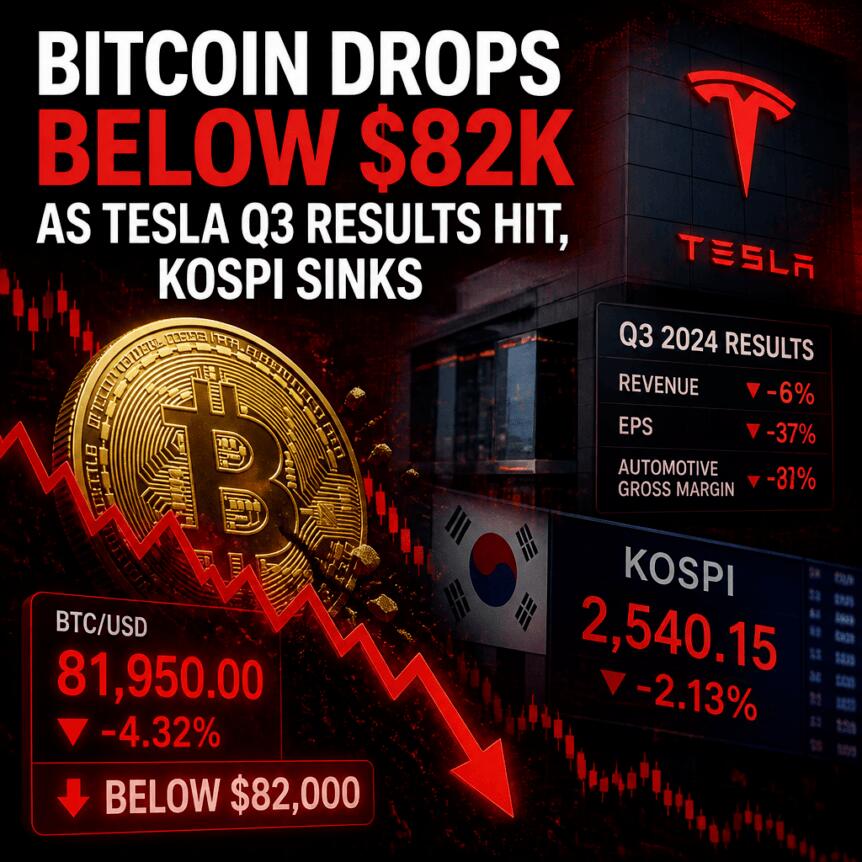
Bitcoin slid nearly 3% on Thursday after a push toward higher levels failed to hold, with price stalling just below the $85,000 area and then retracing back toward the low-$80,000s. The drop followed a late-session shift in risk sentiment after Tesla’s third-quarter results did not match the market’s expectations for capital spending.
At the same time, broader tech pressure returned outside the United States. South Korea’s KOSPI Composite Index closed down 3.52% on Thursday, adding to concerns that the market may be scaling back its enthusiasm for the next wave of AI-linked investment.
Key takeaways
- Bitcoin pulled back after rejecting around $84,840, keeping a “lower highs” pattern intact in the short term.
- BTC traded back near $81,500 after Tesla reported Q3 capex of $4.73 billion, below the $7.96 billion figure expected.
- South Korea’s KOSPI Composite Index fell 3.52% on Thursday, reinforcing weakness in a tech-heavy regional benchmark.
- CoinGlass data shows Bitcoin open interest climbed to $55.95 billion late Tuesday, a dynamic that can amplify market swings after reversals.
Tesla capex disappointment spills into crypto risk sentiment
Trading data referenced by Cointelegraph/TradingView showed BTC/USD giving back gains from Wednesday. After peaking near $84,840 on Bitstamp, the pair retraced and fell back below $82,000, returning toward roughly $81,500 by Thursday.
The catalyst was Tesla’s third-quarter report. Earlier in the week, stronger US corporate earnings helped lift both equities and crypto. But Tesla’s results were more mixed: the company reported Q3 revenue of $28.05 billion, slightly below Bloomberg’s $28.13 billion estimate, and—more importantly for market positioning—capital expenditure of $4.73 billion, far under expectations of $7.96 billion.
Investors appeared to interpret the capex gap as a sign that Tesla may not be matching the “all-in” approach to AI spending that some market participants were anticipating. Reuters cited Direxion’s Ryan Lee, who suggested that lower capex implies less aggressive participation in an AI investment cycle than markets had hoped for.
On Tesla’s earnings call, Elon Musk indicated that spending would pick up over time. Bloomberg’s live coverage quoted him describing capex as “a little lower than we anticipated,” with a more noticeable ramp beginning next year and becoming significant in 2028.
Even so, the immediate effect was a risk-off response. As markets digested capex implications, the crypto rebound that had been riding on broader equity momentum struggled to sustain itself into Thursday.
South Korea’s tech index weakens after earlier drops
Macro pressure also returned in Asia. According to data referenced in the report, South Korea’s KOSPI Composite Index closed Thursday down 3.52%. The same source noted the index had been struggling to maintain a recovery after falling to 5,460 points last week—its lowest level since late July.
When regional tech benchmarks move sharply, they can influence how traders price risk across correlated asset classes, including digital assets—especially during periods when crypto direction is being driven by general market liquidity and sentiment rather than crypto-specific catalysts.
Technical resistance and “lower highs” remain in focus
Beyond macro moves, the day’s price action highlighted the importance of nearby resistance for trend structure. The report pointed to BTC/USD rejecting a downward-sloping trend line on a three-day view, a pattern that keeps “lower highs” intact.
Crypto trader and analyst Rekt Capital argued on Tuesday that this trend line resistance needed to break to unlock sustained upside momentum. Thursday’s failure to hold above the $84,000–$85,000 zone suggests that, for now, the market has not yet achieved that confirmation.
For traders watching near-term structure, this matters because repeated rejection near the same resistance area can encourage profit-taking and reduce the odds of follow-through after rallies—particularly when positioning is already crowded.
Open interest climbed before the reversal, raising cascade risk
Positioning dynamics also appear to have contributed to Thursday’s volatility. The report cited CoinGlass open interest data showing BTC open interest rising to $55.95 billion late Tuesday. It also noted open interest had increased 4.5% over 24 hours and reached its highest level since Sept. 25.
In markets where derivatives exposure builds quickly, reversals can become more dramatic. Higher open interest can mean more leveraged longs and shorts are active simultaneously, which can increase the probability of liquidation-driven moves—turning what might otherwise be a modest pullback into a faster correction.
The report also referenced earlier coverage from Cointelegraph describing a key support zone around $80,000 to $81,500. That area was characterized as important because it aligns with the cost basis for the US spot Bitcoin exchange-traded funds (ETFs). As BTC retreated back toward that band on Thursday, the level became the practical focus for whether the market can stabilize or whether losses broaden.
With resistance still in place and leverage/derivatives exposure elevated relative to recent history, the next few sessions are likely to determine whether Bitcoin can regain the ability to break upward—or whether Thursday’s rejection becomes a step in a deeper decline.
Traders and investors should watch whether BTC can reclaim the broken resistance near the $84,000–$85,000 region, and whether open interest continues rising alongside price or starts to unwind. If open interest stabilizes or falls while price holds support, it could signal that leverage is being reduced; if it keeps climbing as price weakens, the risk of further cascades remains.
https://www.cryptobreaking.com/bitcoin-drops-below-82k-as/?utm_source=blogger%20&utm_medium=social_auto&utm_campaign=Bitcoin%20Drops%20Below%20$82K%20as%20Tesla%20Q3%20Results%20Hit,%20KOSPI%20Sinks%20
Comments
Post a Comment