
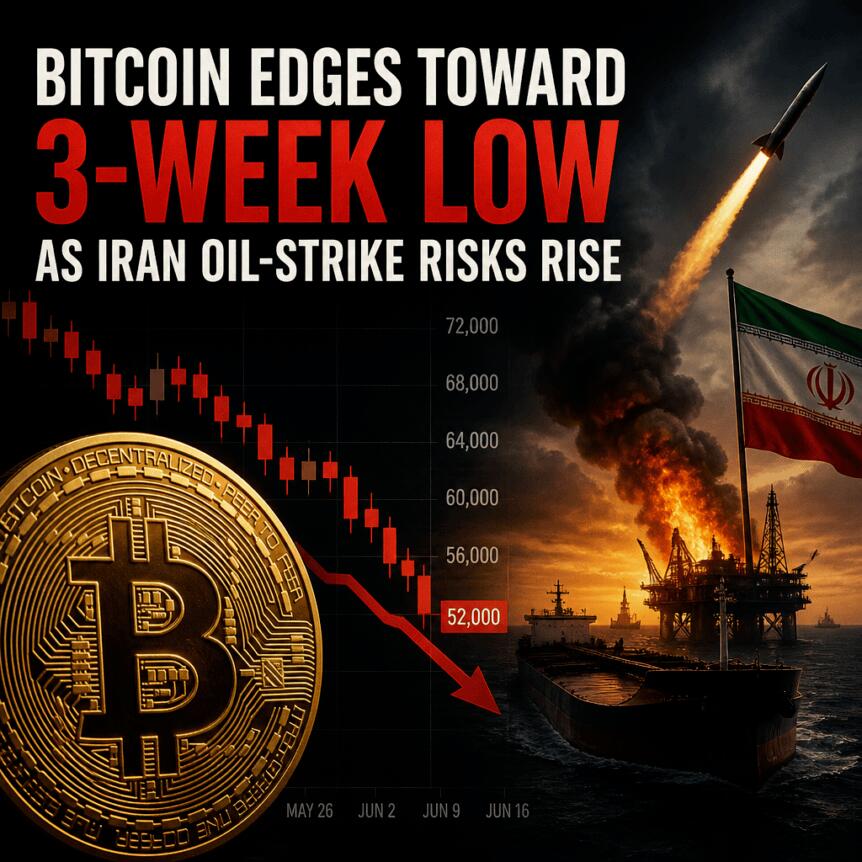
Bitcoin slid back toward the low end of its recent range on Thursday, with traders watching the $82,500 area for signs it could either hold or break. The move coincided with a broader risk-off backdrop driven by rising oil prices and renewed pressure on long-term US interest rates.
According to TradingView data cited by the market coverage, BTC/USD fell to around $81,000 on Bitstamp—its lowest level since Sept. 21. That drop put extra focus on whether Bitcoin can defend a key support zone near $82,500 as macro conditions become less forgiving.
Key takeaways
- BTC/USD revisited about $81,000 on Bitstamp, the lowest since Sept. 21, as support near $82,500 came under renewed scrutiny.
- Reports of potential US military action around Iran helped push oil higher, with WTI and Brent rising to multi-day highs.
- US 30-year yields marked a new 24-year high before easing, reinforcing concerns about higher-for-longer rates.
- Fed-related expectations shifted further toward a December 0.25% hike, according to CME Group’s FedWatch Tool.
- Cross-crypto long liquidations accelerated as Bitcoin dipped, with CoinGlass showing roughly $430 million at the time of writing.
Oil and geopolitical risk tighten financial conditions
The latest leg lower in Bitcoin’s price action followed a noticeable uptick in energy markets. NBC News reported, citing a Pentagon official and another source familiar with the matter, that the US could be preparing for additional military strikes on Iran.
The market response was visible in crude oil benchmarks. WTI climbed to $93.20 per barrel, its highest since Oct. 2, while Brent reached $105.88, according to the figures referenced in the coverage. Even without a confirmed escalation, the prospect of renewed strikes can influence inflation expectations and risk sentiment—two factors that often spill into crypto during periods when rates are also moving against traders.
At the same time, the article noted commentary from US President Donald Trump at a rally in San Antonio, where he said Middle East envoy Steve Witkoff was making progress on peace efforts with Iran, while implying he did not personally prioritize diplomacy. The reporting also referenced an Independent quote in which Trump suggested an end to the conflict could come “very soon.”
Long-end yields and Fed expectations weigh on BTC
While oil offered the immediate catalyst for markets, the bigger potential headwind for risk assets came from US rates. The US 30-year bond yield set a new 24-year high of 5.73% before easing to around 5.65% as traders weighed the implications of geopolitical risk for fuel prices and inflation.
The coverage also tied the rate pressure to remarks from Federal Reserve governor Christopher Waller. In a speech at a Central Bank of Turkey forum in Istanbul, Waller said that if economic data continues to come in as expected, the Fed may still need additional interest-rate hikes to bring inflation back to the 2% goal. He also emphasized that the timing of hikes does not need to follow consecutive meetings, but should occur within an acceptable period of time.
Market pricing reflected those hawkish interpretations. CME Group’s FedWatch Tool, cited in the article, showed rising odds for a 0.25% hike at the Fed’s December meeting; the probability surpassed 70% by Thursday. Expectations for the October meeting continued to favor holding rates in the current 3.75%–4% range.
For crypto traders, the interaction between crude-driven inflation fears and long-end yield volatility matters because it can quickly change the discount rate applied to speculative assets. In periods when yields jump, liquidity often becomes more selective, and charts tend to react faster—especially for assets like Bitcoin that regularly trade as a macro-sensitive instrument.
Technical pressure: $82,500 becomes the battleground
As the macro backdrop worsened, Bitcoin’s chart moved from “range behavior” into a more conditional phase. The coverage pointed to $82,500 as a decisive support level—an area traders were waiting to either reclaim or lose.
The article also referenced earlier reporting that explained why this region may be important within Bitcoin’s rebound from multiyear lows near $57,000, drawing parallels to the end of the 2022 bear market. While those comparisons are not a guarantee, they shape how market participants frame technical levels during transitions between broader market phases.
In updated analysis posted on X, trader and analyst Rekt Capital wrote that Bitcoin is in a “transitional phase,” and that around $82,500 is the deciding price point for how the next market structure forms. That kind of commentary typically matters in markets because technical levels can become self-reinforcing: once enough participants watch the same zone, order flow can cluster around it.
As BTC moved below $82,000, the breakdown also helped trigger forced selling. According to CoinGlass liquidation data cited in the article, cross-crypto long liquidations were around $430 million at the time of writing. These liquidation events can amplify short-term downside by removing leveraged bids and turning volatility into a feedback loop.
What to watch next
With BTC trading close to the $82,500 hinge and macro drivers still in play—oil sensitivity to geopolitical headlines and Fed expectations reflected in long-dated yields—traders will likely watch for confirmation: either a sustained hold and recovery back above the level, or further weakness that forces the market to redefine its next support area. The key question is whether the current pressure is a brief shock, or the start of a more durable shift in risk pricing.
https://www.cryptobreaking.com/bitcoin-edges-toward-3-week/?utm_source=blogger%20&utm_medium=social_auto&utm_campaign=Bitcoin%20Edges%20Toward%203-Week%20Low%20as%20Iran%20Oil-Strike%20Risks%20Rise%20
Comments
Post a Comment