
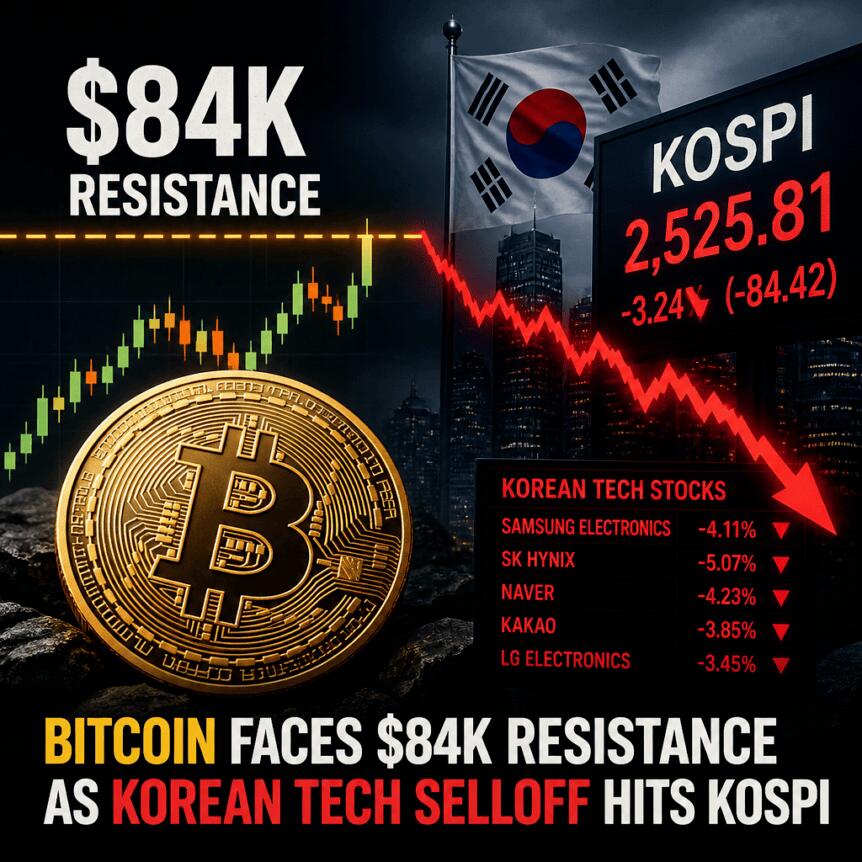
Bitcoin rebounded toward the mid-$80,000s on Tuesday after South Korea’s stock market sold off again, highlighting how BTC is currently reacting to broader risk sentiment rather than moving in lockstep with regional equities.
According to TradingView data cited in the report, BTC/USD gained more than 2.5% to around $83,944 on Bitstamp, recovering from a low near $81,000. However, the upside appeared capped near $84,000 as traders pointed to a visible layer of resistance in exchange order books.
Key takeaways
- Bitcoin rose toward $84,000 while South Korea’s KOSPI Composite Index extended weekly losses and slipped below its 200-day moving average for the first time since late July.
- Semiconductor stocks led the sell-off in South Korea, with pressure on SK Hynix and Samsung after weaker-than-expected Q3 results.
- Foreign selling dominated KOSPI activity, with reported outflows of about 173 trillion won since the start of 2026 concentrated largely in SK Hynix and Samsung shares.
- BTC’s recovery lacked confirmation from spot ETF flows, with US spot Bitcoin ETFs seeing net outflows of $451 million in October so far, including $69 million on Monday.
- CoinGlass data cited in the report suggests thicker ask liquidity near $84,000, helping explain why bulls struggled to press higher on lower timeframes.
South Korea’s market break points again
The immediate driver for Tuesday’s cross-asset divergence was a renewed tech-led sell-off in South Korea. The KOSPI Composite Index extended its losses for the week to 7.4%, and—according to TradingView charts referenced in the report—fell below its 200-day moving average for the first time since late July.
Semiconductor names were singled out as the weakest area. SK Hynix closed more than 10% lower, while the weakness also compounded longer-running pressure on Samsung after it reported Q3 earnings that came in below expectations a week earlier.
The equity stress was further intensified by foreign investor behavior. The report cites that foreign investors sold roughly 173 trillion won (about $129 billion) worth of SK Hynix and Samsung shares since the start of 2026, representing the bulk of year-to-date KOSPI selling.
AI optimism meets competition fears
The selling in Korean tech has echoes of an earlier shock period. The report draws a parallel to August, when concerns tied to the AI boom—and associated corporate debt obligations—triggered a sharp sell-off that spread beyond local markets.
In Tuesday’s move, the narrative from CNBC—reported in the same source material—was that investors are increasingly “jittery,” particularly as traders look for reasons to take profits on stocks that have already outperformed this year, with memory shares named as a key example. UBP senior equity advisor Vey-Sern Ling also highlighted that competition from China is becoming more difficult for Korean investors to navigate, even while noting that the Chinese sector still faces “technology hurdles.”
For crypto traders, the takeaway is less about the fundamentals of semiconductors and more about what this kind of equity pressure signals: risk appetite can shift quickly when high-expectation themes start to look vulnerable, and BTC has recently been trading like a macro-sensitive asset during these periods.
Bitcoin steadies, but ETF demand cools
Against that backdrop, Bitcoin managed to avoid a “copycat move” lower and pushed back toward the upper end of its local trading band between $80,000 and $87,000, as described in the report.
One explanation offered earlier in the coverage—referenced in the input material—was that expectations of potential monetary policy easing could support BTC if global financial conditions loosen. The timing is particularly relevant this week: the report points to US inflation data and the Federal Reserve’s October 28 rate decision, noting that markets were pricing rates to remain at their current level range of 2.75% to 4%.
Still, Bitcoin’s recovery is meeting headwinds from investor positioning. The report cites data showing declining appetite for BTC exposure in October through US spot Bitcoin exchange-traded funds, with net outflows totaling $451 million so far in the month, including $69 million on Monday.
This matters because ETF flows often act as a barometer for sustained demand from traditional investors. When spot ETFs are bleeding out while price attempts to recover, rallies can become more reliant on short-term trading dynamics rather than consistent buy pressure.
$84,000 resistance shows up in order books
Even with the rebound, traders in the report said bulls struggled to hold above $84,000 on lower timeframes. CoinGlass data referenced in the article pointed to a thickening band of ask liquidity on exchange order books near that level—an indicator that sellers were prepared to defend the area.
In practical terms, this kind of liquidity “wall” can slow upward momentum: buyers may still be able to push prices up briefly, but repeated failures near resistance can lead to choppy trading or pullbacks until the order book imbalance clears.
The contrast between price stabilization and thinning demand is the tension currently shaping BTC’s near-term action. Bitcoin is recovering during equity weakness, but with spot ETF outflows continuing and resistance showing up around $84,000, the market doesn’t yet have all the ingredients for a clean breakout.
Traders should watch whether BTC can reclaim and hold above the $84,000 zone as US economic catalysts approach, and whether spot ETF outflows ease—because either a shift in ETF flow or a sustained order-book change near resistance would meaningfully alter the odds of the rally extending.
https://www.cryptobreaking.com/bitcoin-faces-84k-resistance-as/?utm_source=blogger%20&utm_medium=social_auto&utm_campaign=Bitcoin%20Faces%20$84K%20Resistance%20as%20Korean%20Tech%20Selloff%20Hits%20KOSPI%20
Comments
Post a Comment