
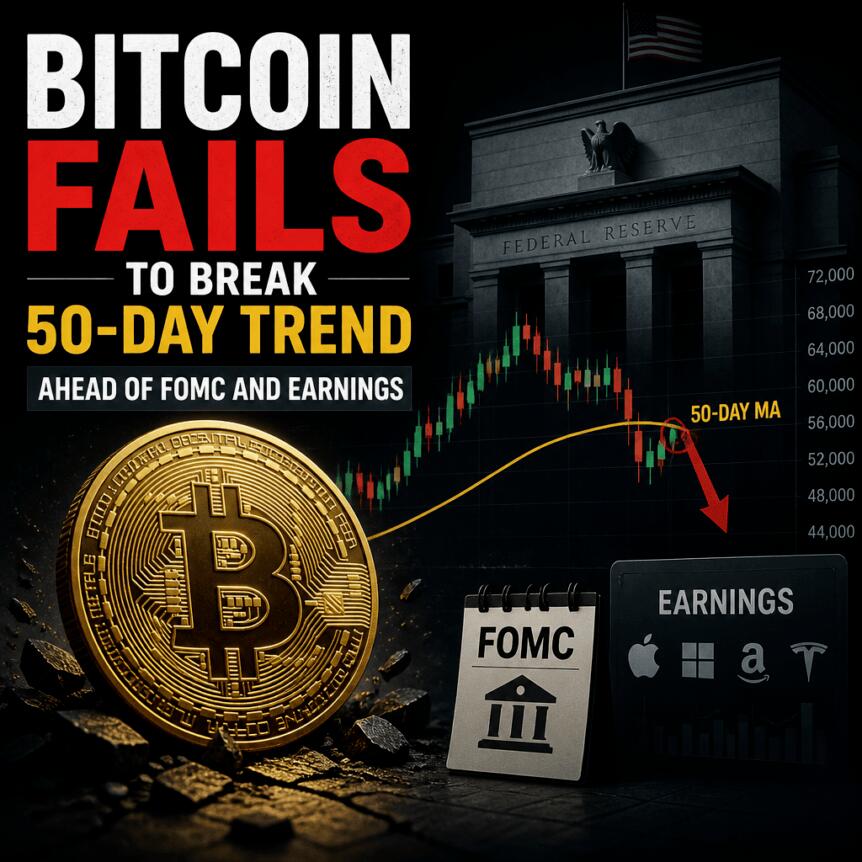
Bitcoin slid modestly Wednesday as traders paused for the U.S. Federal Reserve’s interest-rate decision and Fed chair Kevin Warsh’s follow-up remarks. The pullback came after BTC initially pushed higher, but momentum failed to hold as U.S. markets largely treaded water into the FOMC.
At the time of writing, BTC was down about 0.3% on the day. Data from TradingView showed BTC/USD struggling to stay above roughly $81,700, then reversing lower to as far as $80,297 on Bitstamp—underscoring how much near-term direction is still tied to macro expectations.
Key takeaways
- Bitcoin gave back early gains, slipping around 0.3% as BTC/USD failed to sustain a move above about $81,700.
- Traders are positioning around the FOMC outcome; CME Group’s FedWatch Tool showed a 90.6% probability of a pause at Wednesday’s meeting.
- The 50-day simple moving average near $81,831 is acting as local resistance on intraday charts.
- Order-book liquidity appears thinner below $80,000, potentially shifting where buyers could step in if downside accelerates.
FOMC focus keeps risk appetite on hold
U.S. stock index futures opened roughly flat as investors waited for the FOMC statement and Warsh’s press conference. According to CME Group’s FedWatch Tool, the market leaned strongly toward a hold in the Fed’s current 3.75%–4% target range, with a 90.6% odds of no change for Wednesday’s meeting.
Looking ahead, the same tool implied uncertainty on the December timeline: the probability for a 0.25% rate hike remained the next key pricing point. In other words, while the near-term “pause” was widely expected, Warsh’s language could still influence how traders interpret the path of rates into year-end.
Keith Alan, cofounder of crypto trading platform Material Indicators, suggested that markets may have underweighted how the Federal Reserve’s messaging could interact with the results of the U.S. midterm elections held on Nov. 3. “Markets may have priced in no rate change, but they haven’t priced in the election outcome,” Alan summarized in a post shared on X earlier in the week.
His point matters for crypto traders because bitcoin’s short-term trading behavior often reflects broader capital-market expectations. If Fed communication leads investors to reprice growth or inflation concerns, that can quickly spill into liquidity conditions across risk assets—including BTC.
Stocks fail to follow global optimism
Earlier in the session, South Korea’s KOSPI posted a strong gain—up 6.6%—its best daily performance since July. However, the Nasdaq Composite did not mirror that strength into the U.S. open. The divergence highlights that markets were not fully “risk-on” heading into the FOMC, despite improvement in at least one major Asia-Pacific index.
In a separate read-through on market implications, data analyst Charl van Zyl argued that the Fed’s decision and the week’s key tech earnings could meaningfully affect sentiment around the AI sector. Van Zyl also noted the Nasdaq remains far below its June record, emphasizing how much distance still exists between current levels and prior highs.
For bitcoin, that backdrop is relevant because tech-led sentiment can influence overall demand for liquid, high-beta assets. When equities are cautious into macro catalysts, BTC’s ability to sustain rallies frequently depends on whether investors treat bitcoin as a hedge—or as part of the same risk complex.
BTC’s technical ceiling holds near the 50-day moving average
On the trading side, bitcoin’s rebound ran into a clearly defined technical barrier. The 50-day simple moving average (SMA) around $81,831 appeared to cap upside on shorter time frames after early momentum faded. Alan said that if price action fails to reclaim levels decisively, the odds of revisiting that resistance diminish.
He specifically referenced intraday conditions, noting that “a 4H close below $80,565 reduces the probability of retesting resistance at the 50-Day SMA.” That matters because local support breaks often alter trader positioning quickly—especially when there’s a nearby moving-average level that acts as a reference point for both momentum and mean-reversion strategies.
Until BTC can hold above the 50-day SMA, this zone is likely to remain a decision area: buyers may defend attempts to push through, while sellers can use failure near the SMA to press for another leg down if broader market liquidity loosens.
Order-book liquidity suggests a lower “pivot” for dip buyers
Beyond price levels, liquidity conditions also appeared to shift. Glassnode, in its weekly newsletter The Week Onchain, flagged that bid liquidity moved further below $80,000, implying that the reversal area could shift lower if sell pressure increases.
Glassnode wrote that “Only $3.4M in bids remains at $80K,” adding that bids were moving down into the $78,000–$79,000 band, where orders totaled roughly $42M—up from about $24M in mid-October. The analytics firm highlighted that the larger block of bids near that lower range is the most likely first place where buyers could step in during a dip.
“That is the largest block of bids near price, and the first place where we would expect buyers to step in on a dip,” Glassnode said in the newsletter.
For traders, this is a practical detail: even if $80,000 holds as a psychological level, the depth behind it may not be sufficient to prevent a quick move lower. If macro volatility rises around the FOMC, thinner liquidity below key thresholds can accelerate moves—making the location of the next meaningful liquidity pocket increasingly important.
With Wednesday’s Fed communication now the dominant variable, the key for bitcoin will be whether Warsh’s message keeps rate expectations stable—or forces a repricing that changes risk appetite. Traders should watch how BTC responds to the post-FOMC narrative, particularly whether it can regain and hold above the 50-day SMA near $81,831 and whether liquidity indeed concentrates in the $78,000–$79,000 area if dips deepen.
https://www.cryptobreaking.com/bitcoin-fails-to-break-50/?utm_source=blogger%20&utm_medium=social_auto&utm_campaign=Bitcoin%20Fails%20to%20Break%2050-Day%20Trend%20Ahead%20of%20FOMC%20and%20Earnings%20
Comments
Post a Comment