
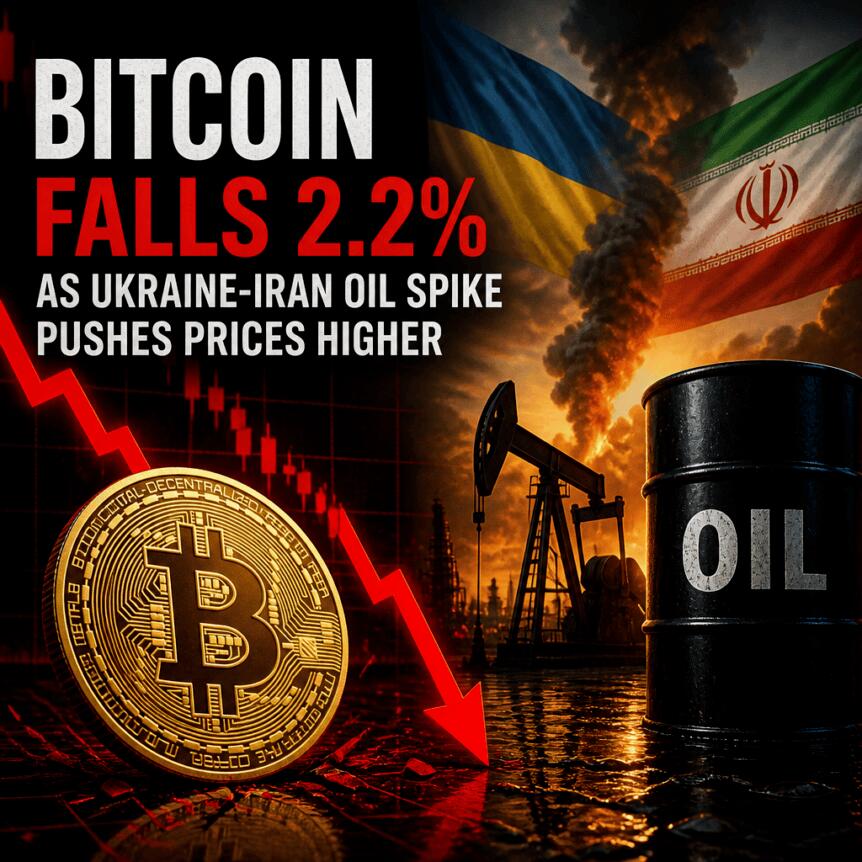
Bitcoin slipped back from an early-week high as geopolitical tensions around energy supply resurfaced and traders braced for a pair of major US inflation releases. After trading as high as $84,254 on Bitstamp—its strongest level since Wednesday—BTC/USD gave back as much as 2.2% into the start of the New York session.
The pressure was tied to renewed concerns over oil markets and the risk that disruptions linked to the Russia-Ukraine war could spill into energy infrastructure, just as traders are watching US CPI and PPI for fresh direction.
Key takeaways
- BTC hit about $84,250 before retreating up to 2.2% during Monday’s Wall Street open.
- Oil benchmarks rose sharply, with Brent climbing above $107 for the first time since Sept. 16.
- Analysts highlighted that oil may have priced in a “too large” risk premium, even as volumes remain impaired around the Strait of Hormuz.
- Bitcoin options activity looked mixed: traders leaned “defensively,” but structure suggested an upside breakout remained plausible.
- Order book and liquidation data pointed to nearby support around the low-$82,000 area, with resistance developing in the mid-$80,000s.
Oil’s rebound feeds into BTC risk concerns
The selloff came alongside growing doubts surrounding a Russia-Ukraine “energy ceasefire.” Ukrainian President Volodymyr Zelenskyy accused Russia of continuing to target energy infrastructure, even after US President Donald Trump announced a moratorium on such strikes.
Meanwhile, Iran reported that an oil tanker was hit and was ablaze in the Strait of Hormuz, adding another layer of uncertainty to already fragile shipping assumptions.
Oil prices responded immediately. WTI crude spiked above $94 per barrel, while Brent crude reached $107.25—its highest level since Sept. 16—according to TradingView data cited by the market report.
These moves matter for crypto because oil can quickly translate into broader expectations for inflation and interest rates. With traders focused on US Consumer Price Index (CPI) and Producer Price Index (PPI) scheduled for Wednesday and Thursday, the market’s sensitivity to energy prices has been a recurring theme. Cointelegraph earlier noted that CPI has proven particularly responsive to rising oil prices, which is why the latest oil strength could amplify near-term volatility in BTC as well.
“Risk premium” debate in the oil market
Not all commentary suggested oil gains were purely a sign of worsening fundamentals. Robin Brooks—former chief FX strategist at Goldman Sachs—argued that oil markets have priced in “too much risk premium,” even as some shipping flow improvements have emerged.
In a blog post shared through his Substack, Brooks pointed to improving transit volumes out of the Persian Gulf. He cited roughly 13 million barrels per day compared with a recent peak of 16.5 million barrels per day “a few weeks ago.” He also emphasized that while this is still an improvement versus the height of the war in March and April, oil prices have already returned toward prior highs.
For Bitcoin traders, this creates a key tension. If oil’s rise is partly an overreaction, the market may later unwind those expectations. But if CPI and PPI respond more strongly than anticipated—whether because of oil pass-through or other components—crypto could see its downside risks re-priced quickly.
Options show defensive positioning, but upside remains possible
Beyond spot prices, derivatives positioning suggested traders were cautious without becoming fully bearish. QCP Capital reported “duality” in Bitcoin options markets: implied volatility held firm even as spot moved back into a range, while risk reversals indicated a less pronounced premium for puts than is typical in more aggressively defensive setups.
QCP’s read of the data was that the overall structure looked less defensively positioned than usual, even though the market still appeared to price a potential breakout scenario.
“A clean move above $87k would bring $94k into focus.”
Other technical levels echoed this idea. Rekt Capital flagged $83,400 as a local resistance level on the day, noting it overlaps with a zone that had previously acted as a pivot between mid-August and Sept. 21—periods that corresponded with BTC/USD breaking higher.
Where liquidity may matter: $82,000 support and $84,500 asks
Order flow and liquidation mapping suggested how BTC could behave if oil-driven risk sentiment persists into the US data releases. According to CoinGlass liquidation heatmap data, ask liquidity clustered around $84,500 on exchanges, with the total near that level around $180 million at the time of reporting.
On the downside, bids were reported to be building around $82,000, while spot price was trending toward that area. That means BTC may find a natural testing ground for either renewed buying interest or deeper downside if traders decide inflation risk is skewing worse after the CPI/PPI prints.
In the immediate term, this is likely to be the market’s balancing act: oil volatility is pulling attention to inflation expectations, while derivatives positioning implies many traders are still keeping one eye on an upside extension—particularly if BTC can reclaim key resistance zones such as the mid-to-high $80,000 range.
With CPI and PPI still ahead, traders should watch whether the latest oil-driven inflation narrative translates into higher bond yield expectations and whether BTC options structures shift from cautious neutrality into a clearer directional bet—either toward protecting downside below $82,000 or toward pressing above $87,000.
https://www.cryptobreaking.com/bitcoin-falls-2-2-as/?utm_source=blogger%20&utm_medium=social_auto&utm_campaign=Bitcoin%20Falls%202.2%%20as%20Ukraine-Iran%20Oil%20Spike%20Pushes%20Prices%20Higher%20
Comments
Post a Comment