
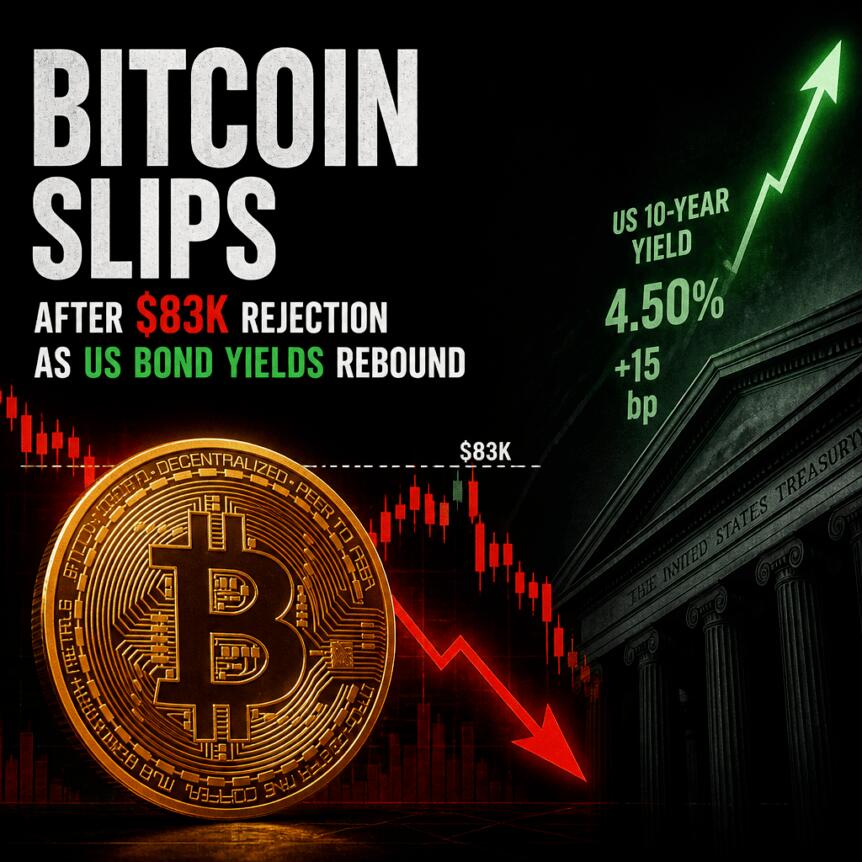
Bitcoin slipped back below $82,000 shortly after the Wall Street open as early gains faded and traders braced for fresh waves of momentum driven by US equities and bond yields. While US stocks and parts of Asia rebounded on Monday, the crypto market appeared less convinced—meeting supply on exchange order books near the low-$83,000s.
At the same time, analysts pointed to a familiar linkage: the direction of Treasury yields has been moving alongside risk assets ahead of major corporate earnings. QCP Capital warned that if the broader equity market starts unwinding again, Bitcoin could face renewed pressure around key support levels.
Key takeaways
- BTC dipped to $81,678 on Bitstamp after earlier trading around $83,062, showing hesitation despite a risk-on start for stocks.
- Order books built a noticeable ask wall above $83,000, helping cap upside in the near term.
- US bond yields rose alongside equities, with the 10-year yield cited at 5.13% ahead of several major tech earnings releases.
- Crypto liquidations totaled $335 million over 24 hours, underscoring ongoing fragility in leverage during a range-bound market.
- CryptoQuant reported a fall in Binance whale activity, with the whale ratio dropping to 0.45 from 0.54 at the start of October.
Stocks and Treasuries set the tone for Bitcoin’s range
TradingView data cited in the report showed BTC/USD falling to $81,678 on Bitstamp, after reaching $83,062 earlier in the day. The move came as the market digested a broader rebound in equities across Asia and the United States.
In the region, South Korea’s tech-heavy KOSPI Composite Index finished higher, up 1.76% at 5,768 points, while the Nasdaq Composite Index rose about 1.5% in the early US session. The correlation reflected a recurring theme seen in recent weeks: when equities regain momentum, Treasury yields tend to follow in step—pulling attention back to rates as a key driver of risk appetite.
According to the report, the US 10-year and 30-year yields reached 5.13% and 5.46%, respectively, as investors looked ahead to a cluster of corporate earnings. The timing matters because earnings can influence both stock valuations and expectations for economic growth—often translating into changes in yield levels and, by extension, liquidity conditions for risk assets like crypto.
QCP Capital framed the issue around the stability of the bond market. In its market commentary, the firm argued that a sustained Treasury rally could support risk assets, particularly if real yields decline and the US dollar weakens. Conversely, it warned that equity deleveraging could spill into cryptocurrency markets and test the $80,000 support area if the pressure persists.
“Broader equity deleveraging dynamics could transmit to cryptocurrency markets and potentially threaten the $80,000 support level if sustained. Conversely, a sustained Treasury rally could provide support for risk assets, particularly if accompanied by declining real yields and a weaker US dollar,” QCP Capital wrote in its analysis (as cited in the report).
Why $83,000 remains a decision point
Even with stocks rebounding, Bitcoin’s price action stalled after early gains. On lower time frames, the report highlighted growing friction once ask liquidity thickened above $83,000 on exchange order books.
In practical terms, this means buyers struggled to clear a zone where sell-side orders were concentrated. When that happens, BTC often oscillates—testing support and retracing—until either liquidity thins out or buyers regain enough strength to absorb the supply.
The report also pointed to leverage and liquidation dynamics as a contributor to the choppy conditions. CoinGlass data cited in the article showed a “wall of asks” weighing on BTC/USD, while 24-hour cross-crypto liquidations reached $335 million. For traders, that type of liquidation level typically reflects active positioning and can amplify short-term volatility when price moves force leveraged accounts to unwind.
Whale activity cools as BTC stays range-bound
On-chain signals offered another perspective on the market’s internal behavior. The report referenced CryptoQuant findings suggesting that large holders (“whales”) were reducing activity.
Specifically, the Binance whale ratio—measuring the share of the 10 largest inflow transactions relative to total inflows—fell to 0.45 from 0.54 at the start of October. CryptoQuant summarized that the decline indicates a smaller portion of large BTC deposit activity within total exchange inflows, which it said may reflect shifts in whale trading strategies and asset management behavior.
“The decline in the Whale Ratio indicates that the proportion of large BTC deposit transactions relative to total exchange inflows is decreasing, potentially reflecting shifts in whales’ trading strategies and asset management activities,” CryptoQuant summarized in its Binance whale activity analysis (as cited in the report).
For investors watching market structure, this matters because whale participation can affect how quickly supply builds near key levels and how confident large holders are in deploying capital. A decrease in whale inflow dominance doesn’t automatically signal bearish intent, but it can coincide with markets that lack strong directional conviction—supporting a broader “wait and see” posture while macro drivers remain in control.
Earnings week risk: what to monitor next
With major corporate earnings expected to be released on Tuesday and Wednesday—including companies mentioned in the report such as Meta, SpaceX, and Tesla—traders may see renewed volatility in both equities and Treasury yields. If bond yields and risk sentiment move favorably, Bitcoin could find renewed support; if equity deleveraging returns, the report’s cited $80,000 level is likely to stay on traders’ radar.
For now, the key issue is interaction: BTC is trading amid a supply zone above $83,000 while macro rates and liquidation flows continue to influence short-term direction. Readers should watch whether the bond market stabilizes and whether exchange order book pressure near $83,000 eases as the earnings calendar unfolds.
https://www.cryptobreaking.com/bitcoin-slips-after-83k-rejection/?utm_source=blogger%20&utm_medium=social_auto&utm_campaign=Bitcoin%20slips%20after%20$83K%20rejection%20as%20US%20bond%20yields%20rebound%20
Comments
Post a Comment