
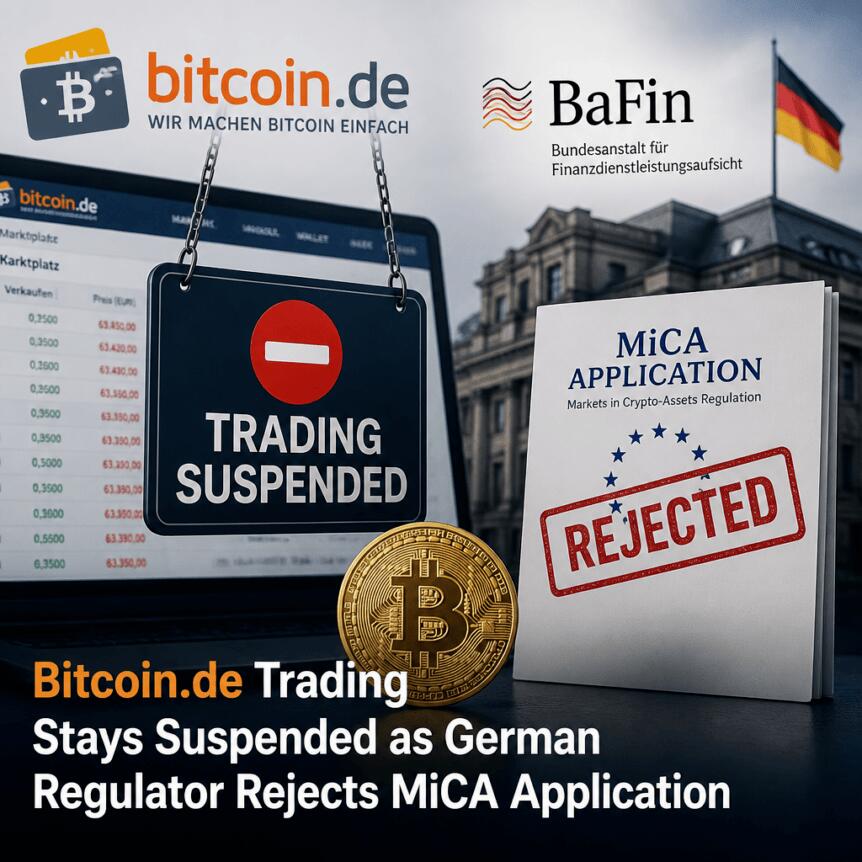
Bitcoin Group SE says it is preparing a different way of operating its bitcoin.de platform after Germany’s financial regulator, BaFin, declined authorization for its banking subsidiary futurum bank AG to act as a crypto-asset service provider under the EU’s Markets in Crypto-Assets Regulation (MiCA).
In an Oct. 6 announcement, the company described the refusal as a setback but said it had already planned for that outcome. Bitcoin Group SE stated it is now reviewing BaFin’s decision and can either file an objection or pursue a new application at a later stage. The group also said it is working to restart trading through regulated partners “as quickly as possible.”
Key takeaways
- BaFin refused futurum bank AG’s MiCA authorization application, forcing Bitcoin Group SE to rethink bitcoin.de’s operating setup.
- The group is reviewing the decision and can lodge an objection or submit a future new application.
- Trading on bitcoin.de has largely been suspended since June 12, after the platform moved customers’ holdings to new custody infrastructure.
- Bitcoin Group SE is aiming to resume trading via regulated partners while it implements an alternative operating model.
- bitcoin.de has over 1.1 million registered users, according to the company, and the platform is slated to shift toward a brokerage model.
Why BaFin’s MiCA refusal changes the plan
Under MiCA, entities providing crypto-asset services in the EU generally need authorization from their relevant national regulators. According to Bitcoin Group SE, BaFin’s refusal impacts its ability to continue bitcoin.de’s forward-looking service structure as planned under the MiCA framework.
bitcoin.de is operated by futurum bank AG, a subsidiary of Bitcoin Group SE. The platform has more than 1.1 million registered users, the company said. While the platform originally functioned as a peer-to-peer marketplace, it has been undergoing a transition to a brokerage-style model.
BaFin’s decision therefore affects not only a compliance timeline but also the mechanics of how trades are supposed to be executed under the new regulatory approach. The company now says its immediate priority is implementing an alternative operating model rather than relying on the rejected authorization path.
What bitcoin.de had been preparing to launch
Bitcoin Group SE said bitcoin.de was revamped during the year to operate as a brokerage, with plans to expand its offering to more than 100 cryptocurrencies. The roadmap also included crypto swaps and staking features, and the launch was expected for late June.
That scheduled rollout did not happen as anticipated. The platform delayed the move while futurum bank AG awaited MiCA authorization. As part of the transition preparation, bitcoin.de told customers in an August update that their crypto holdings had already been moved to new custody infrastructure, and that its previous trading system was switched off.
Trading paused since June as the authorization wait dragged on
The changes were followed by a broad trading halt. The company said trading activity on bitcoin.de has been largely suspended since June 12.
That timeline matters because it clarifies the operational impact of authorization risk: customers were already being shifted to new custody arrangements, while the trading engine that existed before the brokerage transition was deactivated. In other words, the platform’s downtime appears to have been tied directly to the regulatory approval process, not merely a technical upgrade.
With BaFin now rejecting the MiCA application, the question becomes what happens next for customer access and trading execution. Bitcoin Group SE indicates it is pursuing workarounds—specifically, resuming trading through regulated partners—while it builds the alternative operating model it said it is now implementing.
What investors and customers should watch next
Bitcoin Group SE’s next steps are twofold: it is reviewing the BaFin decision and has the option to object or later seek a new application; at the same time, it is attempting to restart trading through other regulated channels. That dual-track approach suggests the company is trying to balance long-run regulatory resolution with short-term customer continuity.
Still, several practical uncertainties remain. It is not yet clear how quickly a trading restart through regulated partners can be fully implemented, or how the planned brokerage capabilities—such as expanded crypto availability, swaps, and staking—will translate under the revised operating model. Readers should also watch whether the company’s appeal process changes the timeline for a fuller relaunch of the platform’s intended services.
For bitcoin.de users, the most immediate signal to monitor is whether regulated partner arrangements begin restoring active trading in a way that matches the platform’s intended brokerage structure. For the broader market, the case is another example of how MiCA authorizations can directly determine whether major retail crypto venues can continue operating under the new regime.
https://www.cryptobreaking.com/bitcoin-de-trading-stays-suspended/?utm_source=blogger%20&utm_medium=social_auto&utm_campaign=Bitcoin.de%20Trading%20Stays%20Suspended%20as%20German%20Regulator%20Rejects%20MiCA%20Application%20
Comments
Post a Comment