
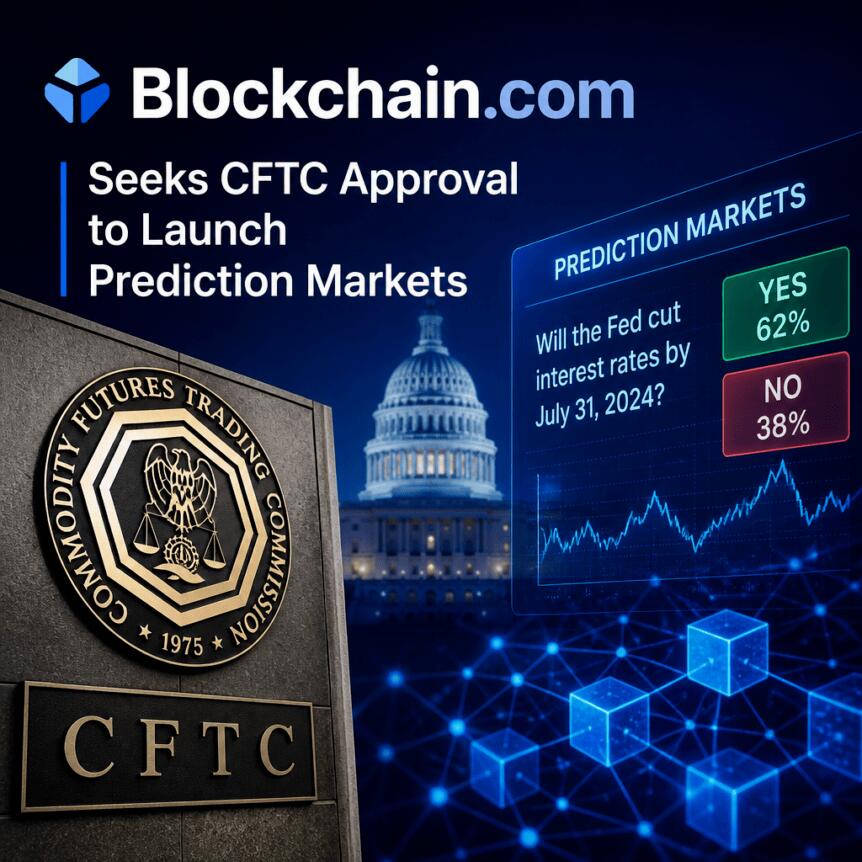
Blockchain.com has reportedly filed with the U.S. Commodity Futures Trading Commission (CFTC) seeking regulatory approval to offer prediction-market “event contracts” and certain crypto derivatives to both retail and institutional customers in the United States. According to CNBC, the company submitted applications for two distinct CFTC licenses that would position it within the agency’s derivatives framework.
If granted, the proposed licenses would allow Blockchain.com to operate as a futures exchange for event contracts and to act as a broker for crypto derivatives. The move also arrives at a moment when the legal boundaries for prediction markets—especially those touching on elections and other regulated domains—are being tested in court.
Key takeaways
- Blockchain.com has reportedly applied to the CFTC for two licenses: a designated contract market (DCM) and a futures commission merchant (FCM), enabling event contracts and derivatives brokering.
- Regulatory approval would let the platform offer its own event-contract marketplace rather than relying solely on third-party integrations.
- Prediction-market oversight remains unsettled in the U.S., with litigation involving state enforcement actions and potential questions over federal versus state authority.
- CFTC Chair Michael Selig continues to emphasize rulemaking tied to crypto safeguards, referencing the fallout from FTX.
Blockchain.com seeks CFTC licenses for event contracts and derivatives
CNBC reported that Blockchain.com filed for two CFTC licenses to support offerings that span prediction markets and crypto derivatives. In the CFTC framework described by CNBC, a designated contract market (DCM) authorization would allow the company to operate as a futures exchange specifically for event contracts. In parallel, a futures commission merchant (FCM) license would permit Blockchain.com to broker derivatives contracts.
For market participants, the practical significance is straightforward: approval would provide a regulated pathway for a platform to offer contract-based products linked to real-world events—an area where enforcement has historically varied depending on how offerings are structured and which regulators view as having primary authority.
From Polymarket integration to a potential in-house marketplace
Blockchain.com previously announced plans in July to partner with Polymarket, positioning the integration as part of a prediction-markets experience inside its app. However, the reported CFTC filing suggests the company is exploring an additional route: offering event contracts through a market it would be authorized to run directly, contingent on approval.
That potential shift matters because third-party integrations and “platform distribution” generally do not replicate the same regulatory responsibilities as operating an exchange. If Blockchain.com receives CFTC approval for the DCM and FCM roles, it could reduce reliance on external partners for core exchange functions while also bringing more control—and more oversight—into its own product stack.
Prediction markets remain a legal battleground in the U.S.
The CFTC’s approach is being watched closely, but prediction markets are also facing parallel legal pressure at the state level. The question of how prediction market platforms are regulated—particularly regarding alleged violations tied to betting on sports and elections—has been actively contested in U.S. courts.
Earlier this year, New Jersey officials reportedly filed a petition with the U.S. Supreme Court seeking review of their case against Kalshi. The reported petition aims to resolve disputes between federal and state regulators, a dynamic that has been central to the ongoing uncertainty for the sector.
That matters for companies like Blockchain.com because the regulatory environment for prediction markets may not be decided by agency action alone. Even with federal licensing on the table, court outcomes could influence how platforms design products, what categories of events they support, and which compliance models they need to satisfy regulators and courts.
CFTC leadership pushes crypto rulemaking, cites FTX
The filing comes amid continued momentum—though uneven progress—around U.S. crypto regulation through CFTC rulemaking. This week, CFTC Chair Michael Selig defended the agency’s strategy of moving forward via rulemaking rather than waiting for legislation from Congress, pointing to the lessons of the FTX collapse.
In a Wednesday Fox Business interview, Selig reportedly argued that proposed rules for companies seeking to register as licensed crypto entities would introduce “safeguards to crypto spot markets,” referencing FTX’s failure. On Friday, he also reportedly posted that the agency’s rules would prevent “theft of customer funds as we saw with FTX,” framing the rulemaking agenda around investor protection and risk controls.
Selig is described as the CFTC’s sole commissioner and chair, with four seats remaining empty. He has also said he intends to implement President Donald Trump’s crypto agenda, and he has previously claimed the CFTC has exclusive jurisdiction over prediction markets—an assertion that, in practice, sits directly alongside the ongoing state litigation over prediction-market activity.
For investors and builders, the tension is notable: even as the CFTC pursues licensing pathways, the courts and state enforcement actions continue to test the boundaries of regulatory authority. The outcome of those disputes can determine how quickly market participants can scale products that sit near the line between regulated contracts and prohibited wagering.
What Blockchain.com’s filing signals for the sector
Blockchain.com’s reported CFTC applications highlight a broader pattern in U.S. crypto: companies are increasingly attempting to align product ambitions with existing derivatives and futures oversight structures. Prediction markets—once treated as niche or informal—are being pulled into mainstream regulatory focus, particularly as platforms package event-linked instruments for large audiences.
Still, approval is not guaranteed, and even with licensing, companies may face additional constraints depending on legal outcomes and how courts interpret the division of authority between federal agencies and states. Market participants should therefore treat any “license application” as a step toward clarity, not the end of uncertainty.
Readers should watch next for whether the CFTC approves Blockchain.com’s DCM and FCM requests, and for further movement in the U.S. court system over prediction markets—especially any rulings that could clarify how federal and state regulators’ roles interact. Those decisions will likely shape what event-linked products can be offered, and by whom, across the entire sector.
https://www.cryptobreaking.com/blockchain-com-seeks-cftc-approval/?utm_source=blogger%20&utm_medium=social_auto&utm_campaign=Blockchain.com%20Seeks%20CFTC%20Approval%20to%20Launch%20Prediction%20Markets:%20CNBC%20
Comments
Post a Comment