
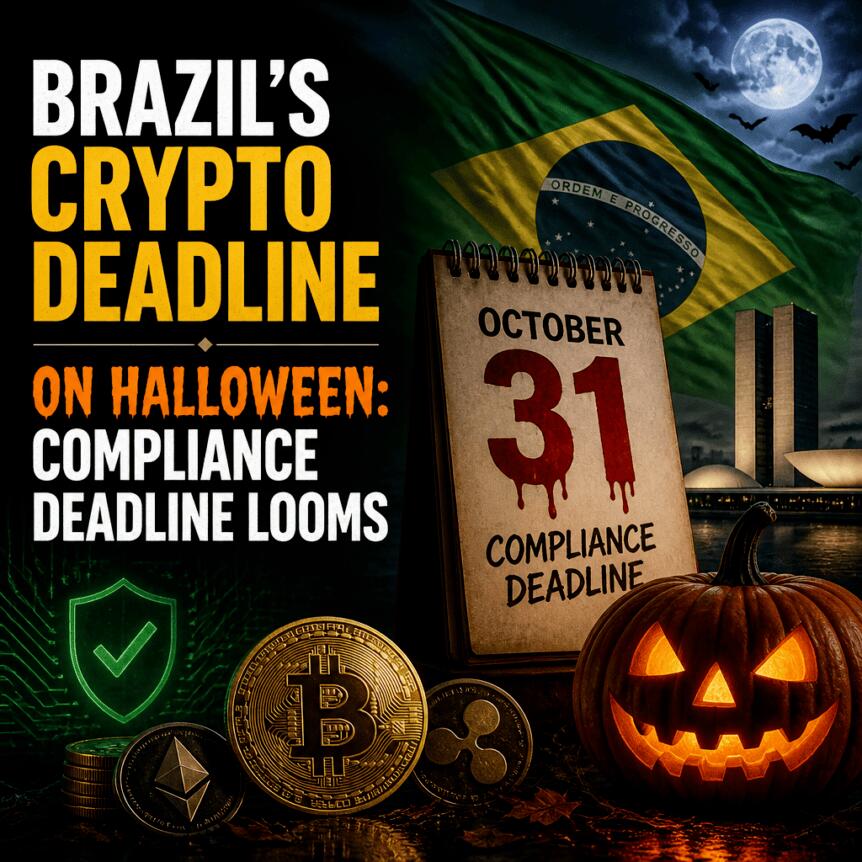
Brazil’s cryptocurrency industry is heading into a tight regulatory phase as exchange operators face a license application deadline tied to the country’s new central-bank framework for crypto services. Companies already operating in Brazil must submit for authorization by Friday in order to continue providing regulated services while the review process begins.
However, filing is only the start. Lawyers and exchange executives say the application window doesn’t resolve the harder parts of compliance—especially for smaller platforms that may struggle with capital requirements, ongoing audits, and unresolved operational questions around wallet identification and transaction reporting.
Key takeaways
- Exchanges already operating in Brazil must apply by Friday to maintain their ability to offer crypto services during the regulator review period.
- Even for timely applicants, the authorization process can take up to two years, according to Brazilian legal counsel.
- Platforms that miss the deadline must stop providing services within 30 days, and banks/payment institutions face restrictions on crypto transactions with unauthorized providers starting Nov. 6.
- Unanswered regulatory details—especially around self-custody wallet identification and key thresholds—create compliance risk for exchanges.
- Minimum capital and control obligations may be too heavy for smaller operators, potentially accelerating market concentration.
Friday’s filing deadline—what comes after
Brazil introduced its crypto regulatory framework in November 2025, setting rules for exchanges, custodians, and other virtual asset service providers under the supervision of the Banco Central do Brasil (BCB). The policy establishes authorization requirements that exchanges must meet to operate legally.
For firms already active in the market, submitting the authorization application by Friday is a condition to remain operational while regulators assess the request. Fabio Cendão, founding partner at FCM Law, told Cointelegraph that the practical challenge begins after the filing, when companies must meet high compliance burdens and prepare for recurring scrutiny.
According to Cendão, regulators can take up to two years to review approved applications. For new entrants, the rules are more stringent: platforms must secure authorization before launching regulated services in Brazil.
Those who miss Friday’s deadline face a limited runway. Marcelo de Castro Cunha Filho, a lawyer at Machado Meyer, said non-compliant providers would need to stop services within 30 days from Friday. He also noted that from Nov. 6, banks and payment institutions will face restrictions on engaging in crypto transactions with providers that are not authorized.
Regulatory gaps still hang over wallet controls
Beyond timing, some of the most important compliance requirements remain difficult to operationalize. Under Brazil’s rules, crypto service providers must verify the origin and destination of crypto transfers, including transfers involving self-custodial wallets.
The framework also sets a $100,000 limit on certain international crypto transfers when the counterparty is not authorized to operate in Brazil’s foreign exchange market. In practice, exchanges must apply these limits while complying with transfer verification obligations.
Binance Brazil general manager Thiago Sarandy told Cointelegraph that key questions remain unresolved—particularly how exchanges should identify self-custody wallets, how to interpret the $100,000 operational limit, and how to determine minimum transaction-reporting thresholds.
For Sarandy, the core issue is consistency and auditability. He said the lack of clarity could lead exchanges to report fragmented or uneven data to regulators, potentially undermining oversight capacity. “The lack of clarity creates a risky situation,” he warned, adding that inconsistent reporting could “jeopardize the oversight capacity.”
Sarandy said industry association ABCripto has submitted questions to the BCB but had not received answers at the time of reporting. The BCB did not respond to Cointelegraph’s request for comment by publication time.
Compliance costs and capital requirements may reshape the market
As larger global exchanges prepare documentation and build compliance workflows, the economics of Brazil’s regulatory standard may prove difficult for smaller operators. Cendão said minimum capital requirements can range from 10.8 million Brazilian reais (about $2 million) to 37.2 million reais (about $6.9 million), depending on what services an exchange offers.
He also pointed to additional cost drivers beyond upfront capital: technical certification, custody audits, and anti-money laundering controls. Taken together, he warned that these expenses could make compliance unviable for smaller exchanges, increasing the likelihood of market concentration as only well-capitalized platforms remain able to meet the requirements.
That shift is already visible in how different players are positioning for the new licensing environment. Cointelegraph previously reported that major global exchanges have filed license applications in Brazil, including OKX, Binance, and Coinbase. Meanwhile, Bitso is said to be ending direct retail services in Brazil through a partnership arrangement with Mercado Bitcoin.
For investors and traders, this regulatory-driven consolidation risk matters because it can affect competition, liquidity, and user choices—especially in periods when platforms may face service restrictions if authorization timelines slip or compliance measures fail.
What happens to users if a provider misses out
Another unresolved operational point concerns customer asset handling for firms that fail to secure authorization. Cunha Filho said it is unclear how exchanges that miss the deadline should return crypto to customers who either do not have accounts with authorized providers or have not agreed to transfer their assets.
The issue is not merely legal—it affects the day-to-day user experience. If compliance decisions lead to service stoppages, users will likely be looking for clear, predictable paths for withdrawing holdings and avoiding delays. Uncertainty about custody and transfer mechanics could become a key operational stress point during the post-deadline transition period.
With the compliance timeline stretching potentially up to two years for authorized applicants, companies and users will need to watch for how regulators clarify wallet identification, reporting thresholds, and operational limits, and how they expect exchanges to manage customer transfers during any enforcement actions.
Next, market participants should focus on whether the BCB issues further guidance on self-custody wallet classification, transaction-reporting thresholds, and the $100,000 operational limit—because those details will determine how exchanges design their compliance systems before the deadline’s consequences begin. Until regulators tighten the remaining ambiguities, exchanges may still face the risk of inconsistent reporting and operational missteps during the authorization review window.
https://www.cryptobreaking.com/brazils-crypto-deadline-on-halloween/?utm_source=blogger%20&utm_medium=social_auto&utm_campaign=Brazil’s%20Crypto%20Deadline%20on%20Halloween:%20Compliance%20Deadline%20Looms%20
Comments
Post a Comment