
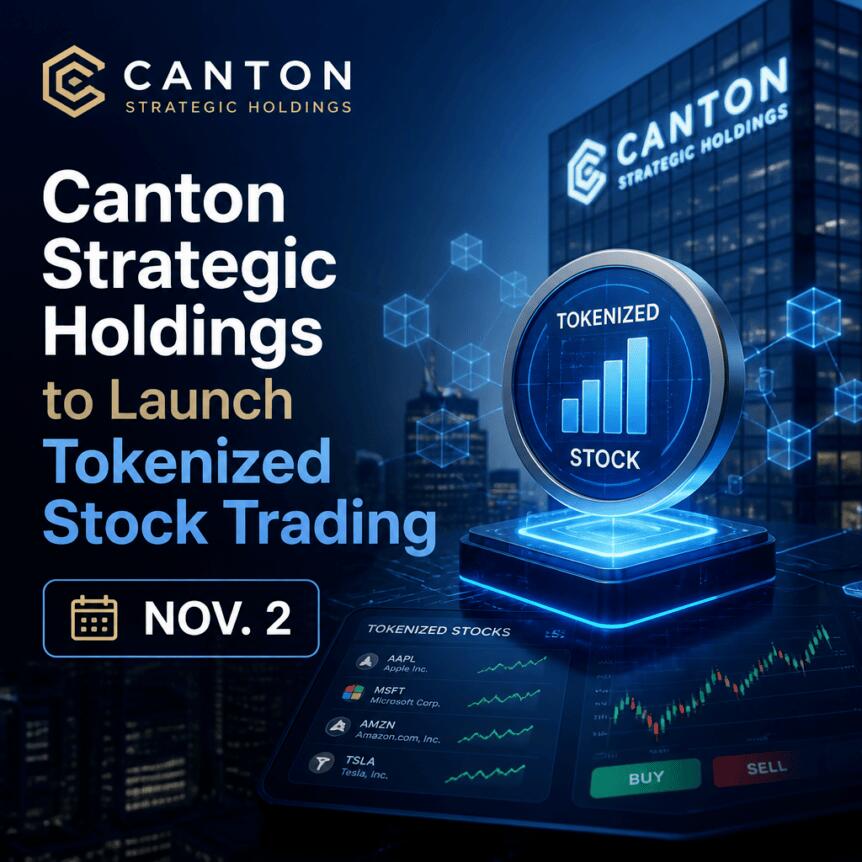
Canton Strategic Holdings, a Nasdaq-listed company previously tied to the biotech sector, says it will move its common shares onto blockchain infrastructure via the Canton Network. The company expects tokenized share trading to begin as soon as Nov. 2, using a structure designed to preserve the same rights attached to its existing Nasdaq-listed stock.
In a Thursday announcement, Canton Strategic Holdings said it is partnering with TSV LLC, described as a venue for tokenized securities trading, and Fairmint, a U.S. Securities and Exchange Commission-registered transfer agent. The plan would tokenize the company’s common shares and make them available for continuous trading through an automated market maker, with settlement occurring immediately on the Canton Network.
Key takeaways
- Tokenized trading is expected to start Nov. 2 for Canton Strategic Holdings’ common shares on the Canton Network.
- Fairmint will maintain ownership and handle transfer compliance tied to shareholder records and obligations.
- TSV LLC is set to provide the trading venue layer for tokenized securities execution.
- The company says its tokenized shares replicate Nasdaq shareholder rights for holders.
- The rollout follows the SEC’s September “innovation exemption”, which Canton and its partners say offers a regulatory pathway for tokenized U.S. stock trading on domestic platforms.
How the tokenization plan is designed to work
Canton Strategic Holdings’ announcement lays out a separation of functions intended to mirror traditional securities processes while leveraging blockchain settlement. According to the company, the tokenized shares will carry the same shareholder rights as the company’s Nasdaq-listed common stock.
Trading, meanwhile, would be available around the clock through an automated market maker. The company also states that transactions would settle immediately on the Canton Network—an operational difference from conventional settlement timelines that many market participants are accustomed to in traditional markets.
To handle the compliance and record-keeping side of share ownership, Canton said Fairmint will maintain ownership records and oversee requirements related to transfers. That element matters because tokenized securities are typically scrutinized for how beneficial ownership, transfer restrictions, and regulatory obligations are enforced—areas where transfer agents have long played a central role in the legacy system.
What Canton says the SEC exemption changes
The company’s move comes after an important regulatory development cited in the announcement: the SEC’s September innovation exemption. Canton Strategic Holdings and its partners said the exemption provides a regulatory path for trading tokenized U.S. stocks on domestic platforms.
While the announcement does not provide additional detail beyond referencing the exemption, its inclusion signals that the tokenized share trading plan is not just a technical integration—it is also framed around the current U.S. regulatory approach to innovation in securities markets. For investors and traders, that distinction can be critical: the difference between a token experiment and a tokenized securities product intended to operate within recognized compliance structures often comes down to how regulators view issuance, trading, and settlement.
Readers should watch how the company operationalizes the exemption in practice—particularly around eligibility requirements, transfer constraints, and how the system handles compliance on-chain while still relying on traditional oversight mechanisms off-chain.
Scale and market context for CNTN
According to Yahoo Finance data cited in the announcement, the Nasdaq-traded issue under the ticker CNTN currently trades an average of 757,704 shares per day. At the time of the company’s update, the stock was up more than 4.5% on the day, trading around $2.13 per share, with a market cap of approximately $170 million.
Those figures matter because tokenized share trading tends to generate the most meaningful liquidity outcomes when there is already a baseline of regular trading activity. In this case, Canton’s stated plan connects tokenized infrastructure to a stock that already sees a steady flow of transactions in traditional markets, which may make it easier for tokenized trading to find a user base—though the actual depth and pricing behavior on the blockchain venue will ultimately determine whether the benefits are primarily convenience, liquidity, or both.
The company’s emphasis on around-the-clock trading and immediate settlement suggests it is targeting frictions in standard market hours and settlement cycles. However, investors should also consider how tokenized markets coordinate with existing venues in terms of price discovery and what happens when volatility rises—especially if traders move between traditional exchanges and tokenized liquidity pools.
Corporate background and ties to the Canton ecosystem
Canton Strategic Holdings has been repositioning itself around digital assets. The company said it shifted its focus to the space in November 2025 after raising $545 million to build a business around Canton Coin. It changed its name in February and now describes itself as holding cryptocurrency, helping operate the Canton Network, and investing in projects built on the blockchain.
Despite the shared “Canton” branding, Canton Strategic Holdings says it is not the developer of the Canton Network itself. Earlier coverage cited in the announcement notes that the blockchain was developed by Digital Asset. Canton Strategic Holdings, the company added, has ties to the Canton Foundation through its investments and participation in network governance.
This distinction is relevant for readers trying to understand governance and operational control. In most tokenization narratives, the credibility of the infrastructure depends not only on whether tokenization is possible, but also on who governs the platform, who maintains the system’s security, and how the network’s participants are structured.
At the same time, the company’s Nasdaq listing and the involvement of a SEC-registered transfer agent indicate it is seeking to connect blockchain trading to established processes rather than treating the tokenized shares as a purely experimental asset.
Going forward, the most important things to monitor are whether trading volume meaningfully shifts onto the tokenized venue after Nov. 2, how compliance and ownership tracking perform through the transition, and how closely tokenized share pricing tracks the underlying Nasdaq-listed instrument under real market conditions.
https://www.cryptobreaking.com/canton-strategic-holdings-to-launch/?utm_source=blogger%20&utm_medium=social_auto&utm_campaign=Canton%20Strategic%20Holdings%20to%20Launch%20Tokenized%20Stock%20Trading%20Nov.%202%20
Comments
Post a Comment