
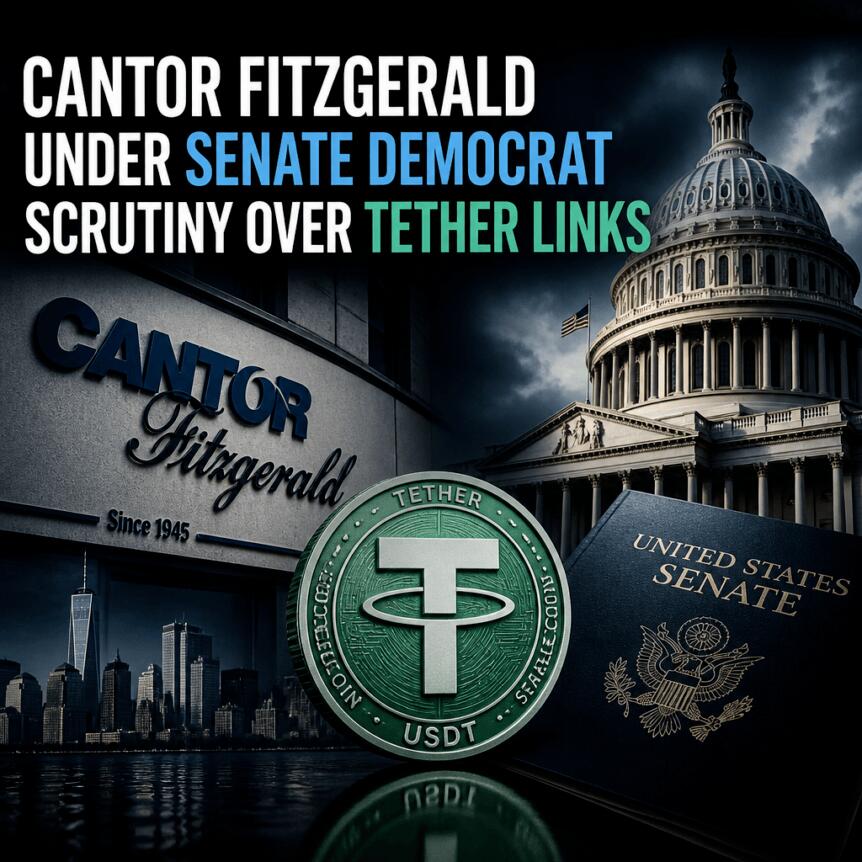
US Senator Richard Blumenthal has opened a fresh line of scrutiny into Cantor Fitzgerald’s business relationship with Tether, asking the investment bank to produce documents explaining how it oversees Tether-related compliance risks, and how much Commerce Secretary Howard Lutnick’s family may have earned through the arrangement.
In a letter sent Thursday, Blumenthal—ranking Democrat on the Senate Permanent Subcommittee on Investigations—requested records from Cantor chairman Brandon Lutnick concerning Cantor’s monitoring of Tether’s compliance with banking and sanctions laws. The senator also asked for all communications involving Howard Lutnick about Tether, including those made after Lutnick left the firm. The letter is dated Oct. 8, 2026.
Key takeaways
- Blumenthal is asking Cantor for detailed records on how it monitors Tether’s banking and sanctions compliance.
- The inquiry extends to communications involving Commerce Secretary Howard Lutnick about Tether, including after he left the firm.
- Blumenthal cites alleged large gains from Cantor’s Tether stake and points to distributions to Lutnick’s family.
- The letter follows earlier Democratic claims that Tether’s USDT has been used in support of Iran-linked financial activity.
- Cantor has been asked to respond by Oct. 23.
Senator targets compliance oversight and communications
Blumenthal’s letter frames the Cantor-Tether relationship as a national security concern, asserting that Cantor’s “lucrative business arrangements” with Tether occur alongside risks posed by illicit finance. He specifically wants Cantor to explain what compliance work is performed regarding banking rules and sanctions obligations, and how that oversight is structured in practice.
The senator’s request is also unusually focused on internal and post-employment communications. He asked for all communications involving Howard Lutnick related to Tether, “including after he left Cantor,” and sought answers about how Lutnick’s role may have shaped the relationship while he was chairman and CEO.
“Disturbingly, Cantor Fitzgerald’s lucrative business arrangements with Tether come at the expense of America’s national security,” Blumenthal wrote in the letter.
According to the article’s account, Cantor Fitzgerald acquired rights to a 5% stake in Tether in 2024. Blumenthal alleges that Cantor is positioned to benefit from Tether’s reserve management as well, including by reportedly custodying tens of billions of Tether’s US Treasury bill reserves.
The senator also claims that Cantor’s Tether exposure increased dramatically in value, alleging that an estimated value rose from $600 million to $10 billion since former President Donald Trump returned to office. Blumenthal further alleges that Howard Lutnick received more than $250 million in that period, including a $192 million distribution from Cantor Fitzgerald.
Earlier Iran-related allegations put Tether—and partners—under the microscope
Blumenthal’s renewed pressure comes after the Senate Permanent Subcommittee on Investigations released a report last month alleging that USDT has become “a key tool” within Iran’s shadow banking network.
In that earlier phase of the investigation, Blumenthal urged US Treasury and the Department of Justice to examine possible sanctions violations linked to Tether. Tether responded by stating that it works with law enforcement and has taken freezing actions. As noted in earlier coverage, Tether said it helped freeze nearly $550 million in Iran-linked USDT during the year.
Those prior claims—and Tether’s response—form the backdrop for Blumenthal’s current request for more transparency from Cantor. The senator argues that if Tether has generated substantial returns from stablecoin activity tied to illicit finance risks, then associated intermediaries also face scrutiny over how they manage compliance and risk.
Blumenthal wrote that, “Just as Tether has made untold millions in interest and investments from the stablecoins used in these illicit activities, so has Cantor Fitzgerald profited from its relationship with Tether.”
Cantor’s role began as a reserves custodian
The relationship between Cantor and Tether dates back to 2021, when Cantor began acting as a custodian for part of the US Treasury securities backing Tether’s reserves.
During that period, Howard Lutnick oversaw Cantor as chairman and CEO and, according to the account provided, helped negotiate Cantor’s investment in Tether in April 2024. Blumenthal’s letter appears to connect those executive responsibilities to questions about whether appropriate oversight and compliance controls were in place, and whether conflicts or governance gaps existed as the arrangement evolved.
Howard Lutnick stepped down from Cantor after being confirmed as commerce secretary in February 2025. Following his exit, the firm appointed his son Brandon as chairman and another son as vice chairman, a restructuring that adds weight to Blumenthal’s focus on who now leads the partnership and what records they can provide.
What Blumenthal wants Cantor to answer by Oct. 23
Beyond questions about compliance monitoring and communications, Blumenthal is seeking documentation related to Howard Lutnick’s divestiture from Cantor and details of any other loans or financing involving Tether that could have assisted the transfer of ownership to his children.
The senator also asked whether Cantor requires independent audits of Tether. He requested clarity on whether Cantor has ever reviewed the possibility of terminating the partnership. He further demanded information about steps Cantor has taken to investigate allegations of illicit finance and sanctions evasion connected to Tether.
The letter sets a deadline: Blumenthal asked Cantor to respond by Oct. 23.
Cantor Fitzgerald and Tether did not immediately respond to requests for comment at the time the report was prepared, according to the account.
Why this matters for crypto compliance and policy
For investors and compliance-focused users, the Cantor inquiry underscores a growing pressure point: regulators and lawmakers are increasingly targeting the banking, custody, and governance relationships that sit around major stablecoin ecosystems—not just the stablecoin issuer itself. What Cantor produces next, and how it describes its monitoring and audit practices, will likely determine how much further this scrutiny expands.
https://www.cryptobreaking.com/cantor-fitzgerald-under-senate-democrat/?utm_source=blogger%20&utm_medium=social_auto&utm_campaign=Cantor%20Fitzgerald%20Under%20Senate%20Democrat%20Scrutiny%20Over%20Tether%20Links%20
Comments
Post a Comment