
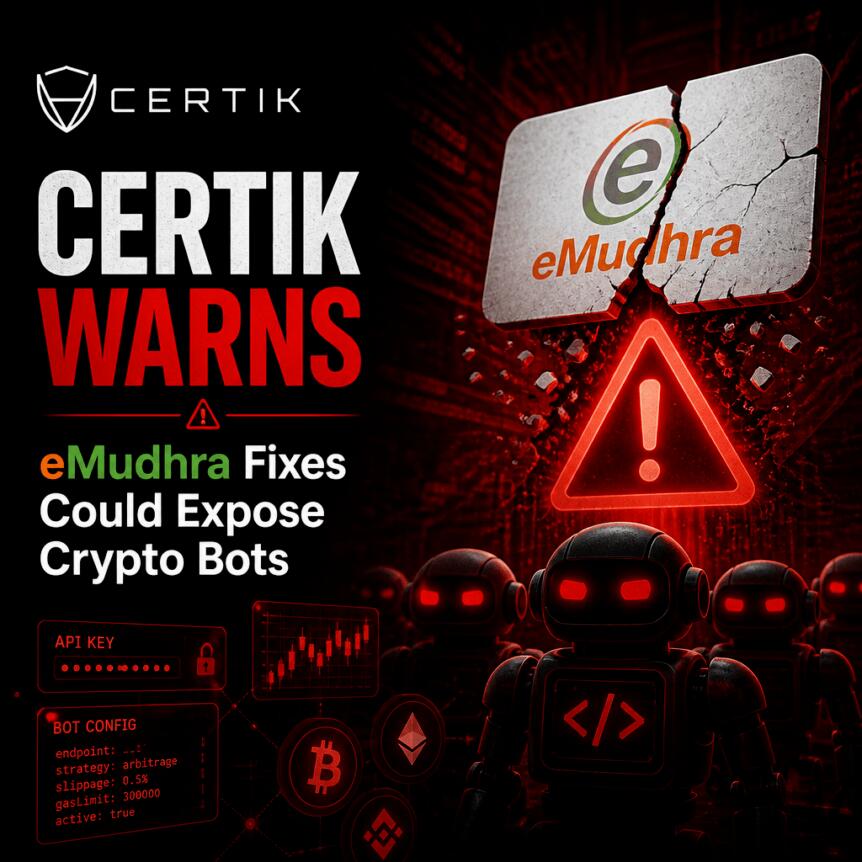
Emergency actions by major browser makers have reduced risk from a certificate security flaw tied to India’s eMudhra, but blockchain security firm CertiK warns that cryptocurrency trading bots and exchange-linked applications may still be exposed. By Tuesday, Google, Apple and Microsoft had blocked eight vulnerable eMudhra certificates, according to Cointelegraph’s reporting.
CertiK senior director of digital assets security Peiyu Wang said the browser-level updates don’t automatically cover every environment where crypto services operate—particularly applications that rely on separate certificate handling or don’t benefit from the same revocation protections enforced in modern browsers.
Key takeaways
- Google, Apple and Microsoft have blocked eight vulnerable eMudhra certificates, lowering exposure for typical browser users.
- CertiK says some crypto applications outside the browser ecosystem may not enforce Certificate Transparency and may not receive the same revocation protections.
- Compromised certificates could be used to impersonate crypto websites and interfaces, potentially facilitating phishing and transaction-manipulation attempts.
- Wang says the flaw would not directly leak wallet private keys from the certificate compromise alone, but attackers could still reroute users’ traffic.
- Crypto operators should update software and certificate trust stores and confirm their applications reject affected certificates.
Why blocked certificates aren’t the whole story
According to CertiK, browser manufacturers substantially reduce risk when they block vulnerable certificates and enforce related controls. Wang told Cointelegraph that “Major browser blocks substantially reduce the risk for clients that receive and enforce them.” In other words, for users accessing crypto through standard web browsers, the “front door” for these HTTPS connections is harder to exploit once blocks propagate.
However, Wang added that some software stacks don’t live inside browsers, meaning they may not enforce Certificate Transparency or receive equivalent revocation protections. That creates an important mismatch for parts of the crypto industry: trading infrastructure and service integrations often use custom TLS verification, backend HTTP clients, or specialized network components that may not automatically inherit the protections applied by mainstream browsers.
“Some applications outside the browser ecosystem do not enforce Certificate Transparency or receive the same revocation protections,” Wang said.
How attackers could target exchanges, wallets, and bots
CertiK’s concern is not that crypto is inherently more vulnerable than other sectors, but that the consequences of impersonation can be severe when attackers successfully place themselves between users and trusted endpoints.
Wang noted that attackers could exploit compromised certificates to impersonate the HTTPS connections used by cryptocurrency exchanges, wallet interfaces, and APIs. In practical terms, an attacker could potentially present a forged—but certificate-authority-backed—connection that a target application accepts, depending on how strictly it validates certificates and how its trust store is managed.
CertiK highlighted a particularly harmful scenario: replacing deposit addresses. If a malicious endpoint successfully impersonates an exchange’s payment flow, a user could be directed to transfer funds to an attacker-controlled address. Separately, attackers might trick users into approving malicious transactions through an impersonated interface.
Importantly, Wang said these attacks would also require intercepting or redirecting users’ internet traffic. The certificate authority keys themselves would not automatically expose wallet private keys by themselves.
What crypto operators should do now
Given that not all crypto software benefits directly from browser certificate blocks, CertiK urged operators to take concrete steps in their own environments.
Wang recommended that crypto services update their software and certificate trust stores. Operators should also verify that their applications reject the affected certificates—an additional control beyond relying on external ecosystem protections.
For teams running automated systems such as trading bots, it’s especially important to ensure that any TLS libraries, container images, and certificate bundles are refreshed so that old trust settings are not silently reused. The risk isn’t limited to customer-facing web pages; backend services and API clients can also be impacted if they validate TLS in a way that differs from browsers.
Wang’s guidance also implies a need for validation testing: teams should confirm that their clients fail gracefully when presented with certificates corresponding to the blocked or vulnerable chain, rather than accepting them because of stale trust stores.
What remains uncertain, and what to watch next
While the browser blocks announced by Cointelegraph’s reporting are a meaningful reduction in exposure, CertiK’s warning points to a more fragmented reality: crypto security depends on multiple layers—certificate trust, revocation handling, and application validation logic. Browser protections are strongest where users interact directly through mainstream browsers and where applications enforce the same certificate transparency and revocation assumptions.
Readers and operators should watch for additional certificate blocks and updates in the broader certificate ecosystems that affect non-browser environments, as well as for guidance on certificate trust-store refresh timelines for common TLS stacks used by exchanges, custodial services, and trading infrastructure.
https://www.cryptobreaking.com/certik-warns-emudhra-fixes-could/?utm_source=blogger%20&utm_medium=social_auto&utm_campaign=CertiK%20Warns%20eMudhra%20Fixes%20Could%20Expose%20Crypto%20Bots%20
Comments
Post a Comment