
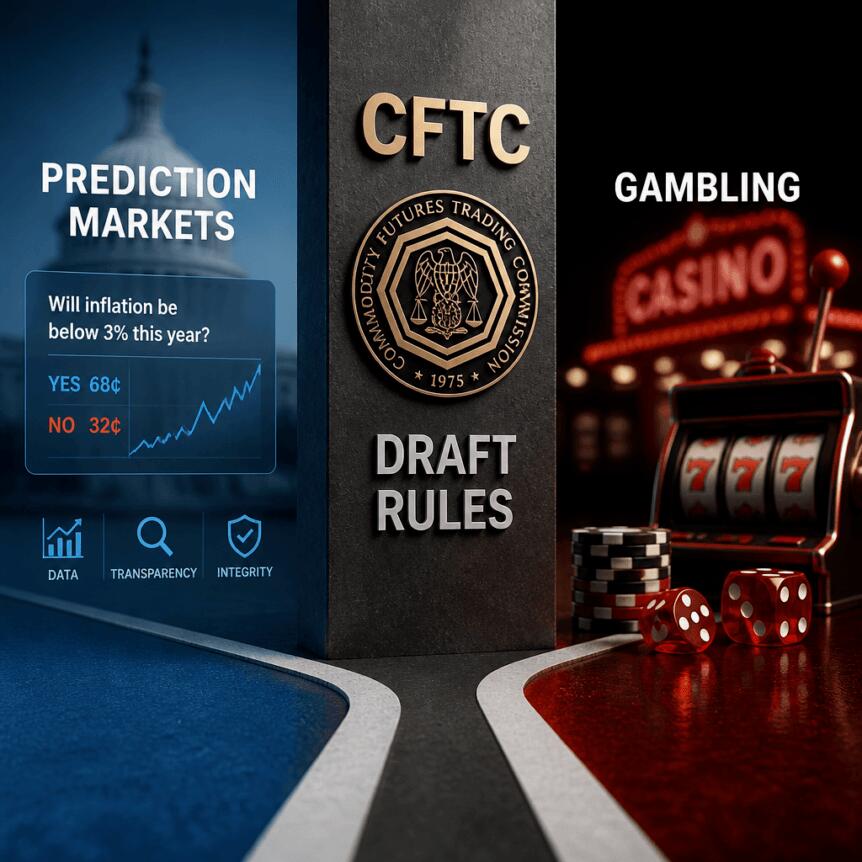
The U.S. Commodity Futures Trading Commission (CFTC) has put forward two proposals aimed at tightening the rules governing prediction markets and other “event contracts.” The moves seek to clarify when these products fall under federal derivatives law—and when they do not—at a time when state regulators have increasingly challenged major operators.
According to CFTC press releases, one proposal would define event contracts as “swaps” under federal law, while the other would carve out casino-style gambling products from the same definition. Both filings were made Friday and come with a 30-day public comment period.
Key takeaways
- The CFTC’s first proposal would treat event contracts as “swaps,” placing them within the agency’s scope under the Commodity Exchange Act.
- The second proposal would exclude casino-style gambling products—such as sportsbook wagers and casino games—from the “swap” definition.
- States have sued prediction-market operators like Kalshi and Polymarket, while the CFTC has pushed back to defend federal jurisdiction over event contracts.
- These proposals may feed into an ongoing effort to resolve, possibly at the Supreme Court level, the boundary between federal oversight and state authority.
How the CFTC wants to classify “event contracts”
In its first proposal, the CFTC argues that event contracts should be treated as “swaps” under federal law. The agency’s stated purpose is to reduce ambiguity around whether these products qualify as commodity derivatives within the Commodity Exchange Act framework.
The CFTC says the proposal would cover event contracts tied to categories including sports, politics, cultural events, and weather, describing them as financial instruments that the market typically refers to as swaps. In a press release accompanying the filing, CFTC Chairman Michael Selig said these products are commodity derivatives “squarely within the CFTC’s regulatory remit” and fall within the agency’s “exclusive jurisdiction.”
“These products are commodity derivatives squarely within the CFTC’s regulatory remit under the Commodity Exchange Act and are within the agency’s exclusive jurisdiction,” Chairman Michael Selig said.
For prediction-market businesses, the practical impact is straightforward: classification as a “swap” generally pulls the product more firmly into federal derivatives regulation rather than state-by-state gambling rules. For traders and users, the larger implication is that product compliance requirements, oversight, and enforcement could be shaped primarily by the CFTC—at least if courts ultimately accept the agency’s interpretation.
Where the CFTC draws the line: casino-style gambling excluded
The second proposal takes the opposite approach for casino-style gambling products. In this filing, the CFTC would codify its view that gambling products—particularly those resembling wagers placed on sportsbooks and casino games—are not derivatives and therefore should not be swept into the “swap” definition.
As another CFTC press release explains, the agency frames this as a clarification of the limits of its authority, “just as the Commission has done with respect to other products historically regulated by the states.” Selig said casino-style gambling products are not derivatives and emphasized that the proposal would formalize the exclusion.
“Casino-style gambling products are not derivatives,” Selig said, “Just as the CFTC has done with respect to other products historically regulated by the states, the Commission today provides clarity regarding the limits of its regulatory remit by codifying the exclusion of casino-style gambling products from the ‘swap’ definition.”
This dual-track approach—bringing event contracts into the “swap” category while pushing casino-style wagers out—underscores the core regulatory tension in the prediction-market debate. Operators often market their offerings as information markets or contracts on discrete events, while state regulators argue that many such products are functionally gambling. The CFTC appears to be attempting to create a clearer statutory dividing line before courts are asked to settle it.
States challenge operators; the CFTC defends federal authority
As the CFTC moves to codify its interpretation, the broader legal conflict is already active. The CFTC has countered state lawsuits alleging illegal gambling by prediction-market operators, including Kalshi and Polymarket. The disagreement is fundamentally about jurisdiction: whether these products should be regulated as federal derivatives or treated as gambling subject to state oversight.
The CFTC’s proposals also explicitly foreshadow litigation over the federal-versus-state boundary. The filings come at a time when courts have issued mixed rulings about whether certain sports-event contracts should be treated as “swaps” under the Commodity Exchange Act.
Supreme Court risk and the circuit split dynamic
The CFTC’s new rulemaking efforts arrive against the backdrop of an evolving appellate record involving Kalshi. Earlier coverage from Cointelegraph reported that Kalshi lost an appeal, with a court ruling that Ohio and Tennessee could regulate sports-event contracts through their state gambling laws. Cointelegraph also noted that the 6th U.S. Circuit Court of Appeals ruled against Kalshi in a unanimous three-judge decision, concluding that Kalshi did not show its sports-event contracts were “swaps” within the scope of CFTC jurisdiction.
Even so, the legal picture is not uniform. An April decision by the 3rd Circuit Court of Appeals allowed Kalshi to continue doing business in New Jersey as its appeal process proceeded. That ruling said Kalshi was likely to succeed with its argument that federal law preempts New Jersey’s regulations.
According to Cointelegraph’s reporting, lawmakers also filed an amicus brief urging the Supreme Court to weigh in. While the input here does not add new details beyond that prior coverage, the key point is that the question of whether state or federal authorities control prediction-market regulation remains unresolved at the highest level.
Rulemaking can’t automatically settle a jurisdictional fight, but it often influences how courts interpret ambiguous statutory language. The CFTC’s proposals—both the inclusion of event contracts as “swaps” and the explicit exclusion of casino-style gambling—could give litigants and judges clearer text to analyze, potentially shaping the arguments as the case(s) move forward.
Readers should watch how the public comment process unfolds over the next 30 days, and whether subsequent court filings treat the CFTC’s proposals as persuasive evidence of the agency’s settled stance. The unresolved question remains the same: whether event contracts belong primarily under federal derivatives oversight or under state gambling frameworks—and the next major developments will likely determine how prediction markets operate in practice across the country.
https://www.cryptobreaking.com/cftc-draft-rules-target-separation/?utm_source=blogger%20&utm_medium=social_auto&utm_campaign=CFTC%20Draft%20Rules%20Target%20Separation%20of%20Prediction%20Markets%20From%20Gambling%20
Comments
Post a Comment