
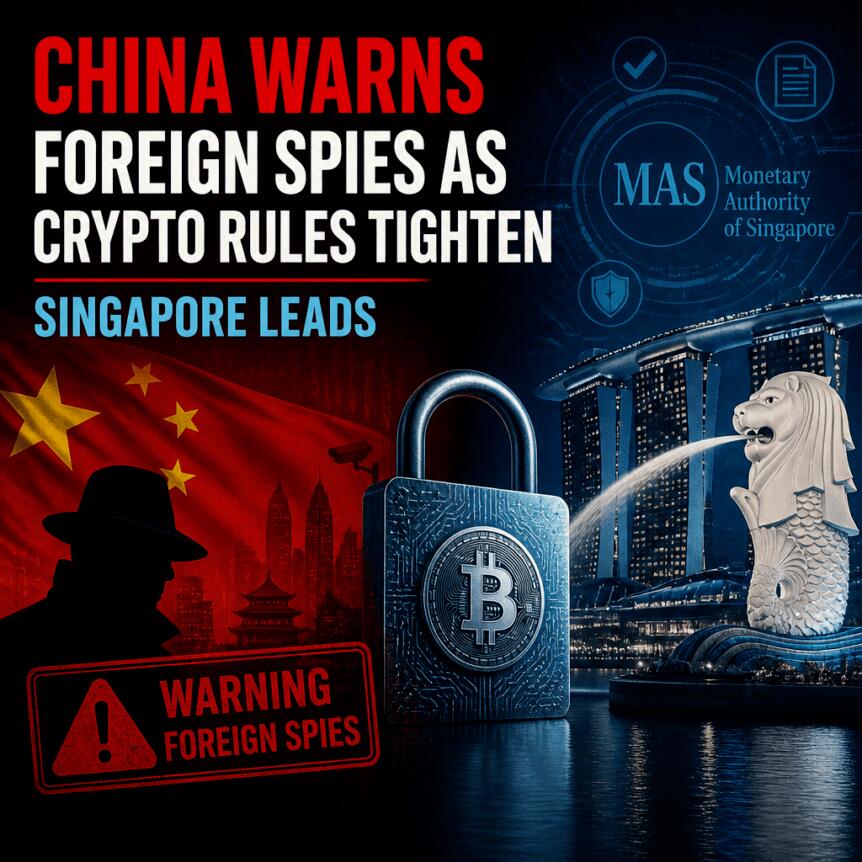
Government agencies across Asia are sending sharply different signals on crypto—ranging from China’s renewed warnings about security risks to regulators in Hong Kong tightening audit oversight, while parts of the region push for more regulated market infrastructure. Meanwhile, crypto activity is shifting unevenly, with Singapore standing out for growth even as its wider region cools.
Below is a regional roundup of the most notable developments, and what they may mean for investors, exchanges, and payment providers operating in the market.
Key takeaways
- China’s Ministry of State Security says cryptocurrencies can facilitate money laundering, cyberattacks, and espionage—arguing “virtual currencies” are not effectively anonymous.
- Chainalysis data shows Singapore’s crypto economic activity rose 55.4% to $284 billion in the year ended June 2026, even as the broader Central and Southeast Asia and Oceania (CSAO) market contracted.
- South Korea’s Financial Services Commission is considering a market-making system for digital assets, after a yen-linked stablecoin briefly traded far above its peg on Upbit.
- Binance Pay says eligible overseas visitors can spend over 100 cryptocurrencies at PayPay-supported merchants in Japan, using the HIVEX interoperability framework for QR payments.
- Hong Kong regulators have expanded cooperation with an agreement covering financial reporting, audits, and coordinated oversight for licensed crypto firms.
China warns crypto can be used as an espionage tool
China’s Ministry of State Security (MSS) has hardened its messaging about crypto’s national-security risks, according to reporting by the South China Morning Post. In a social-media post, the MSS stated that cryptocurrencies are used to facilitate money laundering and cyberattacks, describing them as “accomplices” in espionage.
The MSS also claimed that “overseas anti-China hostile forces” use crypto to disrupt financial order and harm national security. A key part of the warning was framed around the belief that crypto transactions are hard to verify. The ministry suggested that intelligence efforts could include discouraging recruits’ concerns by implying that virtual-currency activity is difficult to trace—an assertion the MSS appears to challenge directly.
“Overseas intelligence agencies would try to dispel the concerns of people they were trying to recruit as spies by claiming that the circulation of virtual currencies was hard to verify, according to the Ministry.”
While the MSS’s broader stance targets crypto as a category, it also aligns with a long-running Chinese policy approach: tightening enforcement and restricting market participation. China has previously imposed bans multiple times, including a comprehensive ban on crypto exchanges in 2017 and a mining ban in 2021, and it has declared crypto businesses illegal.
For market participants, the takeaway is less about the technical nuances between different asset types and more about enforcement posture. When regulators emphasize that crypto is not truly anonymous, compliance expectations tend to rise, even in jurisdictions that still permit limited crypto activity.
Singapore’s crypto activity rises while the wider region shrinks
In contrast to China’s security-focused warnings, Singapore’s crypto market appears to be gaining traction. Chainalysis data cited by Cointelegraph shows Singapore’s crypto activity increased 55.4% to $284 billion in the year ended June 2026, making it the largest crypto economy in Central and Southeast Asia and Oceania (CSAO).
The same dataset indicates that the broader CSAO crypto economy contracted 6.8% over the same period—highlighting that Singapore’s growth is not simply a regional rebound.
A significant driver was institutional platform activity, which climbed 94% to $60 billion. Chainalysis characterized the increase as concentrated among a small group of market makers, over-the-counter trading firms, and institutional brokerages, rather than reflecting widespread expansion of new services. In comments provided to Cointelegraph, Chainalysis said the growth was “very concentrated and marked by mostly high-volume activity by existing platforms rather than the dynamic entry of new services.”
This matters for traders and liquidity providers because concentrated institutional activity can improve market depth and trading efficiency—yet it can also mean market structure depends heavily on a limited set of counterparties. Readers should watch whether this concentrated growth broadens beyond existing platforms or remains dependent on a handful of large players.
South Korea considers allowing market makers after a stablecoin spike
South Korea may be moving toward a more operationally mature market for digital assets, with the Financial Services Commission (FSC) reportedly considering a market-making system. The discussion follows a brief but dramatic move in a yen-linked stablecoin, JPYC, on Upbit earlier this month, according to Cointelegraph.
Per the report, Upbit began trading JPYC on Sept. 17. The stablecoin reportedly opened at 12 Korean won and reached 37.6 Korean won about an hour later—more than four times its market value—an outcome attributed to limited liquidity on the exchange.
In remarks carried by Cointelegraph, Yoo Young-joon, director of digital finance policy at the FSC, said the regulator will review the need for systems such as market-making activities to improve “efficiency and stability” in South Korea’s digital asset landscape.
At present, South Korea’s Virtual Asset User Protection Act does not include an exemption for market-making from its market manipulation provisions. That constraint prevents market makers from providing liquidity under the current legal framing, according to the report.
The immediate point for market participants is straightforward: liquidity and pricing stability are often linked to the presence—or absence—of market makers. If South Korea introduces an exemption or a structured market-making framework, it could affect how exchanges design trading rules, how compliance is implemented, and whether similar stablecoin volatility episodes are reduced.
Binance Pay expands crypto spending at PayPay merchants in Japan
Japan is also seeing progress on crypto payments usability. Binance Pay announced that eligible overseas users visiting Japan can spend more than 100 cryptocurrencies at most PayPay-supported merchants starting Wednesday, according to Cointelegraph.
Binance said the service will route payments through HIVEX, a payment interoperability framework that connects overseas QR payment services to PayPay-supported merchants. In the architecture described by Cointelegraph, Binance Pay uses Tether USDt (USDT) as its backend settlement layer, while HIVEX settlement aligns with PayPay and PayPay settles merchants in yen.
Binance told Cointelegraph it is the first crypto payment service to access PayPay-supported merchants through HIVEX, and that merchants would not need to opt in separately. PayPay—accepted widely across locations including major chains, smaller retailers, taxis, and public transportation—also lists other overseas payment services supported through HIVEX, mainly from China, Hong Kong, and Taiwan.
For users, the most practical implication is lower friction: greater merchant acceptance and fewer steps between choosing a QR payment route and completing a crypto-based transaction. For payment providers, it underscores a trend toward interoperability layers that let new crypto-enabled rails integrate with established cashless ecosystems.
Hong Kong increases audit and financial-reporting oversight for licensed crypto firms
Hong Kong regulators have moved to strengthen financial oversight across licensed crypto businesses. Cointelegraph reported that the Securities and Futures Commission (SFC) and the Accounting and Financial Reporting Council (AFRC) have signed an agreement expanding cooperation on financial reporting and audits.
The arrangement sets out a framework for information sharing and includes case referrals, mutual assistance, and coordinated inspections and investigations for licensed crypto firms. It also covers audit and assurance work.
Separately, Cointelegraph notes that HSBC plans a phased rollout of its Hong Kong dollar stablecoin, RedCoin, beginning with person-to-person and merchant payments before expanding into corporate and institutional use cases. The report also states that HSBC is running an education campaign intended to reduce scams.
Together, these developments suggest Hong Kong is pushing further into institutional-grade compliance and operational controls. If the audit-and-reporting framework becomes more prominent in enforcement and supervision, it may raise the standards licensed firms are expected to meet—and could influence which firms can scale responsibly.
As these regional moves play out, the key thing to watch is how policy changes translate into day-to-day market mechanics: will Singapore’s institutional concentration broaden, will South Korea’s potential market-making system reduce liquidity-driven spikes, and will Hong Kong’s expanded oversight tighten compliance requirements for licensed operators?
https://www.cryptobreaking.com/china-warns-foreign-spies-as/?utm_source=blogger%20&utm_medium=social_auto&utm_campaign=China%20Warns%20Foreign%20Spies%20as%20Crypto%20Rules%20Tighten;%20Singapore%20Leads%20
Comments
Post a Comment