
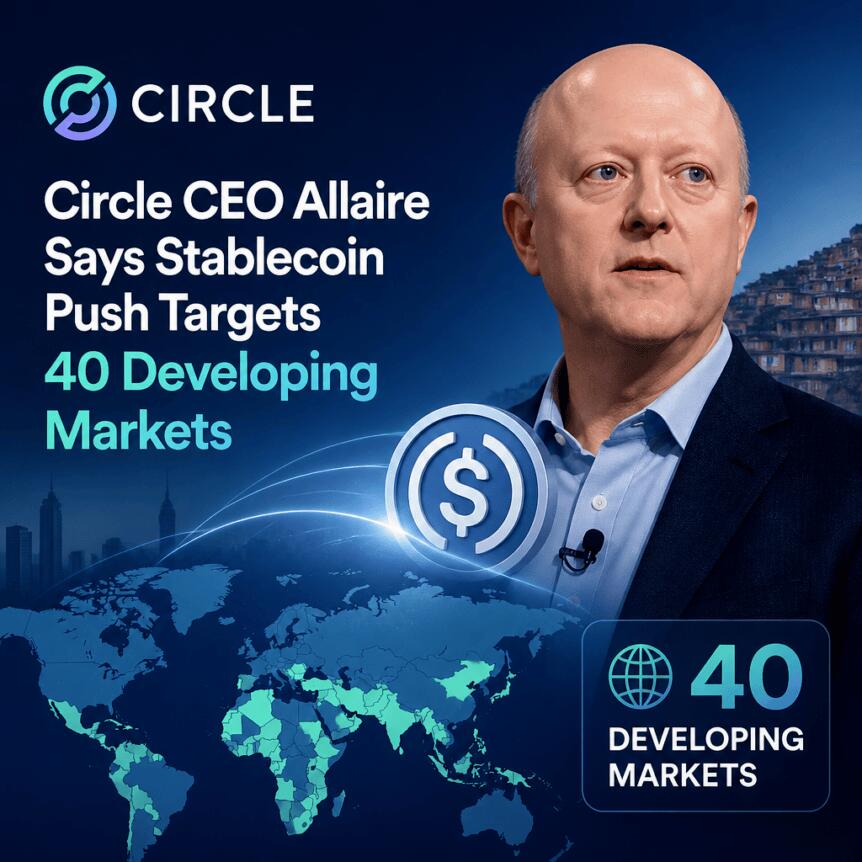
Circle is looking to expand its stablecoin business into roughly 40 developing markets, positioning the company for what CEO and chairman Jeremy Allaire described as a shift from early experimentation to broader “mainstream scaling” of blockchain-based payments.
Speaking to Reuters from the sidelines of the IMF and World Bank meetings in Bangkok, Allaire said demand for stablecoins is rising across Southeast Asia, Latin America, Africa, and the Middle East as businesses and individuals look for ways to participate in an internet-based economy.
Key takeaways
- Circle plans to target about 40 developing markets as it moves from early blockchain adoption toward wider scaling.
- Reuters reports Allaire linked increased stablecoin demand to business and retail interest in faster, more accessible digital payments.
- Bernstein expects a potential new USDC growth cycle supported by clearer US regulation and the expansion of tokenized finance.
- Bernstein data cited by Cointelegraph indicates USDC has gained ground in transaction volume, surpassing USDt on an adjusted basis.
- Circle’s acquisition of cross-border payments firm Tazapay—covered earlier by Cointelegraph—adds to its push into international payment rails.
Circle’s “mainstream scaling” push
Allaire’s remarks frame Circle’s next phase around geographic and user expansion. Rather than focusing on niche adoption, the company is aiming to bring stablecoin infrastructure to regions where stable, dollar-denominated digital value can be used for commerce and financial services.
According to Reuters, Allaire highlighted a broader pattern: stablecoins are increasingly viewed as a practical bridge between everyday payments and blockchain networks, particularly in markets where cross-border costs, banking friction, or access gaps can make traditional rails less efficient.
Why USDC could become the preferred stablecoin for payments
While USDC is still behind Tether’s USDt by overall market capitalization, Bernstein’s analysis—reported earlier by Cointelegraph—suggests USDC’s momentum may be strengthening in the area that matters most for payments: actual usage.
Cointelegraph’s Aug. 24 report referenced Bernstein’s view that a new growth cycle for USDC could lift Circle over the next 12 months. The analysts pointed to multiple catalysts, including renewed crypto market momentum, improving US regulatory clarity, expanded tokenized capital markets, and broader adoption of stablecoins for payments.
Bernstein also noted early signs of stablecoin usage in payments made by AI agents, an angle that matters because it points to new categories of “buyers and counterparties” for digital payment rails—potentially increasing demand for stable, low-volatility settlement assets.
On transaction activity, Bernstein’s figures—again cited by Cointelegraph—show USDC’s share of adjusted stablecoin transaction volume rising from about 40% in 2025 to more than 60% so far in 2026. In that same measure, USDC has overtaken USDt, indicating that even if market cap positioning remains unchanged, usage dynamics are moving in Circle’s favor.
Regional expansion meets payments and infrastructure
Circle’s plan to enter around 40 developing markets aligns with a strategy that has increasingly emphasized cross-border payments and regulated distribution. If stablecoins are going to become part of mainstream commerce, adoption hinges not only on token liquidity, but also on partnerships and payment workflows that make it simple to move value into and out of digital assets.
That theme connects to Circle’s earlier reported corporate move: on Sept. 8, Cointelegraph reported that Circle agreed to acquire Singapore-based cross-border payments platform Tazapay in a $400 million all-stock deal expected to close in 2027. The acquisition is relevant to investors watching Circle’s execution because it targets payment infrastructure rather than only token growth—potentially reducing friction for users seeking international settlements.
Together, these developments suggest Circle wants to pair its stablecoin rollout with operational capabilities in cross-border transfer systems. The market impact of such a plan will depend on execution in each region, the regulatory environment, and whether Circle can convert stablecoin adoption into sustained transaction volumes.
What could determine whether this “next cycle” materializes
Bernstein’s thesis, as summarized by Cointelegraph, points to several conditions that could influence whether USDC’s growth accelerates further. Among the factors mentioned were greater US regulatory clarity and the pace at which tokenized capital markets mature. Both can affect developer activity, institutional participation, and the availability of compliance-friendly on-ramps and settlement models.
Just as important, however, is the durability of transaction-led growth. Bernstein’s comparison of adjusted transaction volume shares—where USDC’s proportion rises while USDt’s relative share declines—signals that users are not just holding USDC, but routing payments through it. If that trend continues alongside Circle’s market expansion, it could strengthen Circle’s position in the stablecoin ecosystem beyond raw issuance.
Still, the data cited focuses on momentum through 2026 and does not guarantee future results. Readers should watch for whether increased stablecoin transaction activity in those regions turns into ongoing usage, and whether Circle’s acquisition-driven roadmap translates into improved payment flows.
For investors and builders, the key question now is how quickly Circle can turn its planned entry into multiple developing markets into measurable, sustained payment demand—while also seeing whether regulatory and infrastructure milestones support USDC’s apparent advantage in transaction volume.
https://www.cryptobreaking.com/circle-ceo-allaire-says-stablecoin/?utm_source=blogger%20&utm_medium=social_auto&utm_campaign=Circle%20CEO%20Allaire%20Says%20Stablecoin%20Push%20Targets%2040%20Developing%20Markets%20
Comments
Post a Comment