
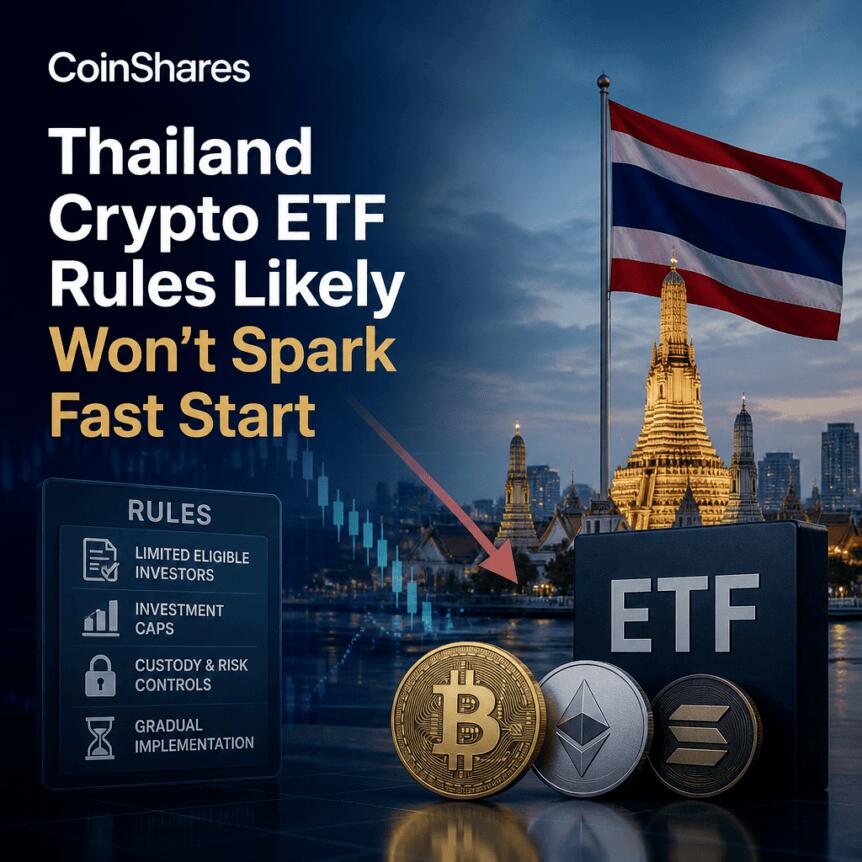
Thailand is preparing to open a new, regulated route for retail investors to gain exposure to Bitcoin and Ether through locally listed crypto exchange-traded funds (ETFs). The initiative begins Friday, when Thailand’s finalized ETF rules for Bitcoin and Ether take effect and allow approved products to list on the Stock Exchange of Thailand.
While the regulatory framework is a significant milestone for the country’s digital-asset market, CoinShares research head James Butterfill said early demand may be muted. He expects “modest inflows initially,” adding that “tens of millions of US dollars” across the first products could be a more realistic starting point than major billions.
Key takeaways
- Thailand’s Bitcoin and Ether ETF rules take effect Friday, enabling local listing on the Stock Exchange of Thailand.
- The framework is designed to let retail Thai investors access locally listed crypto ETFs, while limiting overseas crypto ETF exposure via domestic brokers.
- Trading cannot start immediately; issuers still need regulatory approval and custody and distribution arrangements.
- CoinShares expects early inflows to be limited, citing global experience—particularly Hong Kong’s small share of crypto ETP assets.
- Thailand’s first local launches remain uncertain, with demand potentially capped by existing foreign funds and direct crypto trading.
Thailand’s ETF rules: a retail-focused access model
According to earlier reporting from Cointelegraph, the rules governing Thai Bitcoin and Ether ETFs were finalized to pave the way for listing on the Stock Exchange of Thailand. The key shift is that locally listed crypto ETFs will be available to retail investors inside Thailand through domestic channels.
At the same time, the rules aim to control how overseas crypto ETF exposure can be routed through Thai intermediaries. Under the framework described by Cointelegraph, domestic brokers face restrictions on channeling overseas crypto ETF investments, limiting participation to institutional and ultra-high-net-worth investors.
Even with the rules in place, ETFs cannot begin trading immediately. Butterfill noted that Thailand’s first crypto funds will require additional regulatory approval and the setup of custody and distribution arrangements before they can launch.
Why CoinShares expects “modest” early inflows
Butterfill’s caution is grounded in how crypto ETP adoption has played out internationally, even in major financial centers. He pointed to Hong Kong as a telling comparison: despite its status as an international hub, Hong Kong represents only 0.42% of assets in global crypto exchange-traded products (ETPs).
CoinShares data cited by Butterfill shows global crypto investment products totaling $172.9 billion in assets under management as of late September, with $733 million held in Hong Kong during that period.
The investor takeaway is straightforward: having a regulated product structure does not automatically translate into large immediate allocations. For Thailand, that means the market may need time—along with sustained distribution push and investor education—before meaningful volumes accumulate.
First Thai crypto ETFs: potential issuers, but no confirmed timeline
Demand for new locally listed ETFs may also face friction from existing ways investors already access Bitcoin. Butterfill suggested that some Thai investors may already obtain Bitcoin exposure through foreign funds or by trading crypto directly, which could reduce the urgency to switch into new domestic products.
Among issuers that could play a role, Butterfill highlighted MFC Asset Management. In 2024, the company introduced its Bitcoin ETF Tracker Fund (MBTCETF-UI), which invests in BlackRock’s iShares Bitcoin Trust (IBIT), described as the largest spot Bitcoin ETF by assets under management.
For Butterfill, that creates a clear hurdle for new local spot-BTC or ETH offerings: “Local ETFs therefore need to attract new investors or offer a compelling reason to switch.” In other words, a domestic listing alone may not be enough—investors may need additional benefits such as improved access, better incentives, or differentiated product features.
Butterfill also pointed to ONE Asset Management as another firm to watch. In 2024, ONE reportedly became the first Thai asset manager to receive approval for a Bitcoin ETF-linked fund, according to coverage earlier this year by Bangkok Post.
However, Butterfill said he had not confirmed whether either company plans to launch a locally listed crypto ETF, nor did he have clarity on when the first products might begin trading. Cointelegraph reported that it reached out to Thailand’s SEC and to both ONE Asset Management and MFC Asset Management for comment about potential ETF launches, but had not received responses by the time the article was published.
What Thai investors—and global markets—should watch next
For Thailand, the immediate question is practical: which issuers will ultimately secure regulatory approval, and how quickly they will complete custody and distribution arrangements required before trading can begin. The second question is commercial: whether local ETFs can win allocations from investors who already have exposure through foreign vehicles or direct crypto markets.
Beyond Thailand, the broader implication is that regulated access is necessary but not sufficient for rapid inflows—experience in markets like Hong Kong suggests adoption can be slow even when the product is available. Readers should watch for early fund approvals, launch dates, and the initial distribution strategy, since those details are likely to determine whether Thailand’s ETF rollout gains traction beyond “modest” early numbers.
https://www.cryptobreaking.com/coinshares-thailand-crypto-etf-rules/?utm_source=blogger%20&utm_medium=social_auto&utm_campaign=CoinShares:%20Thailand%20Crypto%20ETF%20Rules%20Likely%20Won’t%20Spark%20Fast%20Start%20
Comments
Post a Comment