
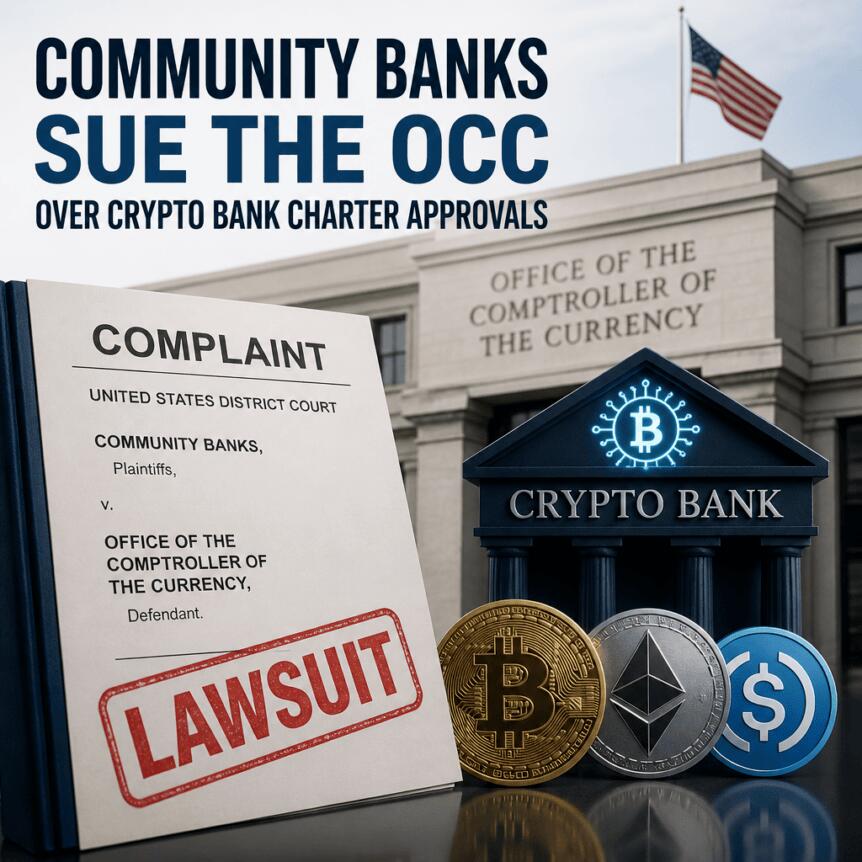
Crypto’s push into mainstream finance has triggered another legal challenge in the United States. The Independent Community Bankers of America (ICBA) has filed a lawsuit against the Office of the Comptroller of the Currency (OCC), arguing that the regulator went beyond its statutory authority by allowing cryptocurrency companies to pursue “national trust bank” charters for activities beyond fiduciary work.
In the complaint, the ICBA says the OCC effectively provides crypto firms with the credibility associated with a federal bank charter while sidestepping safeguards and requirements that normally apply to insured depository institutions.
Key takeaways
- The ICBA claims the OCC exceeded Congressional authority by granting national trust bank charters for “substantial” non-fiduciary activities.
- The suit argues crypto applicants receive federal charter credibility without key banking obligations such as capital and liquidity standards, FDIC insurance, and consolidated supervision.
- The OCC’s use of trust charters is central to the dispute, but these charters do not permit deposits or loans, unlike conventional commercial banks.
- The legal action seeks to push the OCC back toward what the ICBA says are its statutory limits.
ICBA challenges the OCC’s trust-charter approach
According to the ICBA, the lawsuit was filed Friday in the US District Court for the District of Columbia. The trade group’s argument is focused on the scope of the OCC’s chartering powers—specifically, how “national trust bank” status is being used.
ICBA president and CEO Rebeca Romero Rainey said the OCC’s decision allows companies to obtain national trust bank charters to conduct substantial non-fiduciary activities, which she argues goes beyond what Congress authorized.
“Congress did not create the national trust charter as a side door into the banking system for crypto firms seeking the credibility of a federal bank charter without the Community Reinvestment Act obligations, consolidated supervision, capital and liquidity standards, and FDIC insurance that apply to insured depository institutions,” Rainey said in an ICBA statement.
The group is asking the court to direct the OCC back to its statutory limits.
Why “trust charters” are at the center of the dispute
The trust charter framework matters because it sits in a regulatory middle ground between traditional commercial banking and narrower trust or fiduciary operations.
Earlier coverage from Cointelegraph noted that, under President Donald Trump and OCC head Jonathan Gould, the OCC has approved or conditionally approved multiple applications from crypto-related firms seeking trust charters to broaden their US offerings. Those approvals are part of the backdrop to the ICBA’s complaint.
However, Cointelegraph also reported that trust bank charters do not allow companies to accept deposits or make loans—meaning they are not the same as conventional commercial banks. That distinction is likely important in how the legal arguments are framed: the ICBA is not claiming the charters replicate full-service banks in every respect, but rather that the OCC is allegedly allowing the charters to be used in ways that resemble broader banking participation without corresponding regulatory burdens.
What the lawsuit is seeking, and what comes next
The ICBA’s central allegation is essentially an “authority and safeguards” claim: that the OCC is providing crypto firms a federal banking credential while not requiring the same compliance architecture typically tied to insured depository institutions.
Romero Rainey’s statement highlights the specific obligations the group says Congress intended to remain in place—such as requirements associated with the Community Reinvestment Act, consolidated supervision, capital and liquidity standards, and FDIC insurance.
By asking the court to “return” the OCC to statutory limits, the ICBA is seeking a legal and practical boundary on how the regulator interprets its chartering authority for trust banks in the context of cryptocurrency activity.
The OCC did not respond to requests for comment by the time of publication, according to the report accompanying the filing.
Broader implications for banks, regulators, and crypto businesses
This case lands at a moment when crypto firms have increasingly pursued regulated status through established banking channels. Yet it also reflects a continuing tension between two goals: expanding access to regulated financial infrastructure while ensuring that regulatory oversight and consumer-protection mechanisms remain appropriately matched to the risks and scale of the activities being authorized.
If the court agrees with the ICBA, the outcome could affect how future crypto-adjacent charter applications are evaluated—particularly where applicants are seeking credibility associated with federal banking charters but where regulators may be distinguishing their activities from traditional deposit-taking and lending.
For community banks and their trade groups, the suit also signals a protective stance: arguing that the regulatory perimeter should not be reshaped in a way that disadvantages smaller institutions that are subject to long-standing compliance requirements tied to insured deposit banking.
For crypto companies pursuing regulated expansion, the case underscores that regulatory pathways are not purely technical filings; they are increasingly subject to legal scrutiny over the boundaries of agency authority and the adequacy of safeguards.
As the litigation moves forward, readers should watch for how the court frames the key question of statutory authority—especially whether the OCC’s trust-charter interpretation can stand when challenged as a workaround. The resolution will likely influence not only the immediate parties, but also how the industry and regulators test the limits of “banking credibility” through narrower charter types.
https://www.cryptobreaking.com/community-banks-sue-the-occ/?utm_source=blogger%20&utm_medium=social_auto&utm_campaign=Community%20Banks%20Sue%20the%20OCC%20Over%20Crypto%20Bank%20Charter%20Approvals%20
Comments
Post a Comment