
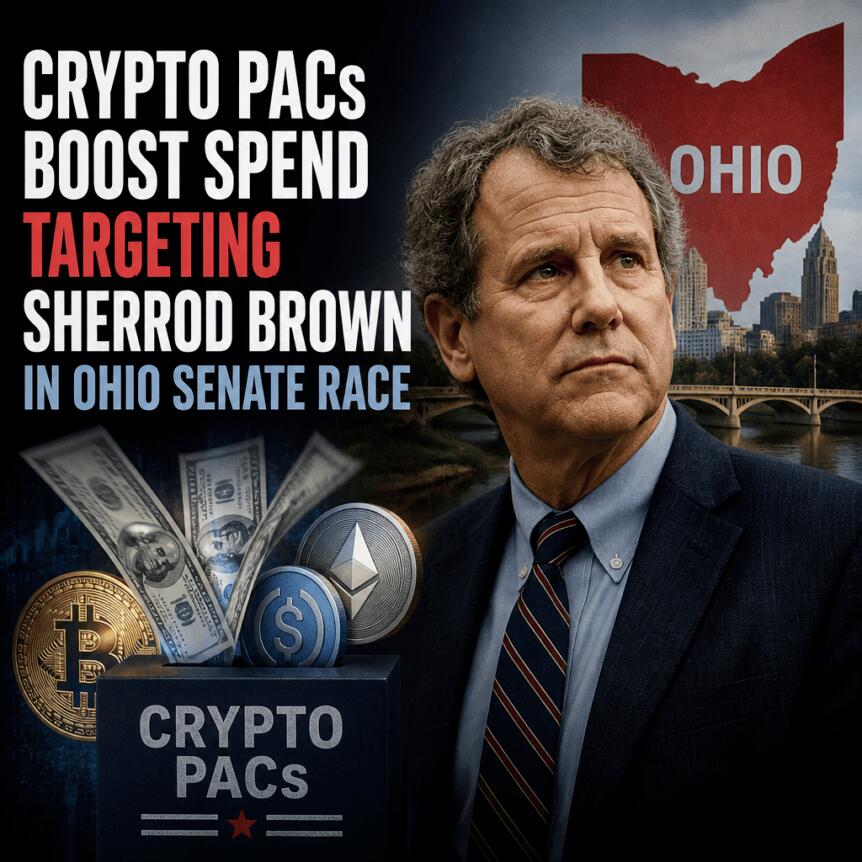
Crypto-backed political spending is intensifying as the 2026 midterm elections approach, with new Federal Election Commission (FEC) filings showing that affiliates linked to the Fairshake political action committee (PAC) have boosted their previously announced buy of Ohio Senate advertising.
According to Thursday FEC reports, Defend American Jobs—an affiliate that backs Republican candidates in primaries and general elections—spent $46.6 million on media opposing former Senator Sherrod Brown and supporting Republican incumbent Jon Husted in Ohio. The amount represents a substantial increase from the $30 million Fairshake initially said it planned to spend when it first described its Ohio strategy in September.
Key takeaways
- Defend American Jobs spent $46.6 million on Ohio Senate ads, surpassing Fairshake’s earlier $30 million estimate.
- Ohio’s early voting is already underway, with ballots cast for more than 10 days as the election nears in under three weeks.
- Another crypto-aligned group accelerated spend: the Digital Freedom Fund reported about $3 million this week and more than $5.9 million total in the Ohio race.
- Fairshake’s broader 2026 push is multi-state, including reported spending against Independent candidate Dan Osborn in Nebraska.
Ohio Senate race: spending ramps up late in the cycle
The latest FEC filing details how Defend American Jobs increased its outreach in the Ohio Senate contest. The group’s reported $46.6 million in advertising aims directly at Brown’s political return while bolstering Husted’s bid to retain the seat.
Fairshake had previously outlined an Ohio plan in September that called for $30 million in opposition spending. The new figure—reported less than a month before the election—signals the committee’s decision to press harder as voters begin casting ballots and campaigns seek last-mile momentum.
The scale of the media buy also underscores the political stakes for the crypto industry’s priorities, particularly in races involving lawmakers who have historically shaped debates over digital-asset regulation.
Brown responds as ads proliferate
In response to the ad pressure, Brown addressed the messaging campaign in an interview aired Friday on Pod Save America. He characterized the strategy as being backed by interests he associates with crypto industry players, saying Husted is aligned with those backers and that the opposition spend is significant.
“Jon Husted is their boy They know he’s their guy, they know I’m going to hold him accountable and I guess it’s a perfect storm, so they spend literally tens and tens of millions of dollars.”
While Brown’s remarks are not a direct accounting of ad costs, they reflect how the Ohio race is being framed publicly: as a contest in which digital-asset policy preferences and perceived industry influence could help determine the outcome.
Crypto-linked groups escalate beyond one committee
Defend American Jobs is not alone in increasing pressure in Ohio. The Digital Freedom Fund, a Super PAC created by Gemini co-founders Tyler and Cameron Winklevoss, reported roughly $3 million in advertising spending this week aimed at opposing Brown and supporting Husted. That brings the group’s total media purchases in the Ohio race to more than $5.9 million, based on the FEC reports cited in the coverage.
Taken together, the filings point to a more crowded and competitive late-stage advertising environment—where multiple crypto-aligned committees are independently driving attention to the same candidate matchup.
Fairshake’s own spending profile also provides context. The PAC’s affiliate expenditures in Ohio have been higher in this cycle than in the comparable 2024 effort: in 2024, Fairshake spent $41 million supporting Republican Bernie Moreno while opposing Brown, then running for reelection. At that time, Brown chaired the Senate Banking Committee and was a prominent voice in challenging policies favored by the crypto sector.
What 2026 spending suggests for crypto policy fights
Ohio is a focal point, but it is not the only arena for crypto-aligned political groups. Defend American Jobs also reported spending more than $6.7 million to oppose Independent candidate Dan Osborn in Nebraska’s Senate race. Osborn is competing against Republican Pete Ricketts, whose voting record included support for bills such as the Digital Asset Market Clarity Act and the Guiding and Establishing National Innovation for US Stablecoins Act, according to the reporting summarized in the source.
More broadly, Fairshake has said it intends to back pro-crypto candidates in 2026 and has previously disclosed its financial capacity: in January, it reported holding $193 million in cash on hand ahead of the elections.
Other committees aligned with crypto interests are already showing similar levels of activity. The Fellowship committee, backed by Cantor Fitzgerald and Anchorage Digital, reported spending more than $11 million between August 2025 and August 2026, primarily on media supporting House and Senate candidates. That kind of sustained investment suggests the election cycle is being treated less like a single-race effort and more like a longer campaign to shape the next class of legislators.
For investors, traders, and builders in the digital-asset ecosystem, the practical takeaway is straightforward: large, coordinated ad budgets tend to correlate with efforts to move policy priorities. Even when the immediate impact is political—rather than regulatory—election outcomes can influence committee leadership, the pace of rulemaking, and how aggressively lawmakers pursue legislation affecting stablecoins, market structure, and enforcement.
As early voting continues and final ballots approach, readers should watch whether additional FEC disclosures show further ad increases in Ohio and Nebraska, and whether other crypto-aligned committees shift spending toward new races—signals that could hint at where political pressure is expected to matter most for upcoming crypto policy decisions.
https://www.cryptobreaking.com/crypto-pacs-boost-spend-targeting/?utm_source=blogger%20&utm_medium=social_auto&utm_campaign=Crypto%20PACs%20Boost%20Spend%20Targeting%20Sherrod%20Brown%20in%20Ohio%20Senate%20Race%20
Comments
Post a Comment