
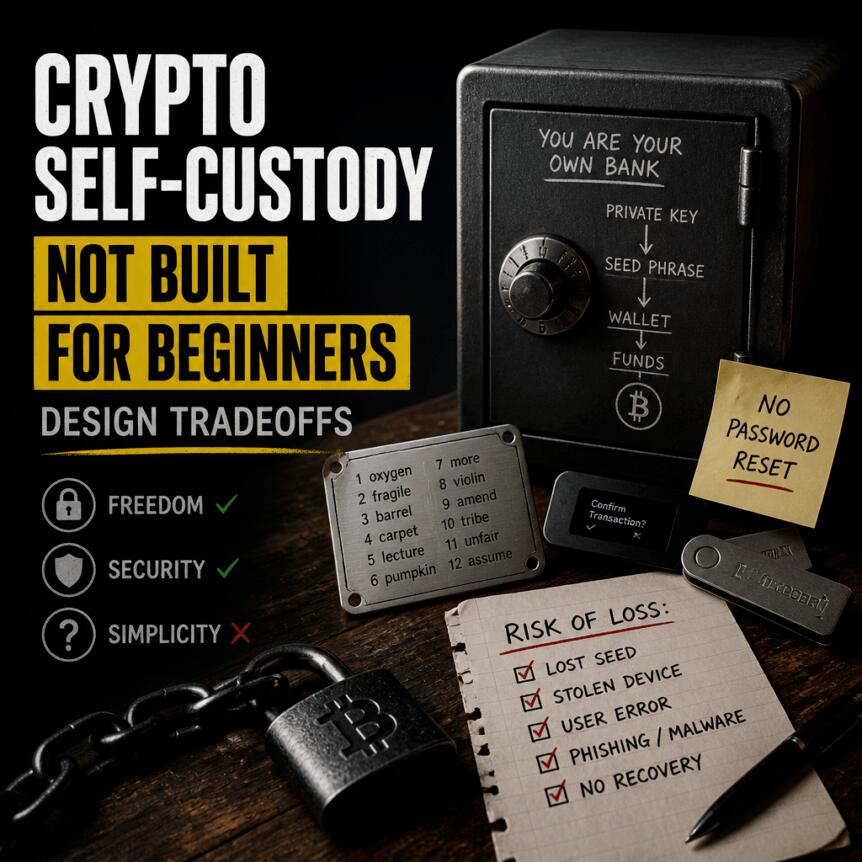
Self-custody is often promoted as the “default” way to hold Bitcoin and other cryptocurrencies—but a growing debate among industry executives is testing that assumption. In recent comments to Cointelegraph, Safe Labs CEO Rahul Rumalla argued that self-custody was always meant for everyone, while Onramp CEO Michael Tanguma said the model still isn’t built for newcomers.
The disagreement comes as real-world hardware wallet incidents have underlined that “self-custody” doesn’t automatically mean “risk-free.” According to Cointelegraph, implants in some Ledger devices were linked to stolen recovery phrases, while a Coldcard firmware bug allegedly enabled attackers to recreate private keys and drain funds. The question for investors and builders now is less whether self-custody is valuable, and more how it can be made usable without quietly increasing other attack surfaces.
Key takeaways
- Executives disagree on whether self-custody was designed for beginners or whether the current approach mainly serves experienced users.
- Multisignature (multisig) can improve security, but it adds operational complexity that may challenge new users.
- Even multisig doesn’t fully eliminate risk if all signers can be deceived through a compromised or misleading interface.
- Seedless wallet designs reduce exposure to seed phrases, but they shift responsibility to physical device safety and may rely on phone-based transaction verification.
Usability vs. “be your own bank”
Bitcoin’s appeal for many holders is that it enables users to control their assets directly, without intermediaries. Rumalla emphasized that the principle remains central: owning and controlling funds is “the whole point of crypto,” he told Cointelegraph.
However, Tanguma framed the problem differently. In his view, self-custody was never designed for people who are new to the technology. He compared the evolution of Bitcoin custody to the early era of personal computers in the 1970s, when assembling and operating systems required technical skills. As computers became more accessible, the idea of “users as mechanics” gave way to simpler interfaces for everyday owners.
Rumalla responded by saying self-custody should be possible for everyone, and clarified that “self-custody does not mean doing everything yourself.” That nuance matters for practical adoption: it suggests a path where users can retain control while still relying on interfaces, tooling, or structured backup flows that reduce human error.
Hardware wallet incidents sharpen the debate
The push for better usability is occurring alongside reminders that hardware wallets—and the broader concept of keeping private keys offline—aren’t a complete shield.
Cointelegraph previously reported that “implants” in some Ledger devices were associated with recovery phrase theft, undermining the assumption that offline key storage automatically prevents compromises. In another case highlighted by Cointelegraph, a Coldcard firmware issue was linked to an attacker’s ability to recreate private keys and steal funds.
For investors, these incidents shift the decision-making process from a simple question (“Is this a hardware wallet?”) to a more nuanced one (“How is signing verified, and what does the system do when the software or supply chain is compromised?”). For builders, they also reinforce that usability improvements must be engineered alongside stronger verification and recovery protections—not treated as separate concerns.
Multisig: stronger by design, harder in practice
Multisignature wallets require multiple keys to authorize a transaction, a structure intended to limit the damage from a single compromised component. But executors who spoke to Cointelegraph stressed that multisig can be difficult to implement and operate safely.
Synergy Network’s CTO, Justin Hutzler, warned that traditional multisig implementations can create additional complexity around signer coordination, key backups, recovery procedures, and transaction approvals. In other words, improving security often requires more moving parts—each of which can become a source of confusion or mistakes for non-experts.
There’s also the question of how multisig behaves under real attacks. Rumalla noted that multiple signers still cannot prevent every scenario if all of them are deceived by the same compromised interface. That observation points to a deeper issue: multisig is robust against certain key-compromise pathways, but it may not protect users from social-engineering or from malicious software that manipulates what signers believe they are approving.
Seedless wallets remove one risk, shift others
Another approach to beginner-friendly self-custody is reducing or eliminating dependence on recovery phrases. Tangem highlighted its seedless design as an attempt to simplify ownership by removing the need to manage a traditional recovery phrase. Instead, users secure access by protecting physical devices.
According to Cointelegraph, Tangem says a private key is generated on one card, with backup copies stored on up to two additional devices. The company confirmed that if users lose every card, they would be permanently locked out of funds. Tangem also told Cointelegraph it had not received reports of users losing all of their cards.
But a seedless design doesn’t automatically solve the signing problem. Foundation’s CEO, Zach Herbert, argued that while seedless backups can preserve self-custody, Tangem’s approach lacks a built-in screen. As Herbert put it, the reliance on smartphones for transaction verification introduces a vulnerability: an attacker might not need to extract a private key if they can trick a user into authorizing a malicious transfer.
That critique underscores a recurring tension in wallet design: reducing one class of risk (for example, seed phrase theft) can concentrate risk elsewhere—especially around user confirmation and trusted display/verification. The most secure workflow is ultimately the one that reliably shows users what they’re signing, even when surrounding software is untrusted.
Executives appear to agree on one core point: making self-custody work for everyday users requires careful engineering, not just new backup formats or extra signing steps. For readers, the most important watch items are whether wallet products pair usability features with stronger transaction verification and clearer protections against interface-based deception—especially as hardware wallet incidents continue to shape expectations.
https://www.cryptobreaking.com/crypto-self-custody-not-built/?utm_source=blogger%20&utm_medium=social_auto&utm_campaign=Crypto%20Self-Custody%20Not%20Built%20for%20Beginners:%20Design%20Tradeoffs%20
Comments
Post a Comment