
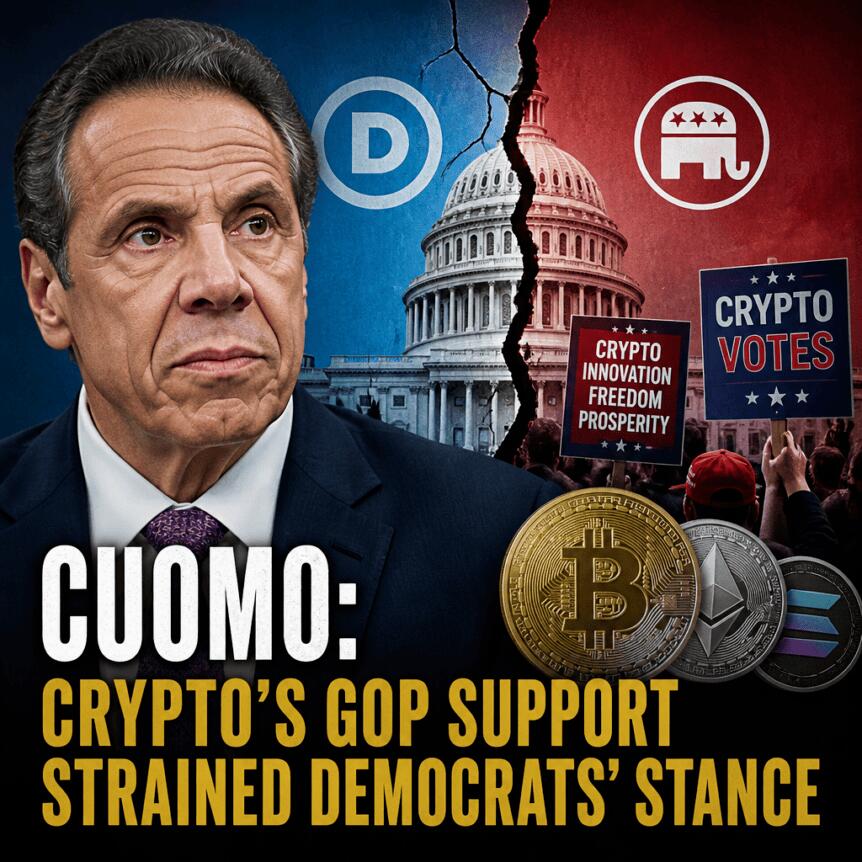
The U.S. push for federal crypto legislation is facing a political matchmaking problem, former New York Governor Andrew Cuomo argued this week. Speaking at Token2049 alongside OKX CEO Star Xu, Cuomo said the industry’s financial and organizational support has leaned heavily toward Republicans—an approach he believes is undermining the Democratic buy-in needed to pass major bills.
Cuomo linked that strategy to the reality that, even if Democrats currently appear likely to regain control of Congress, lawmakers will still need cross-party cooperation to move legislation forward. He also pushed back against the idea that Democrats are broadly “anti-crypto,” arguing that Democratic priorities align with the technology’s promise of expanding access to financial products.
Key takeaways
- Cuomo said heavy crypto funding for Republicans is likely to alienate Democrats, complicating efforts to pass federal crypto bills.
- Tech Influence Watch’s tracker shows crypto-focused PAC spending has favored Republicans over Democrats in the 2026 election cycle.
- A Kalshi prediction market put Democrats’ odds of winning both chambers at about 61%, according to figures checked Thursday.
- Cuomo argued Democrats are not inherently opposed to crypto, and he framed crypto technology as consistent with Democratic goals around financial access.
- Historical votes show some bipartisan participation on major legislation, even though procedural attempts have faced opposition.
Why Cuomo says the industry’s GOP-heavy strategy could backfire
Cuomo’s central point was political math: if the crypto industry invests heavily in one party, it can reduce incentives for the other party to support legislation. He said that belief has already created friction in the fight to secure enough votes for the CLARITY Act.
“When you invest heavily in the Republican Party, by definition, you’re going to alienate Democrats,” Cuomo said during the panel.
The claim aligns with spending data cited from Tech Influence Watch. According to the tracker’s latest figures checked Thursday, crypto-focused political action committees spent $54.3 million supporting Republicans in the 2026 election cycle, versus $26.2 million supporting Democrats. The same tracker reported an additional $23.2 million spent opposing Democrats.
While those figures describe political activity rather than legislative behavior directly, they help explain why lawmakers who feel sidelined may be less willing to compromise—especially on bills that require cross-chamber cooperation.
Democrats in control could shape the fate of the CLARITY Act
Cuomo pointed to the probability of a Democratic-controlled Congress as a key variable for the next phase of crypto legislation. As of Thursday, a Kalshi prediction market put the probability of Democrats winning both chambers of Congress at about 61%.
In that scenario, Cuomo said Democrats could pursue different paths: either attempt to roll back agency initiatives related to crypto, or work with the Trump administration to pass the full CLARITY Act.
His takeaway for investors and policy watchers is that the legislative timetable may depend less on whether crypto is “approved” broadly and more on coalition-building—particularly the balance of priorities between parties, and the willingness to negotiate specifics.
Cuomo summed up the practical requirement: “You need Democrats to pass the bill. You need Republicans. You have to be more balanced.”
Cuomo rejects the “Democrats are anti-crypto” narrative
Cuomo also challenged what he described as a widespread assumption that Democrats oppose crypto technology. He said that perception is inaccurate, arguing that crypto aligns with Democratic aims to broaden access to financial services.
“There’s a sense that Democrats are anti-crypto,” he said. “As a matter of fact, I could argue that the crypto technology is exactly suited to the Democratic Party,” Cuomo added. He framed crypto as empowering people who otherwise lack access to financial products, and said the Democratic Party has long pursued that goal.
The legislative record offered in the panel discussion suggests the picture is not purely partisan. Crypto legislation has drawn support from both parties, though Republicans have tended to show stronger alignment behind major measures.
For example, the article referenced a July 2025 vote in the House in which 78 Democrats joined 216 Republicans to pass the CLARITY Act, while 134 Democrats voted against it. Separately, the GENIUS Act received backing from 18 Democratic senators and passed the Senate in June 2025.
At the same time, procedural and factional dynamics have posed obstacles. The article cited an earlier September procedural vote in which all Senate Democrats and four Republicans voted against advancing the CLARITY Act. It noted that some concerns at the time related to potential conflicts of interest involving Trump’s crypto businesses.
Later, seven Democratic senators issued a joint statement reaffirming their commitment to passing the CLARITY Act, indicating that while opposition has existed, it hasn’t been uniformly dismissive.
What political activity may signal for the next election cycle
Beyond Cuomo’s arguments, the political landscape itself continues to move. The article also cited a statement from Fairshake, a crypto-focused PAC, saying that it would support 32 House candidates in November’s midterm elections—19 Republicans and 13 Democrats.
For readers tracking policy risk, that kind of candidate-level involvement can matter because it shapes which lawmakers feel pressure to deliver on legislation and which may calculate that supporting crypto initiatives could be politically costly.
With a likely Democratic majority viewed as plausible by at least one prediction market, and with recent legislative history showing both cooperation and resistance, the next phase may hinge on whether crypto advocates recalibrate their outreach—and whether Democrats can be brought into a stable coalition rather than treated as an obstacle to be overcome.
Going forward, the most important developments to watch are whether spending and coalition signals change before major votes, and whether Democrats—despite internal skepticism on prior procedural efforts—move from conditional support to the kind of durable cross-party agreement required to pass the full CLARITY Act.
https://www.cryptobreaking.com/cuomo-cryptos-gop-support-strained/?utm_source=blogger%20&utm_medium=social_auto&utm_campaign=Cuomo:%20Crypto’s%20GOP%20support%20strained%20Democrats’%20stance%20
Comments
Post a Comment