
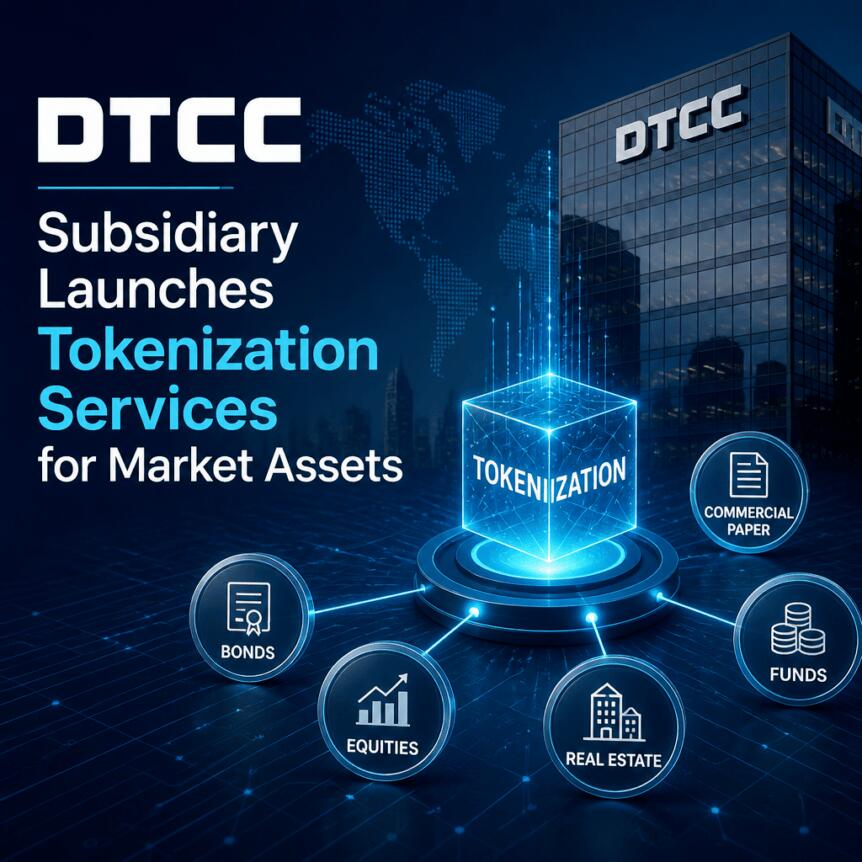
The Depository Trust Company (DTC), a subsidiary of the Depository Trust & Clearing Corporation (DTCC), has begun offering tokenization services for eligible market participants. Through the DTCC Tokenization Service (DTS), users can mint tokenized representations of securities that are held at DTC—aiming to bridge traditional custody with digital-wallet transfer while keeping the same underlying ownership rights and investor protections.
DTCC said in a Wednesday announcement that DTS will support conversion between traditional and tokenized forms of securities. The effort is positioned as a practical route for bringing tokenized assets into mainstream post-trade workflows, rather than treating tokenization as a standalone experiment.
Key takeaways
- DTC’s DTS is now live, allowing eligible users to mint tokenized representations of securities held at DTC.
- DTCC says tokenized securities transferred to digital wallets preserve the same ownership rights and investor protections as traditional holdings.
- DTCC clients already signed to access the service include major Wall Street firms such as Fidelity Investments, JPMorgan, and Citadel Securities.
- DTS is currently integrated with Canton Network and DTCC’s Besu private network, with plans to expand blockchain support in 2027.
DTCC moves tokenization from pilot to “go-live”
DTCC’s post-trade platform has long been viewed as a potential gatekeeper for broader tokenization adoption, largely because it sits at the center of securities settlement and custody. With DTC launching DTS, the focus shifts from infrastructure testing to operational service delivery.
DTCC described DTS as enabling a conversion layer between traditional and tokenized securities. In practical terms for market participants, that means tokenized representations are intended to correspond to securities already held at DTC, with the resulting tokens designed to be transferable to digital wallets. DTCC also emphasized that the service maintains the same ownership rights and investor protections afforded by traditional instruments—an element that matters for investors evaluating whether tokenized assets truly function as legal and economic equivalents, not just digital wrappers.
Who can use the service—and which firms have signed up
DTCC said its DTCC clients are eligible to use the DTS. According to the company, 20 of its clients have already signed agreements to access the service.
The list of participating firms includes Alpaca, Citadel Securities, Citi, Clear Street, DriveWealth, Fidelity Investments, Interchange Clearing, and JPMorgan. Having a mix of brokerage, market-making, and wealth management-related players is notable because it suggests the service is designed to support multiple parts of the distribution chain—from custody and trading workflows to delivery and client access.
While DTS being live does not automatically guarantee widespread trading activity immediately, it creates a foundation for downstream use cases. Traders and platforms can integrate minting and conversion capabilities into their own systems, potentially reducing friction for future tokenized-security settlement and transfer.
Regulatory groundwork: SEC “no action” and timeline toward tokenized trading
DTCC’s progress on tokenization has been accompanied by regulatory positioning. In December 2025, the U.S. Securities and Exchange Commission issued a “no action” letter stating it would not recommend enforcement action against DTCC’s subsidiary related to its proposed tokenization program. That step is often treated by market participants as an important signal of regulatory comfort, especially when tokenized instruments raise questions around custody, transfer mechanics, and investor protections.
DTCC’s latest announcement also sits within a longer roadmap. Earlier, DTCC said it planned a full service launch of trading of tokenized securities in October 2026, following a July 2026 pilot. The DTS go-live today can be interpreted as part of that sequencing: establishing tokenization capability first, then extending toward trading operations and broader market activity.
Blockchain integration: Canton Network and DTCC’s Besu, with expansion planned
DTCC said the DTS is currently integrated with Canton Network and DTCC’s Besu private network. The company plans to add additional blockchain networks in 2027.
This matters for interoperability and platform reach. Rather than forcing users to operate solely within one chain, expanding network support can help reduce integration costs for firms that already operate across multiple blockchain environments—or that want to match specific settlement, compliance, or privacy requirements to different network capabilities.
For builders and institutional developers, the current integrations also provide a clearer starting point for technical adoption. If tokenized representations are to be transferable to digital wallets, then wallet support, token standards, and network compatibility become key variables that determine how quickly tokenized securities can move through real-world custody and distribution systems.
Why “tokenization services” may matter more than token hype
The industry has repeatedly seen tokenization announcements that never translate into durable post-trade adoption. DTCC’s move stands out because it focuses on the mechanics of minting tokenized representations of securities already sitting in DTC custody, with DTCC framing the result as preserving the same investor protections as traditional instruments.
For investors and market participants, the practical question is whether tokenized securities can slot into established workflows—settlement, custody, rights, and transfer—without introducing new legal ambiguity or operational risk. DTCC’s emphasis on ownership rights and protections suggests the company is aiming to keep the structure close to existing market guarantees, even as the transfer mechanism shifts toward digital wallets.
Readers should watch how quickly DTS participation translates into real trading and settlement volumes, particularly with DTCC’s earlier plan pointing to an October 2026 full service trading launch. Equally important will be how the network expansion roadmap plays out in 2027 and whether tokenized transfers remain frictionless across different wallet and platform integrations.
https://www.cryptobreaking.com/dtcc-subsidiary-launches-tokenization-services-2/?utm_source=blogger%20&utm_medium=social_auto&utm_campaign=DTCC%20Subsidiary%20Launches%20Tokenization%20Services%20for%20Market%20Assets%20
Comments
Post a Comment