
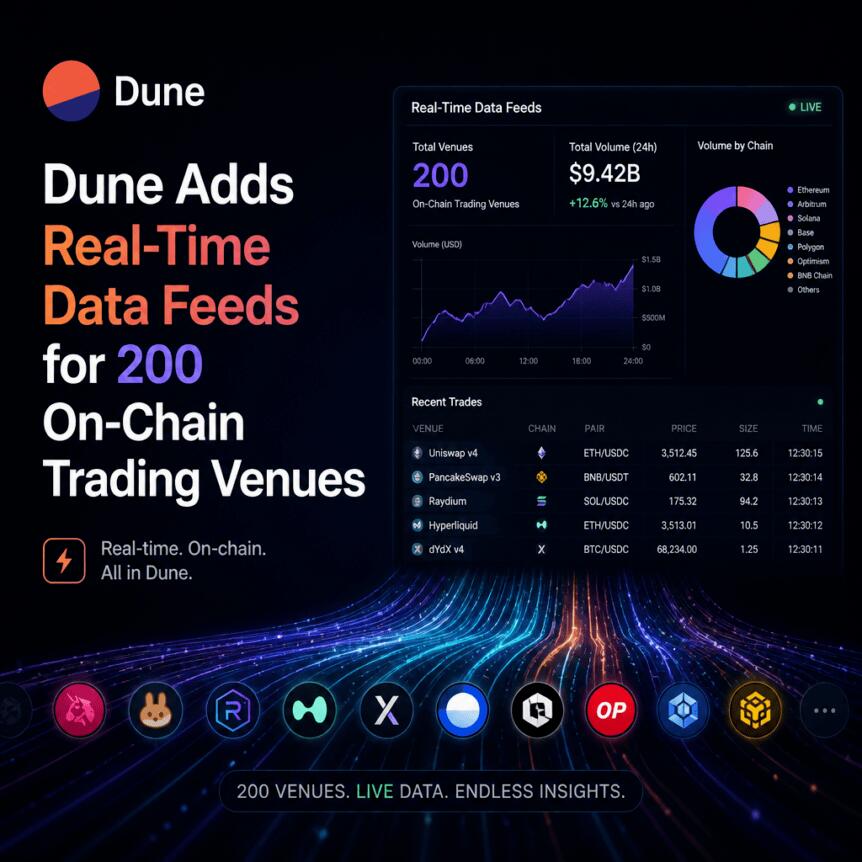
Data infrastructure is moving from experimental dashboards to tools that look and feel familiar to institutional trading teams. Dune has launched real-time market data feeds that aggregate onchain activity across more than 200 trading venues, aiming to make decentralized pricing and liquidity more usable inside traditional market workflows.
In a Thursday announcement, Dune said the service delivers trade data from 12 blockchains—including Ethereum, Solana, Base, and XLayer—at roughly one second after execution. The feeds cover spot trades across decentralized exchanges, as well as perpetual futures activity on Hyperliquid and Lighter, with standardized fields such as prices, trade sizes, and transaction-level details.
Key takeaways
- Dune’s new feeds provide near real-time onchain trade data (about one second lag) across 12 blockchains and more than 200 trading venues.
- The coverage spans both decentralized spot trading and perpetual futures on Hyperliquid and Lighter, using standardized trade metrics.
- Early users include institutional-style market participants such as quant funds, market makers, asset managers, and bank trading desks, according to Dune’s CEO.
- The rollout highlights a core institutional barrier to onchain trading: venue fragmentation and messy liquidity/pricing across multiple networks and platforms.
- The broader tokenized-stocks ecosystem continues to grow quickly, but fragmentation and issuer disputes are still shaping how onchain markets develop.
Dune targets institutional-grade visibility into onchain trading
Dune is positioning the new service as a bridge between blockchain market activity and the expectations of professional traders. By translating decentralized executions into a consistent data format, the company is effectively reducing the work required to stitch together venue-specific information into something that can support analysis, monitoring, and execution planning.
According to Dune co-founder and CEO Fredrik Haga, quant funds, market makers, asset managers, and bank trading desks are among the first clients. He did not name specific organizations, citing nondisclosure agreements, but described common use cases: assessing liquidity, comparing prices across venues, and evaluating trading strategies before deploying capital.
Haga framed the need in practical terms. Institutions, he said, are increasingly watching onchain markets because they can’t properly price these assets without them. But he emphasized that “direct onchain trading” is still held back by operational complexity, especially the fact that the same underlying asset can trade across numerous venues on different chains—making it difficult to know where liquidity and orders actually sit.
What still holds institutions back is how messy it is. The same stock trades on dozens of venues across different chains, and you need to know what’s trading where before you can touch it.
Why one-second trade feeds matter for liquidity and execution
For institutions, timing and consistency in market data are not just conveniences—they affect how strategies are designed and how confidently teams can compare venues. A feed that updates about a second after trade execution can support faster monitoring and more accurate cross-venue comparisons than slower batch-style datasets.
By covering both spot decentralized exchange activity and perpetual futures on specific venues, Dune is also addressing a structural issue: onchain liquidity is often distributed across different instruments and platform types. Standardizing core fields—prices, trade sizes, and transaction details—reduces the friction of mapping disparate event streams into a single analytical layer.
Still, the service doesn’t eliminate the broader challenge Haga referenced. Even with aggregated data, traders must interpret how fragmentation changes effective spreads, slippage, and execution outcomes. Near real-time feeds help with measurement, but they do not remove the need for robust execution logic when liquidity is split across chains and trading venues.
Tokenized stock growth continues—alongside fragmentation and issuer disputes
While Dune’s product focuses on trading data, its launch arrives amid continuing evolution in tokenized securities. The market for tokenized stocks has expanded sharply over the past year, but it has also surfaced tensions around how these shares should trade onchain and who should have a say in the process.
Recent disputes around OKX ICE illustrate the governance and compliance friction that can arise as tokenized equities move closer to real trading venues. On Oct. 4, the joint venture between crypto exchange OKX and Intercontinental Exchange (ICE)—as reported in earlier coverage—announced plans for a tokenized stock trading platform. Following that announcement, several publicly traded companies objected to having their shares included.
So far, 16 companies—including Microsoft, Alphabet, and Goldman Sachs—have filed objections to the proposed platform, according to reporting cited in the original coverage. The filings reportedly did not spell out the specific reasons, leaving investors and builders without clear guidance on what regulatory or contractual issues are driving resistance.
Fragmentation also remains a central risk. In May, Tiger Research director Ryan Yoon warned that trading the same tokenized stock across multiple blockchain platforms could lead to price discrepancies, increase slippage, and reduce market efficiency. The concern is not just that liquidity is split—it’s that splitting can distort pricing in ways that harm both execution quality and longer-term market confidence.
Data from RWA.xyz, as cited in the original report, suggests the tokenized stock value footprint is still accelerating. RWA.xyz data shows distributed value of tokenized stocks at $3.58 billion, up from about $627 million a year earlier—an increase of roughly 470%. That growth underscores how quickly infrastructure and product demand are expanding, even as market structure issues remain unresolved.
What to watch next for onchain trading and tokenized markets
Dune’s real-time feeds signal that institutional interest in onchain markets is becoming increasingly operational: teams want data they can analyze and act on quickly, not just proof-of-concept charts. The next question is whether standardized visibility will translate into smoother liquidity discovery and more direct execution as venue fragmentation and issuer concerns continue to shape tokenized markets. Investors and builders should watch how quickly onchain trading workflows mature—and whether market structure issues shrink as more institutions integrate better data tools.
https://www.cryptobreaking.com/dune-adds-real-time-data/?utm_source=blogger%20&utm_medium=social_auto&utm_campaign=Dune%20Adds%20Real-Time%20Data%20Feeds%20for%20200%20On-Chain%20Trading%20Venues%20
Comments
Post a Comment