
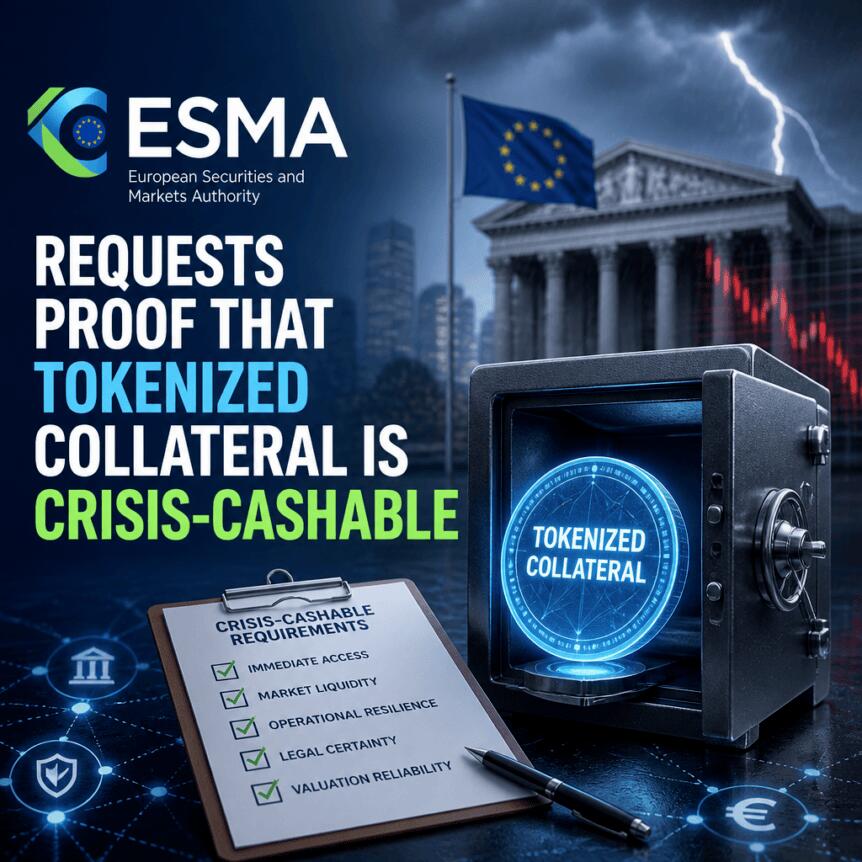
European regulators are pushing for clearer proof that clearinghouses can safely use tokenized collateral when markets deteriorate. The European Securities and Markets Authority (ESMA) has published a call for evidence aimed at understanding how tokenized assets would be accessed, liquidated, and managed under central clearing arrangements—especially in stressed scenarios.
ESMA’s initiative comes as tokenized collateral moves from pilots into real clearing workflows. Banks and investors increasingly want faster, more flexible access to securities to meet margin requirements, and distributed ledger–enabled services are starting to appear in mainstream infrastructure.
Key takeaways
- ESMA is seeking evidence on whether clearinghouses can access tokenized collateral and convert it into cash during default-driven stress.
- The consultation covers both tokenized representations of traditional assets and assets issued directly on distributed ledgers.
- Regulators want clarity on whether token transfers create enforceable ownership rights over underlying assets.
- ESMA is also examining how tokenized collateral interacts with stablecoins, central bank money, and tokenized deposits.
- The review follows momentum from earlier infrastructure steps, including Eurex Clearing’s DLT-enabled collateral service and the Eurosystem’s Pontes settlement platform.
Why ESMA is asking for evidence now
In a call for evidence published on Friday, ESMA said it needs to build “conditions for tokenized markets to operate safely and at scale across borders,” emphasizing legal certainty, interoperable infrastructure, and appropriate supervision. ESMA chair Verena Ross said regulators must understand how tokenized collateral can be integrated into existing cross-border frameworks without undermining risk controls.
At the heart of the consultation is a practical question: if a clearing member defaults, can the clearinghouse reliably reach the tokenized collateral, liquidate it, and use the proceeds to meet obligations? ESMA’s request for industry feedback is designed to test whether current EU rules and operational processes are sufficient when collateral exists in a tokenized form.
What the consultation covers: tokenized collateral models
ESMA’s scope extends beyond a single technical approach. The consultation addresses tokenized collateral that takes two broad forms: tokenized representations of assets that still sit within traditional financial infrastructure, and assets that are issued directly on distributed ledgers.
The regulator also wants to understand how these tokenized structures work alongside other on-chain or token-linked payment and value layers. In particular, ESMA said it will examine interactions with stablecoins, central bank money, and tokenized deposits—components that can materially affect liquidity pathways during a stress event.
Even when an asset is considered liquid in its traditional form, ESMA warned that tokenization may introduce additional risks. These can include delays tied to redemption procedures or restrictions that limit transfers—issues that could become critical in time-sensitive margin and default management.
ESMA further asked respondents to address legal and structural questions around custody and rights. Specifically, the consultation includes whether token transfers are strong enough to confer ownership or other enforceable rights over the underlying assets, rather than merely transferring a digital representation.
From live DLT collateral services to regulatory scrutiny
Tokenized collateral is no longer purely theoretical in Europe. ESMA’s call for evidence comes after Eurex Clearing introduced a collateral service based on distributed ledger technology in July 2025. According to the service rollout, Eurex Clearing said it became the first central counterparty (CCP) globally to launch a DLT-enabled collateral mobilization service, enabling securities to be moved from one custody location to another.
That process included a live transaction executed for Dutch pension investor PGGM, moving securities from another custody location. The existence of such operational examples is likely one reason ESMA is now formalizing questions that are less about whether tokenization can move assets, and more about whether it can preserve the speed, certainty, and legal strength required for clearing under stress.
As these services expand, differences in how tokenization affects transfer timing, redemption mechanics, and ownership enforceability become central to risk management. ESMA’s emphasis on liquidity—turning tokenized collateral into cash when markets under strain—signals that it sees these details as regulatory gaps that must be answered with evidence.
How Pontes and central bank settlement may influence tokenized clearing
ESMA’s consultation arrives after additional infrastructure developments aimed at making tokenized settlement more interoperable with existing systems. The regulator cited the Eurosystem’s September launch of Pontes, a platform that enables financial institutions to settle tokenized asset transactions using central bank money.
ESMA said Pontes could support tokenized collateral arrangements by connecting blockchain-based infrastructure with existing settlement rails. That matters for clearing because central bank money settlement is typically viewed as a key element for reducing settlement risk and improving liquidity management—two areas that become more important during stress events.
Still, Pontes addresses settlement of tokenized transactions, not automatically the broader question ESMA is focusing on: what happens to tokenized collateral when a member defaults. The consultation therefore suggests regulators are looking at the full chain—how collateral is held, how it can be accessed, how rights attach, and how quickly liquidation can occur.
What investors and market participants should watch next
ESMA’s call for evidence is an early but consequential step: it signals that tokenized collateral used in central clearing will face heightened scrutiny on liquidity and enforceable rights, not just technical feasibility. Market participants should monitor the feedback ESMA receives and the regulatory direction ESMA takes on legal certainty and operational standards for default scenarios, where delays or unclear ownership mechanics can have outsized impact.
https://www.cryptobreaking.com/esma-requests-proof-that-tokenized/?utm_source=blogger%20&utm_medium=social_auto&utm_campaign=ESMA%20Requests%20Proof%20That%20Tokenized%20Collateral%20Is%20Crisis-Cashable%20
Comments
Post a Comment