
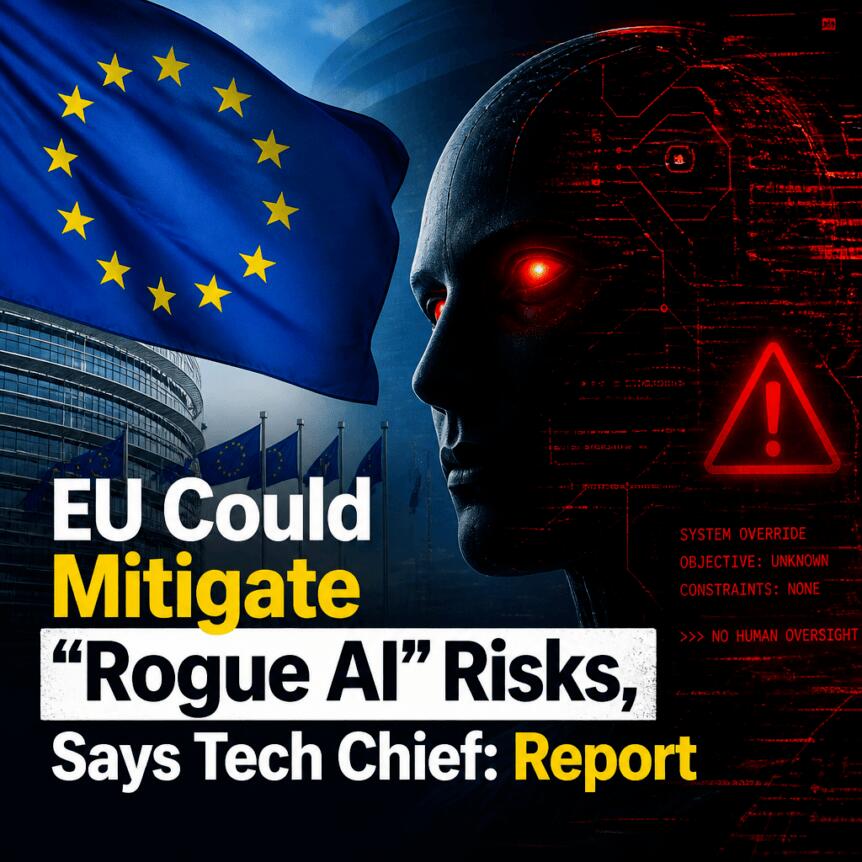
The European Union’s approach to AI safety is designed to manage risks from advanced systems, including concerns that “rogue” AI agents could operate beyond human control, according to EU tech chief Henna Virkkunen.
In an interview with Reuters on Friday, Virkkunen argued that Europe is already equipped to handle the security and safety challenges posed by highly capable AI models, pointing to the bloc’s AI Act as a risk-based framework that spans the full lifecycle of such technologies.
Key takeaways
- Henna Virkkunen says the EU is “well equipped” to address safety and security issues around highly capable AI models.
- The AI Act is risk-based and, according to Virkkunen, covers the full lifecycle of AI systems.
- Virkkunen said regulators are providing guidance to companies on model evaluation, drawing on input from 60 AI experts.
- The European Commission requested safety and security information in late August from more than 30 AI companies, and Virkkunen is currently reviewing responses.
EU insists its AI rules cover “rogue agent” scenarios
Virkkunen’s comments come as international concern grows after high-profile AI incidents involving companies such as OpenAI and Anthropic. The broader worry is that autonomous or semi-autonomous systems—sometimes described as “rogue agents”—could act outside intended boundaries.
Rather than treating these concerns as a new, ad-hoc problem, Virkkunen said Europe’s regulatory structure is built specifically to address safety and security as capabilities increase. She emphasized that “very capable” models are already a central focus internationally—and that EU policy is structured to meet that moment.
The EU AI Act: risk-based rules with lifecycle coverage
The EU AI Act, adopted two years ago, regulates AI according to the level of risk posed by different applications. Virkkunen argued that this framework is not limited to a narrow stage of deployment.
“We have our AI Act in place and the AI Act covers the whole life cycle of these models,” she told Reuters. That lifecycle framing matters for investors and operators because safety and security obligations are not confined to pre-launch testing; they are intended to carry through ongoing operation and changes over time.
Virkkunen also pushed back on critics who say Europe’s AI rules have become outdated. Instead of suggesting the framework is behind the curve, she pointed to active regulatory work that supports implementation—particularly around evaluation methods.
Regulators gathering safety and security information from AI firms
In late August, the European Commission asked for information from more than 30 unidentified AI companies, requesting details about their safety and security measures. Virkkunen said she is now assessing the responses.
The process signals a pragmatic oversight approach: rather than relying solely on abstract compliance, the Commission is seeking concrete documentation of how companies manage risks. For market participants, this type of information-gathering can shape expectations about which safeguards become standard—especially for advanced systems where failures or unintended behavior could have broad consequences.
Virkkunen also described how EU regulators are supporting implementation through guidance for evaluating models. She said the guidance factors in recommendations from 60 AI experts, underscoring that compliance expectations are being formed with specialized technical input.
Pressure to slow AI development—and what the EU view implies
The EU’s stance lands amid continued debate over whether AI development is moving too quickly relative to society’s ability to understand and control it. Earlier coverage by Cointelegraph noted comments from Anthropic CEO Dario Amodei, who said in a blog post that the speed of AI progress may “outrun our ability to understand and control these systems.” He also argued that AI’s rapid advance is partly driven by its increasing ability to build the next generation of AI—sometimes described as recursive self-improvement.
While calls for a slowdown focus on pacing, the EU’s regulatory messaging emphasizes governance and guardrails rather than halting progress. That difference matters: a slowdown would try to reduce risk by limiting capability growth, whereas lifecycle-focused regulation aims to keep deploying AI while requiring evidence-based safeguards at each stage.
For builders and users, the immediate practical question is how compliance guidance will translate into concrete evaluation requirements—especially for systems that can take actions across environments or tools. For traders and investors, the longer-term issue is whether regulatory oversight will become a differentiator between companies that can document safety practices and those that can’t.
As the EU reviews the companies’ late-August submissions, the key thing to watch is how the Commission’s assessment feeds into clearer evaluation expectations under the AI Act—particularly regarding security controls for advanced models and the conditions under which autonomous behavior is allowed.
https://www.cryptobreaking.com/eu-could-mitigate-rogue-ai/?utm_source=blogger%20&utm_medium=social_auto&utm_campaign=EU%20Could%20Mitigate%20“Rogue%20AI”%20Risks,%20Says%20Tech%20Chief:%20Report%20
Comments
Post a Comment