
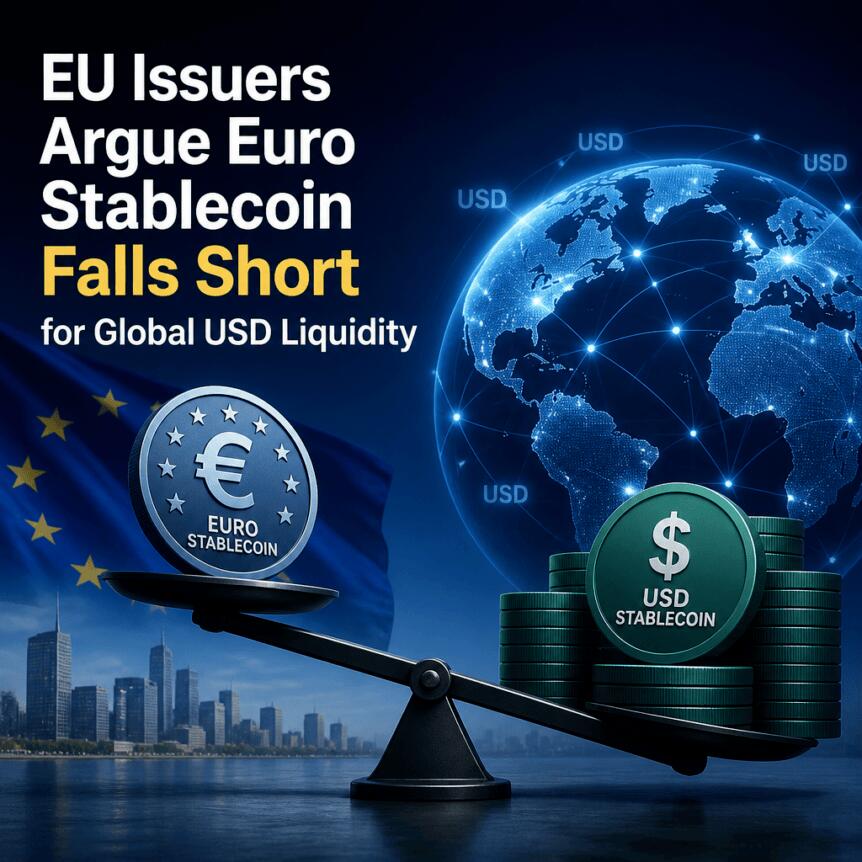
European stablecoin issuers are stepping up efforts to offer regulated US dollar tokens, arguing that the EU’s push to strengthen the euro does not eliminate the practical need for dollar liquidity in cross-border commerce and payments.
On Wednesday, the German issuer AllUnity launched its MiCA-regulated US dollar-pegged stablecoin USDAU, expanding its lineup beyond euro-denominated offerings. AllUnity CEO Alexander Höptner told Cointelegraph that in global trade and FX markets, the dollar remains a central “glue” for settlement—an outcome that cannot be replaced simply by issuing more euro tokens.
Key takeaways
- AllUnity launched USDAU, a MiCA-regulated dollar stablecoin, to address real-world dollar settlement demand in Europe.
- Issuers argue euro strengthening doesn’t remove dollar needs for cross-border payments between Europe, the UK, and North America.
- Industry players emphasize regulation over token choice, saying policymakers can shape issuers and rules even if dollar demand remains.
- Europe-issued dollar stablecoins are still small relative to major global stablecoins, according to CoinGecko.
Why issuers are doubling down on dollar tokens
AllUnity’s USDAU launch reflects a broader push among European stablecoin companies to make dollar liquidity available in a regulated framework. Höptner’s argument is straightforward: for European corporates that need to move value globally, euro-only stablecoin access can be insufficient when counterparties, pricing, and settlement cycles are dollar-centric.
The push also comes as the EU continues to reassess parts of its regulatory approach to crypto. The article notes that the EU is reviewing its MiCA framework, while the European Central Bank (ECB) has continued raising concerns about stablecoins reinforcing the dollar’s dominance.
In that environment, issuers are framing dollar stablecoins not as a political preference, but as an operational requirement. Stable Mint CEO James Bennett said demand for dollar tokens in Europe reflects business needs rather than something policymakers can “steer” away from. In his view, the key controllable factor is which entities are allowed to issue to European users—and under what compliance rules.
Stable Mint provided metrics for its USDSM stablecoin, stating that as of Wednesday it had moved more than $380 million on-chain across 3.8 million transfers and was held by more than 2,600 addresses. Fiat Republic CEO Adam Bialy made a similar case, pointing to demand from crypto platforms and stablecoin businesses for dollar settlement that operates around the clock. He added that regulated dollar tokens can reduce friction in cross-border settlement between Europe, the UK, and North America.
“Not euro versus dollar,” but a regulated choice
Some participants argue the debate should not be framed as a competition between euro and dollar stablecoins. Societe Generale-FORGE (SG-Forge), the digital asset subsidiary of French banking group Societe Generale, said its stance is to support a diversified and resilient ecosystem where users can access both euro- and dollar-denominated digital cash solutions—so long as they operate within a robust regulatory structure.
A spokesperson for SG-Forge told Cointelegraph that the goal is not to oppose dollar stablecoins, but to ensure that users can choose among denominations while staying inside the compliance boundaries set for regulated issuers.
SG-Forge also highlighted its own dollar product: USD CoinVertible (USDCV), launched in 2025. The company said it has attracted interest for applications including trading, settlement, collateral management, and treasury operations. The implication is that dollar stablecoins are being positioned as a practical tool for institutional workflows, not merely as a retail convenience.
Where Europe-issued dollar stablecoins stand today
Despite growing interest from European issuers, the market size of locally issued dollar stablecoins remains small compared to dominant global tokens.
The article cites CoinGecko data placing USDSM and USDCV at roughly $13 million each, versus $184 billion for Tether USDt (USDT) and $74 billion for Circle’s USDC. This gap underscores the central challenge for European issuers: even with regulatory clarity under MiCA, the liquidity and network effects behind established dollar stablecoins are difficult to replicate quickly.
CoinGecko’s stablecoin category data is presented in the article with a reference to a comparison chart for USDCV and USDSM against USDT and USDC. The numbers suggest that while new entrants may grow, scale is still heavily concentrated among the most widely adopted brands.
AllUnity’s Höptner frames the opportunity differently, arguing the goal is not “US versus Europe,” but building interoperable financial infrastructure—connecting dollar liquidity with European banks and businesses—within a regulatory framework. That view effectively treats the current imbalance as a starting point rather than a reason to abandon the effort.
What to watch next
For traders, developers, and corporates in Europe, the next signal will be whether these MiCA-regulated dollar tokens can convert real demand into durable liquidity—especially as the EU continues to refine MiCA and as central-bank scrutiny remains focused on stablecoins’ role in reinforcing dollar dominance.
https://www.cryptobreaking.com/eu-issuers-argue-euro-stablecoin/?utm_source=blogger%20&utm_medium=social_auto&utm_campaign=EU%20Issuers%20Argue%20Euro%20Stablecoin%20Falls%20Short%20for%20Global%20USD%20Liquidity%20
Comments
Post a Comment