
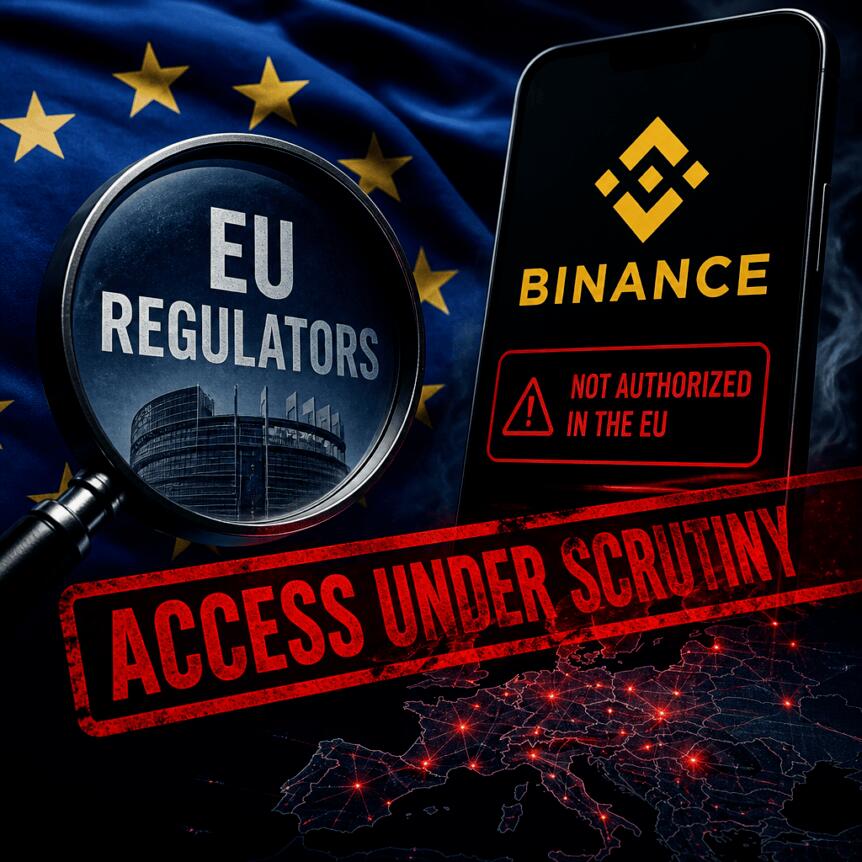
EU regulators are questioning Binance’s continued access to European customers after its MiCA licence setback and use of the reverse solicitation exemption.
Binance faces fresh EU scrutiny as regulators examine whether its reverse solicitation approach complies with MiCA rules.
Key Insights
- EU regulators are examining Binance’s continued services to customers across the bloc.
- Binance lacks a MiCA licence but says it is working toward regulatory approval.
- Regulators could pursue enforcement measures if Binance fails to satisfy their concerns.
EU Scrutiny Focuses on Reverse Solicitation
BNB trades near $771 as EU regulators examine Binance’s continued services after its MiCA licence setback.
The scrutiny focuses on how Binance uses reverse solicitation to serve customers across the European Union.
Regulators are assessing whether that approach meets the strict conditions under the bloc’s crypto rules.
Binance Faces Questions Over EU Operations
European regulators have opened fresh questions around Binance’s access to customers across the bloc.
The Financial Times reported that ESMA and national regulators are examining the exchange’s operating model.
The review follows Binance’s failure to secure authorisation under the Markets in Crypto-Assets framework.
MiCA requires crypto service providers to obtain regulatory approval to operate across the European market.
Under the rules, unlicensed companies faced a July 1 deadline to begin winding down their EU operations.
They could continue limited services mainly to help customers transfer or sell existing crypto holdings.
Binance continues serving some European customers through structures outside the EU regulatory framework.
The exchange has also relied on reverse solicitation, which permits certain cross-border services under specific conditions.
Regulators now want to establish whether customers genuinely initiated those relationships themselves.
Reverse Solicitation Becomes the Central Issue
Reverse solicitation allows companies outside the EU to serve customers who independently request their services.
European crypto rules restrict the exemption and require firms to use it only in narrow circumstances.
ESMA has stressed that companies cannot use the provision to bypass MiCA licensing requirements.
Regulators in France, Germany, and Greece have reportedly examined Binance’s use of the exemption.
Some authorities have also requested information from Binance as they assess its European activities.
The review could determine whether Binance’s current arrangements comply with EU requirements.
The Dutch financial regulator has also highlighted strict conditions surrounding reverse solicitation.
It said crypto providers must satisfy clear requirements before relying on the exemption for European customers.
Regulators are reportedly examining other smaller crypto companies using similar arrangements.
Binance Seeks MiCA Authorisation
Binance previously held local licences in several European countries, including France, Spain, and Poland.
Those licences have lapsed under the transition to the unified MiCA regulatory framework.
As a result, Binance has adjusted how it provides services to customers across different European markets.
The exchange now uses an Abu Dhabi-regulated entity for some customers outside countries where it previously held licences.
Binance obtained regulatory approval in Abu Dhabi in December 2025, according to the Financial Times report.
EU regulators are assessing whether that structure affects Binance’s obligations under European law.
Binance maintains that it follows applicable regulatory requirements in the jurisdictions where it operates.
The company also says it is working toward MiCA authorisation for its European activities.
If regulators reject its explanation, authorities could pursue enforcement measures, including financial penalties.
The latest review adds another regulatory challenge for Binance after years of scrutiny across major markets.
In 2023, US authorities imposed a $4.3 billion settlement on the exchange over criminal and regulatory violations.
The EU investigation places renewed attention on Binance’s ability to operate under Europe’s new crypto regime.
https://www.cryptobreaking.com/eu-regulators-turn-up-heat/?utm_source=blogger%20&utm_medium=social_auto&utm_campaign=EU%20Regulators%20Turn%20Up%20Heat%20on%20Binance%20Over%20Continued%20Access%20to%20European%20Customers%20
Comments
Post a Comment