
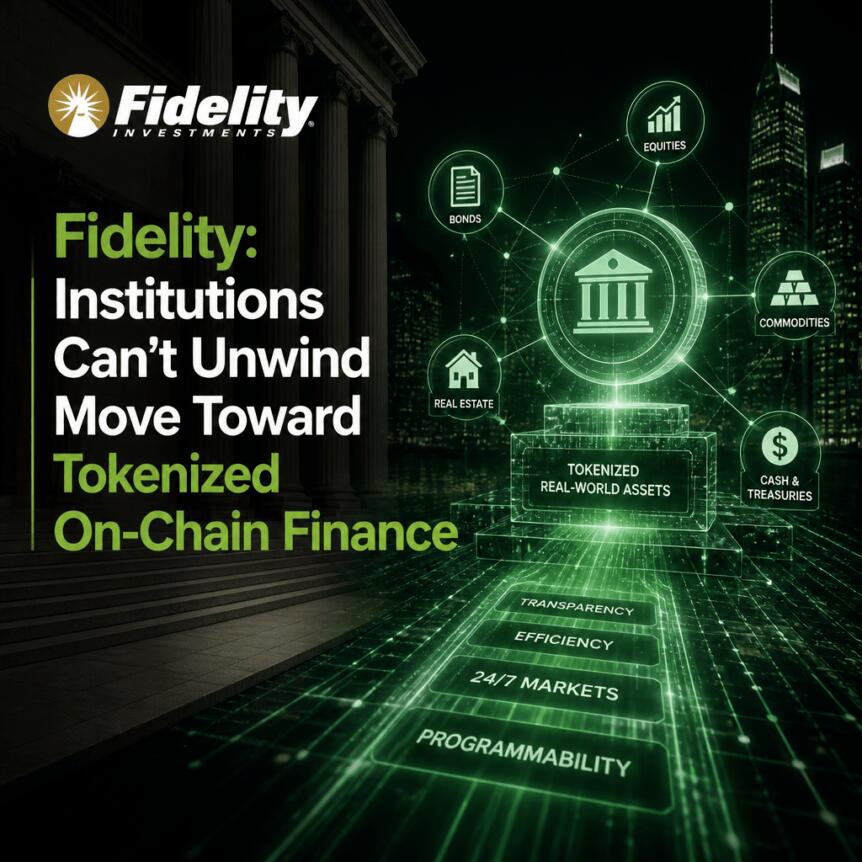
Institutional interest in tokenized finance is accelerating, with executives arguing that the shift toward onchain capital markets is now difficult to reverse. Speaking at Longitude Singapore on Thursday, Matthew Horne, head of digital asset strategists at Fidelity Investments, said the momentum from “true institutions” over the last 18 months has created a lasting move toward an onchain future.
Across the panel, UBS’s Ka Yan Chan tied the next phase of growth to regulated market infrastructure—particularly custody and settlement layers—while other industry data points suggest steady expansion in tokenized real-world asset (RWA) activity. Together, the remarks highlight how tokenization is evolving from experimentation into a pipeline that could expand much further as compliance and market plumbing improve.
Key takeaways
- Fidelity’s Matthew Horne said institutional push toward onchain finance over the past 18 months is unlikely to reverse.
- RWA.xyz data shows tokenized real-world assets gained 41% demand over the past 30 days, with 493,000 holders measured by tokenized asset addresses excluding stablecoins.
- UBS’s Ka Yan Chan argued that major scale depends on infrastructure players transforming custody into tokenized platforms.
- Recent SEC actions and trading launches are extending tokenization beyond issuance into limited trading on onchain venues.
- OnchainBenchmark reported over $1.2 billion moved onchain in the past 30 days, with total stablecoin and tokenized-asset capital exceeding $323 billion.
Fidelity: Onchain is becoming institutional default
Horne framed tokenization as both a market-access tool and a structural shift in how major institutions operate. He emphasized that institutional adoption has moved beyond a short-lived trend, describing the push toward an onchain future as something that “it’s really no going back” from.
For US asset managers in particular, Horne said tokenization offers incentives tied to distribution and reach. Tokenized products can broaden access for investors and help firms “reach new markets,” a factor that goes beyond pure technology novelty and speaks to the business case for migrating assets to onchain rails.
Supporting that narrative, RWA.xyz reported that demand for tokenized assets increased by 41% over the past 30 days. The same dataset put the number of holders at more than 493,000, defining holders as total addresses holding tokenized RWAs while excluding stablecoins.
UBS links “billions” to tokenized custody and settlement
UBS’s Ka Yan Chan focused on what must change for tokenization to scale in the mainstream portfolio construction process. She suggested that treasuries and equities—core staples in many investment strategies—could move “billions” onto onchain once the operational foundation is ready.
Chan argued that infrastructure transformation is the likely catalyst. In her remarks, she said that what could drive expansion from “billions to trillions” is when market infrastructure players such as the Fed or DTCC make the first move to convert the custody layer to a tokenized platform.
That framing is important for investors and builders because it implies tokenization’s bottleneck is not only asset issuance or token standards—it is the institutional “plumbing” that governs how assets are securely held, transferred, and reconciled across regulated systems. Chan added that industry participants could “piggyback” on these initiatives by building the distribution layer for tokenized assets.
Regulatory and market milestones push trading from theory to execution
The panel discussion also referenced regulatory signals that have enabled incremental movement toward onchain securities markets. The article notes that in December 2025, the US Securities and Exchange Commission (SEC) issued a “no action” letter to a subsidiary of the Depository Trust and Clearing Corporation (DTCC), allowing it to offer a tokenization service.
It also cited an SEC approval in September for a temporary exemption enabling limited trading of tokenized US stocks on certain onchain venues. Earlier on Thursday, Securitize announced the launch of trading for tokenized shares of a dozen widely held US stocks, including security entitlements—another step that connects tokenization with actual market activity rather than solely issuance.
While these developments are still described as limited and conditional, they matter because tokenization can only become practical at scale when trading, custody, and compliance expectations align. Each incremental regulatory greenlight reduces uncertainty for firms deciding whether to invest in products and market connections.
For readers tracking the pace of institutional rollout, the key question is how quickly these “pilot-style” approvals translate into broader participation and more liquid markets, particularly for treasuries and large-cap equities.
Market activity: onchain value keeps growing
Alongside the policy and infrastructure discussion, onchain volume metrics point to continued expansion. According to OnchainBenchmark, more than $1.2 billion in capital moved onchain during the past 30 days. The same source reported total capital across stablecoins and tokenized assets of more than $323 billion.
Industry expectations cited in the coverage also suggest that tokenized RWAs could grow rapidly if adoption continues. Standard Chartered’s global head of digital asset research, Geoff Kendrick, predicted in August that tokenized RWAs may reach $4 trillion by the end of 2028.
Of course, long-range forecasts depend on regulatory clarity, operational upgrades, and market adoption—not just issuance. The UBS remarks underline that the custody and settlement layers are central to unlocking that scale.
For now, investors and builders should watch whether tokenized custody initiatives progress beyond current exemptions and pilots, and whether trading volumes and holder growth continue to rise in tandem. If the industry can convert regulatory permissions and infrastructure momentum into durable market utility, tokenized finance may move from selective use cases toward broader portfolio construction.
https://www.cryptobreaking.com/fidelity-institutions-cant-unwind-move/?utm_source=blogger%20&utm_medium=social_auto&utm_campaign=Fidelity:%20Institutions%20Can’t%20Unwind%20Move%20Toward%20Tokenized%20On-Chain%20Finance%20
Comments
Post a Comment