
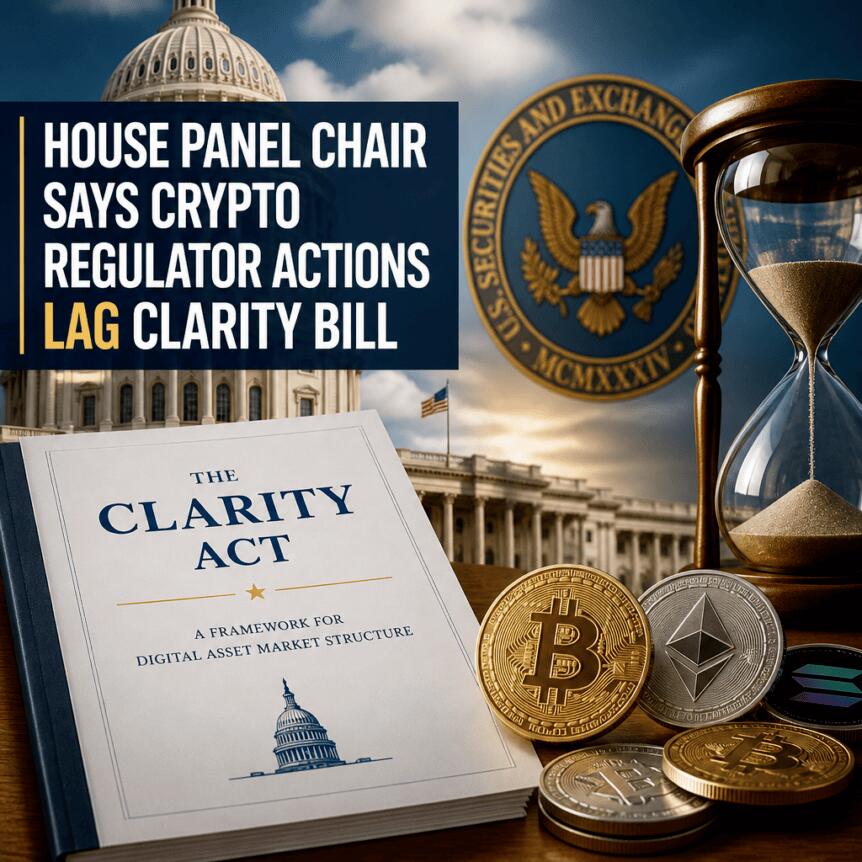
U.S. Representative French Hill, who chairs the House Financial Services Committee, argued this week that regulators are making progress on digital-asset oversight, but that the U.S. still lacks the kind of durable, market-stabilizing framework only Congress can provide.
In a Wednesday interview with Fox Business, the Arkansas lawmaker said the Securities and Exchange Commission (SEC) and the Commodity Futures Trading Commission (CFTC) have taken steps toward clearer rules for crypto after last month’s U.S. Senate failure to pass the Digital Asset Market Clarity (CLARITY) Act. Hill said those agency moves have “fallen short” compared with a permanent legislative solution.
Key takeaways
- French Hill said the SEC and CFTC have advanced regulatory proposals after the CLARITY Act failed, but he believes only Congress can provide lasting certainty.
- Hill is pushing for CLARITY to be revisited during the “lame duck” session of Congress, hoping for a legislative fix before the next Congress begins.
- The Senate’s limited window between November elections and the 2027 incoming lawmakers—Hill cited a 22-day session—could shape whether CLARITY gains momentum.
- Leadership-level vacancies at both the SEC and CFTC include a total of seven openings, following Hester Peirce’s resignation from the SEC.
- Hill’s remarks come as SEC and CFTC heads announced plans to proceed with crypto regulation following direction from President Donald Trump.
Hill argues regulation needs a congressional “permanent law”
Hill’s comments framed the current regulatory push as a response to political timing rather than a substitute for statutory clarity. According to Hill, the SEC and CFTC moved after the Senate did not pass the CLARITY Act last month, including by initiating proposed rulemaking to address different areas of crypto oversight.
Earlier coverage from Cointelegraph noted that the CFTC’s proposed framework would have attempted to handle distinct aspects of enforcement and regulation, but Hill pointed to the broader problem: without legislation, regulatory outcomes can remain less predictable for the market over time.
During the interview, Hill said he still hopes to see the CLARITY Act advanced in the lame duck session of Congress, describing it as a necessary “permanent law change” to ensure the U.S. remains competitive in digital assets and blockchain technology.
Why the lame duck window could matter for CLARITY
Hill also highlighted the constraints facing congressional lawmakers. He noted that the Senate would have only 22 days in session between the November midterm elections and the next group of lawmakers entering Congress in 2027. That short timeline, he suggested, could become a practical factor in whether legislators support or oppose CLARITY.
In a lame duck period, Hill said lawmakers may be more attuned to the likelihood of returning to office or leaving Congress in January. That political calculus could affect which measures get prioritized once the election results are known.
SEC and CFTC leadership vacancies add uncertainty
Hill’s remarks came alongside signs that institutional capacity at both major crypto regulators may be uneven. As of Wednesday, Cointelegraph reported that there were a total of seven vacancies at leadership level for the SEC and CFTC.
Commissioner Hester Peirce announced her resignation from the SEC last week, leaving SEC Chair Paul Atkins and Commissioner Mark Uyeda. On the CFTC side, Michael Selig serves as chair and sole commissioner.
For market participants, leadership changes and vacancies can matter because regulatory agendas—especially for rulemaking timelines and enforcement priorities—often depend on internal consensus and staffing stability. While agencies can still act with existing authority, prolonged vacancy gaps can slow decision-making or reshape how agencies coordinate on overlapping jurisdictions.
Regulatory plans advance, but statutory clarity remains the gap
Hill’s critique also reflects a larger tension in U.S. crypto governance: agencies have continued to propose and advance regulatory approaches, yet the industry continues to argue that a comprehensive congressional framework would reduce ambiguity. In this case, Hill positioned legislative action as a way to lock in long-term rules rather than rely on the changing pace of agency proposals.
His comments followed announcements that SEC and CFTC leadership—Atkins and Selig, respectively—planned to move forward with crypto regulation at the direction of President Donald Trump. Even so, Hill said the current path is not enough, arguing that proposed rulemaking cannot fully replicate the stability of legislation.
Investors and builders should watch whether CLARITY can realistically gain traction during the limited lame duck session, and whether SEC and CFTC leadership turnover affects how quickly proposed rules are finalized and implemented—especially given the vacancy levels reported at both agencies.
https://www.cryptobreaking.com/house-panel-chair-says-crypto/?utm_source=blogger%20&utm_medium=social_auto&utm_campaign=House%20panel%20chair%20says%20crypto%20regulator%20actions%20lag%20CLARITY%20bill%20
Comments
Post a Comment