
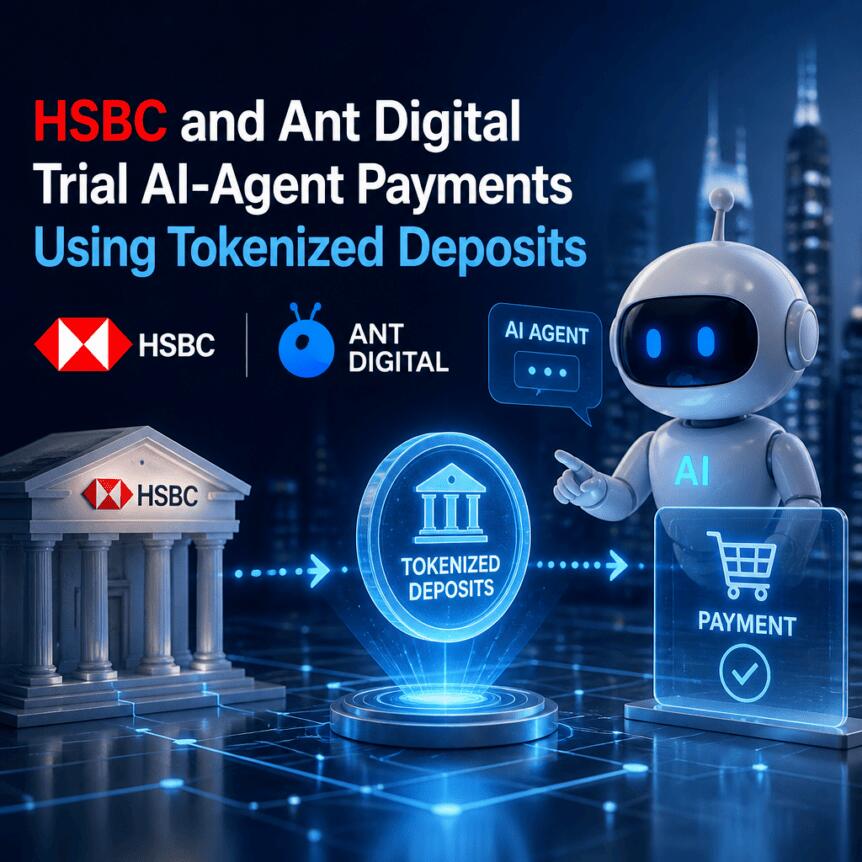
HSBC and Ant Digital Technologies say they have completed a technical test of an AI-agent payment system that uses tokenized bank deposits, with transactions settled in real time on a blockchain test environment. The demonstration is notable for showing how an AI agent could locate a digital service, initiate payment, and complete the transaction via a programmable flow—without relying on a human to execute the steps manually.
The companies framed the run as “micropayment” verification—typically defined as transfers under $2—and stressed it was not a commercial rollout. Even so, the test reflects a broader push among established financial institutions to explore whether AI agents can safely interact with payment rails and digital services in an automated, always-on manner.
Key takeaways
- HSBC and Ant Digital conducted a technical verification of AI-agent micropayments using tokenized bank deposits and blockchain testnet settlement.
- The system combined roles across the stack: HSBC handled settlement capabilities and real-time risk checks, while Ant Digital coordinated service access and payments.
- Transactions were settled in real time on a layer-2 testnet environment, highlighting a focus on near-instant settlement during automated flows.
- The participants say it was not a live customer offering, limiting conclusions about production readiness.
- Related bank tests show a broader industry pattern—from Mastercard and Visa agent infrastructure to blockchain mainnet experiments—though opinions differ on feasibility.
How the HSBC and Ant Digital test worked
In an announcement made on Friday, HSBC and Ant Digital Technologies described a system designed to let AI agents interact with digital services and make small payments through tokenized deposits. The test integrated three key components: HSBC’s Tokenised Deposit Service, Ant Digital’s Anvita Flow network (intended to help AI agents find and use services and execute payments), and Jovay Testnet, described as a layer-2 blockchain testing environment.
According to the companies, the demonstration functioned end-to-end: an AI agent selected a digital service and completed a payment. HSBC’s contribution centered on settlement capabilities and real-time risk checks, while Ant Digital’s network was responsible for coordinating service access and the payment flow.
The project’s use of blockchain settlement is where the experiment’s relevance for crypto infrastructure becomes clear. Rather than treating tokenization purely as an internal bookkeeping exercise, the test aimed to move toward an on-chain settlement process suitable for automated, programmatic transaction execution.
At the same time, the firms were explicit that the trial was limited to technical verification and did not represent a commercial launch or live customer offering, as stated in their release.
Company release on the HSBC and Ant Digital test
Why micropayments matter for AI-agent commerce
Micropayments are often discussed as a natural fit for machine-driven commerce. When an AI agent is making frequent, small purchases—such as paying for access to a feature, a single digital transaction, or a low-cost service—the economics and user experience of payments can differ from traditional card or bank transfers.
By describing the trial in “micropayment” terms (less than $2), HSBC and Ant Digital are implicitly targeting scenarios where transaction volume is high and the payment process must be efficient. For investors and builders, the core question is less about whether the specific test could process tiny payments, and more about whether the architecture can support automated authorization, settlement, and compliance checks without introducing bottlenecks.
HSBC’s inclusion of real-time risk checks within the demonstration suggests the trial’s authors understand that AI-agent autonomy doesn’t remove the need for guardrails. If banks want AI systems to initiate payments on behalf of users, they must embed controls that can respond instantly to suspicious patterns or policy violations.
A wider trail of bank experiments with AI-agent payments
HSBC’s test joins a chain of banking and payments-provider trials that explore AI-agent-initiated transactions. Earlier this year, Santander completed what it described as Europe’s first live end-to-end payment executed by an AI agent using Mastercard’s Agent Pay infrastructure, according to a controlled test involving the bank’s live payment systems.
Santander and Mastercard test (Santander press room)
In May, Swiss digital asset bank Sygnum reported a test of AI-agent-driven transactions on a blockchain mainnet, while keeping customer approval and signing requirements in place. Shortly after, CaixaBank completed a card transaction initiated by an AI agent in collaboration with Visa Intelligent Commerce, using existing merchant payment systems.
Sygnum’s mainnet test (Sygnum)
CaixaBank’s AI-agent card transaction (CaixaBank)
What these examples collectively underline is that the industry is not moving along one uniform route. Some experiments emphasize agent-to-payment infrastructure on traditional rails, while others explore tokenization and blockchain settlement. HSBC and Ant Digital’s approach sits closer to the latter, at least in how the settlement is presented.
Can incumbent systems adapt—or will purpose-built infrastructure win?
Despite the momentum behind these trials, skepticism remains about whether established banks can retrofit legacy infrastructure for autonomous, 24/7 payment flows.
In a May interview with Cointelegraph, Augustus Bank CEO Ferdinand Dabitz argued that traditional clearing banks were built for human processes rather than automated operations around the clock. He also described Augustus as working on a US bank designed around stablecoins and AI-driven processes, aiming to replace parts of traditional systems with infrastructure built for machine-initiated activity.
Cointelegraph report on Augustus CEO’s comments
HSBC’s test doesn’t resolve that debate. The trial was framed as technical verification, and it remains unclear how far from production it is. Still, the very act of running settlement and risk checks in real time on a blockchain testing environment suggests banks are at least exploring architectures that look meaningfully different from standard payment pipelines.
Blockchain adoption may hinge on always-on programmability
Outside individual pilots, research firms have been laying out a more conceptual case for why blockchain could matter in AI-agent commerce. Citrini Research, in an Oct. 8 report titled Breaking The Wall, argued that autonomous AI agents—operating programmatically and continuously—could increase demand for programmable financial infrastructure.
In the report, Citrini said that traditional systems were largely designed for human users, and that as AI handles transactions across applications, money and financial assets may need to move programmatically as well. The firm’s core reasoning is that blockchain networks can provide infrastructure that is “always-on” and suitable for asset movement in an automated context.
“AI agents move programmatically, 24/7, across applications, and it’s only logical that money and financial assets eventually will, too,” Citrini wrote in the report.
Citrini Research report (Breaking The Wall)
HSBC and Ant Digital’s test can be read as an attempt to operationalize that argument in a constrained setting: tokenize deposits, route service access through an AI-agent flow, settle payments quickly, and apply risk checks in the moment.
For readers watching this space, the next signals to track are whether these demonstrations evolve into production-grade systems with clear user authorization models, whether tokenized deposits become more than test objects, and how quickly banks can reconcile real-time risk controls with AI-agent autonomy in operational environments.
https://www.cryptobreaking.com/hsbc-and-ant-digital-trial/?utm_source=blogger%20&utm_medium=social_auto&utm_campaign=HSBC%20and%20Ant%20Digital%20Trial%20AI-Agent%20Payments%20Using%20Tokenized%20Deposits%20
Comments
Post a Comment