
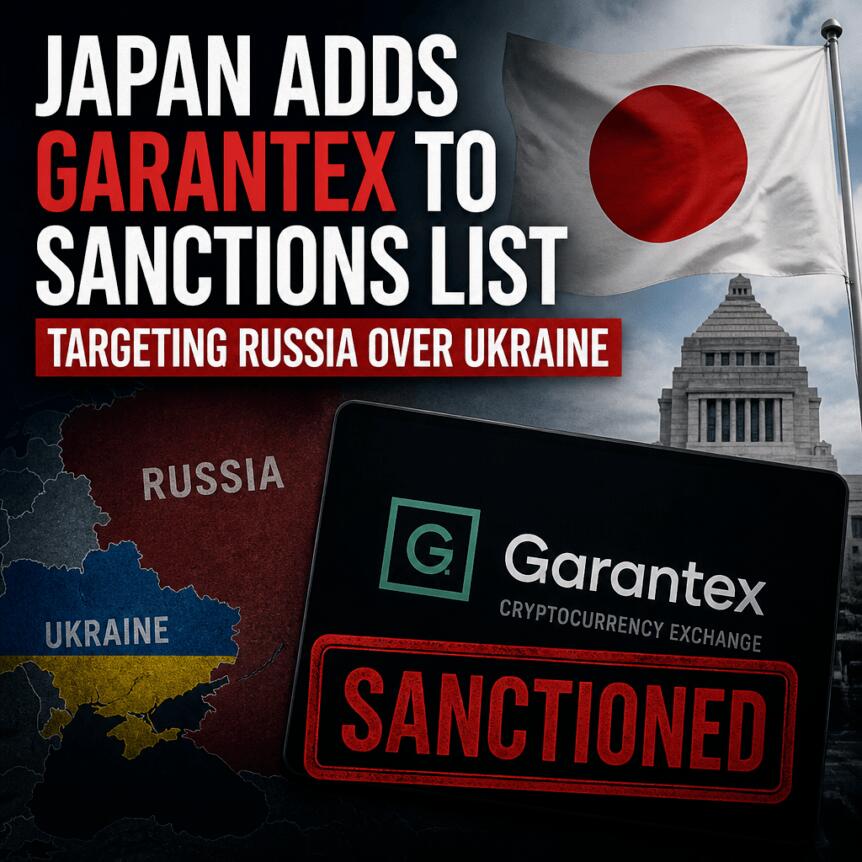
Japan has broadened its sanctions against Russia as the war in Ukraine continues, adding the Russian cryptocurrency exchange Garantex to a new asset-freeze list. The update, announced in a joint statement by Japan’s Ministry of Foreign Affairs, Ministry of Finance and Ministry of Economy, Trade and Industry, extends restrictions on payments and capital transactions involving designated parties.
Beyond Garantex, Japan also increased the number of sanctioned Russian-linked entities and individuals, and targeted dozens of vessels believed to be involved in the “shadow fleet” used to support oil shipments—an area Japan says is closely tied to Russia’s ability to earn revenue from crude exports.
Key takeaways
- Japan added the crypto exchange Garantex to its asset-freeze list, tightening restrictions on payments and capital transactions with the firm.
- The sanctions expand to 33 additional organizations and nine individuals linked to Russia.
- Japan also designated 35 vessels associated with a “shadow fleet,” restricting services such as repairs and insurance for these ships.
- Earlier reporting cited potential contingency planning by Garantex that could reduce the practical impact of enforcement actions.
Japan targets Garantex and Russia-linked financial infrastructure
According to the joint statement released Friday by Japan’s foreign, finance, and trade ministries, Garantex is now included among parties subject to an asset freeze. These measures are designed to prevent sanctioned organizations from accessing financial channels tied to Japan, including through restrictions on payments and other capital-related transactions.
Japan’s move follows a wider pattern seen across multiple jurisdictions: Garantex has already been sanctioned by the United States and the European Union, among other countries, for allegedly helping Russian entities bypass existing financial restrictions. The Japanese action therefore builds on earlier restrictions rather than introducing a completely new line of pressure.
Expansion includes “shadow fleet” vessel restrictions
Japan’s sanctions package also reaches beyond the crypto sector. The statement says Japan added 35 vessels identified as part of Russia’s “shadow fleet,” which is widely described in sanctions policy discussions as a set of ships used to keep oil shipments moving despite efforts to block or limit trade with Russia.
Importantly for enforcement, Japan’s measures do not only freeze assets; they also restrict services related to the targeted vessels. The statement specifies limitations including repairs and insurance for coverage to support operations involving the designated ships.
By tightening those service pathways, Japan’s government appears to be aiming at the operational sustainability of the shadow-fleet network—an approach that seeks to reduce the real-world capacity to move oil rather than focusing solely on financial constraints.
Why Japan says the measures matter for Russia’s oil revenue
Through these sanctions, Japan said it intends to help reduce Russia’s earnings from crude oil exports. That framing links the crypto exchange designation to a broader strategy: while Garantex is being targeted for its role in enabling sanctions evasion, the vessel restrictions are aimed at a primary revenue stream underpinning Russia’s war effort.
This integrated approach is notable because it reflects a growing tendency in sanctions policy—pairing pressure on financial facilitators (including certain crypto services) with pressure on logistics and trade enablers (like ship insurance and repair services).
Prior concerns about contingency plans and migration risk
While Japan’s latest move strengthens formal restrictions, the real effect may be influenced by how quickly affected platforms can reorganize. Earlier coverage from Cointelegraph in August 2025 reported that blockchain intelligence firm TRM Labs suggested Garantex may have had a contingency plan ahead of US enforcement actions.
That earlier reporting highlighted the possibility that sanctioned entities could prepare well in advance—allowing them to migrate clients, infrastructure and funds to successor platforms if enforcement tightens. TRM Labs’ assessment, as referenced in Cointelegraph’s report, suggested that sanctions might be less effective when actors can quickly shift to alternative services before restrictions bite fully.
The US has also taken action that underscores the scale of scrutiny facing Garantex and related entities: Cointelegraph reported that the US Treasury’s Office of Foreign Assets Control (OFAC) sanctioned Garantex a second time, along with its successor, Grinex.
For investors and market participants, the key issue is how quickly compliance frameworks, counterparties, and on-ramps respond to new designations. Even when enforcement is strict on paper, the practical impact depends on whether operational pathways are cut off fast enough to prevent funds and users from moving to alternate venues.
What to watch next
Japan’s added designations raise the pressure on Russia-linked crypto and logistics channels, but the most important developments to monitor will be how exchanges, insurers, ship-service providers and financial intermediaries implement the new restrictions—and whether counterparties continue to see sanctioned entities reconstitute operations through successor platforms.
https://www.cryptobreaking.com/japan-adds-garantex-to-sanctions/?utm_source=blogger%20&utm_medium=social_auto&utm_campaign=Japan%20Adds%20Garantex%20to%20Sanctions%20List%20Targeting%20Russia%20Over%20Ukraine%20
Comments
Post a Comment