
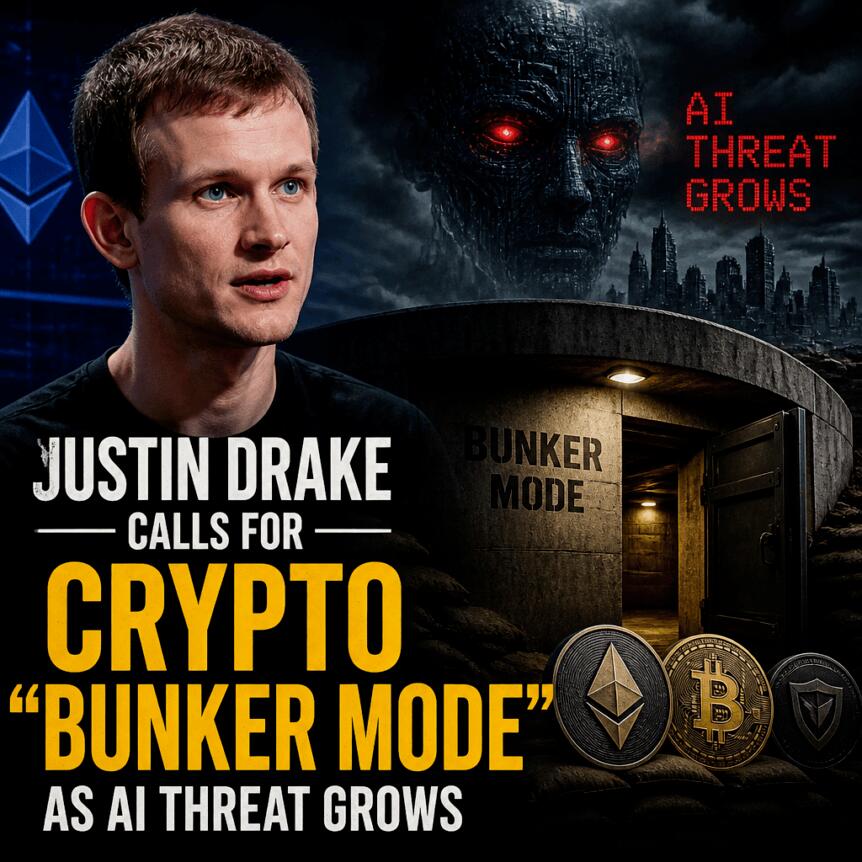
Ethereum co-founder Vitalik Buterin has endorsed a new warning from Ethereum researcher Justin Drake that rapid progress in artificial intelligence could eventually weaken the cryptographic assumptions underpinning many blockchain systems—potentially even before quantum computers pose a direct threat.
In separate posts on X, the two researchers emphasized that the near-term focus should be on careful, optional risk reduction rather than panic. Both pointed to the possibility that AI-accelerated advances in mathematics could make it easier to break or materially weaken widely used signature schemes such as ECDSA, while also casting doubt on the idea that some classes of cryptography are automatically “safe” for the medium term.
Key takeaways
- Buterin and Drake say AI-driven mathematical progress could, in principle, undermine blockchain cryptography before quantum computers arrive.
- Drake’s “bunker mode” framing includes a gradual migration strategy: move funds to fresh addresses whose public keys have not been exposed.
- Both stressed that holders should not rush—migration can introduce operational risks, including mistakes that cost money.
- Buterin broadened the concern beyond elliptic curves to lattice-based cryptography, suggesting AI advances could weaken it as well.
From “quantum risk” to AI-driven cryptography concerns
Drake’s comments, posted on Wednesday, urged the industry to treat cryptographic risk from AI as a serious, ongoing issue. His central concern is that AI could make it feasible to break the elliptic curve digital signature algorithm (ECDSA) that many crypto wallets rely on to authorize transactions.
Importantly, Drake framed this as a long-horizon problem, not an immediate emergency. He called for a gradual shift toward addresses that have not publicly revealed their associated keys—effectively reducing the exposure of already-used cryptographic material.
Buterin responded by aligning with the premise but discouraging sudden action. “I don’t recommend anyone scramble to move their funds to new wallets today,” he wrote, while adding that the industry should take risks to cryptography from AI-accelerated math seriously.
Why Drake thinks AI mathematics changes the timeline
Drake said his concerns were sharpened after OpenAI released hundreds of new mathematical findings across a range of areas, including algebra, theoretical computer science, and mathematical logic. In his view, the breadth and pace of these results show how quickly AI capabilities can advance within fields that have historically relied on human intuition.
He pointed to an example from last month in which OpenAI used 10,000 autonomous AI agents working in parallel to solve the Navier-Stokes equation—a long-standing problem in mathematics and physics—within 88 hours.
Drake argued that this kind of acceleration is humbling for traditional approaches to mathematical discovery, noting that long-held assumptions can collapse quickly once new methods become available.
In a technical aside, he suggested that elliptic curve cryptography could be especially sensitive to superhuman mathematical techniques. He contrasted the structured algebra underlying curves with hashes, which are designed to minimize exploitable algebraic structure.
Buterin extends the warning to lattice-based cryptography
Buterin’s response broadened the focus from elliptic curves to other cryptographic families. He acknowledged the common view that if elliptic curves fall, hashes may remain safe, and lattice-based systems might continue to resist quantum attacks. But he challenged that framework.
“So far most people have been in the mode of thinking ‘elliptic curves broken, hashes safe, lattices safe,’” Buterin wrote. He added that there is a “good chance” that the practical security of lattice-based cryptography could face “serious hits” within the next two years due to AI-driven mathematical advances.
Buterin linked the concern to Ethereum’s direction of travel in its “lean roadmap,” saying it has been moving toward a “hash-only” approach. The underlying idea is that cryptographic design choices—especially those related to future-proofing—may need to account not just for quantum computing, but also for faster-than-expected algorithmic progress enabled by AI.
What “controlled migration” could look like for wallet holders
Beyond the theoretical cryptography discussion, both researchers offered practical steps aimed at reducing exposure. Drake recommended that holders begin a controlled mass migration of assets to fresh addresses where the public key has not been exposed.
He suggested that large and sophisticated holders should move first, and that remaining funds should be transferred to new addresses after signing a transaction—an approach designed to keep exposure to previously used keys contained.
Buterin supported the precaution “if it’s not difficult for you,” describing it as a good idea to keep funds in addresses that have not yet been used to make a transaction.
However, both emphasized that migration itself carries risk. Buterin cautioned that he has lost more money through “botched migrations” than through hacks combined. Drake likewise stressed that a rushed migration could cause more harm than good, recommending gradual, carefully managed steps instead of abrupt behavior that could lead to user error, mis-sends, or operational downtime.
The central tension in their advice is straightforward: if cryptographic risks are evolving due to AI advances, reducing exposure by rotating addresses could help. But making that change hastily, without proper operational safeguards, can create immediate losses that outweigh the hypothetical future gains.
What readers should watch next
For now, the most important signal is not an instruction to empty wallets, but a shift in how developers and users may need to think about cryptographic timelines—balancing AI-driven mathematical progress against the practical risks of operational change. The next key question is whether wallet and protocol teams translate these concerns into clearer migration practices and updated cryptographic roadmaps, and how quickly best practices for “controlled” key exposure reduction spread across the ecosystem.
https://www.cryptobreaking.com/justin-drake-calls-for-crypto/?utm_source=blogger%20&utm_medium=social_auto&utm_campaign=Justin%20Drake%20Calls%20for%20Crypto%20“Bunker%20Mode”%20as%20AI%20Threat%20Grows%20
Comments
Post a Comment