
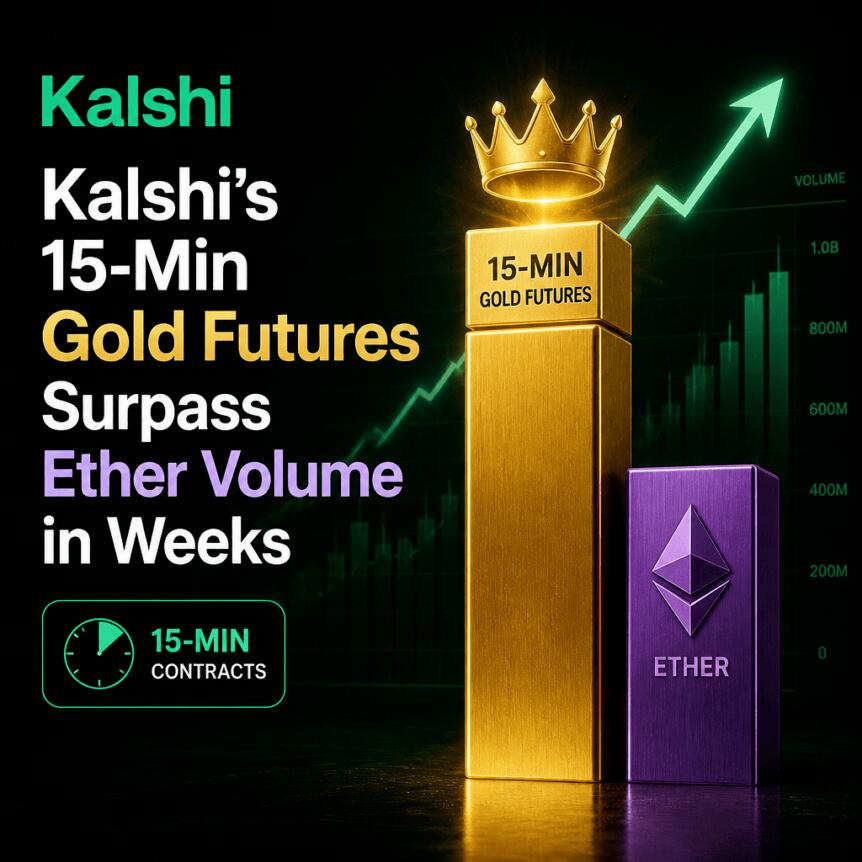
Kalshi’s short-duration “non-sports” markets are turning out to be a lucrative driver of platform revenue, with its 15-minute gold contracts generating roughly double the estimated fees of comparable Ether markets only weeks after their debut. The figures highlight how fast micro-interval trading is finding traction on the prediction platform.
According to data compiled by Predict Charts, Kalshi’s 15-minute gold markets produced about $5 million in estimated fees during September—compared with $2.6 million for Ether contracts over the same period. Bitcoin remained the largest single market by fees, pulling in an estimated $60.4 million.
Key takeaways
- September fees: 15-minute gold generated about $5 million, nearly twice the estimated fees of Ether’s 15-minute contracts at $2.6 million.
- Bitcoin still leads by a wide margin, with an estimated $60.4 million in fees for non-sports markets in September.
- Kalshi’s short-duration formats are scaling quickly: gold overtook Ether’s 15-minute contracts in September by volume and fees performance.
- InGame’s analysis suggests 15-minute markets account for a disproportionate share of fees versus volume, driven by Kalshi’s fee structure relative to contract odds.
Gold’s rapid rise inside Kalshi’s 15-minute lineup
The 15-minute gold contracts allow traders to bet on whether gold will move up or down over 15-minute intervals. Predict Charts data indicates these contracts, launched only in August, generated close to $5 million in estimated fees in September—nearly double the figure for Ether.
That outcome matters because it shows Kalshi isn’t merely replicating crypto-adjacent demand. Instead, short-duration trading appears to be transferable to commodity instruments quickly enough to reshape the platform’s fee rankings.
Kalshi’s crypto markets also remain central to the overall picture. Predict Charts estimated that Bitcoin’s 15-minute markets generated far more fees than other series, with $60.4 million in September. Still, the gold results demonstrate that non-crypto categories can meaningfully compete for attention inside the same short-horizon framework.
From launch to scale: how Ether and Bitcoin evolved
Predict Charts data shows that after their initial launch in December, 15-minute Bitcoin markets became Kalshi’s biggest market series outside of parlays by July. The platform’s Ether counterpart also grew rapidly in its early phases.
As the data outlines, Ether’s 15-minute contracts increased from 6.1 million to 233 million contracts traded between January and July. By September, Ether’s volume continued rising to 318 million contracts.
Even with that growth, gold took a clearer lead in the September results. Predict Charts reported that 15-minute gold recorded 542 million contracts traded in September, overtaking Ether’s 318 million. That pattern suggests that, within Kalshi’s 15-minute ecosystem, liquidity and participation can shift quickly when a new asset class is added.
Why short duration may be driving fees more than volume
Short duration markets are also expanding their share of Kalshi’s broader non-sports activity. InGame, in an analysis published Tuesday, found that 15-minute crypto, commodity, and financial markets generated $20.4 million in fees over the seven days through Oct. 5. InGame said this accounted for 80% of Kalshi’s non-sport fees during that period.
The same analysis points to an even more striking imbalance: InGame estimated that short-duration markets represented 13% of Kalshi’s trading volume but 20% of its fees during the week. In other words, traders appear to be paying a higher effective fee per unit of volume in these shorter intervals.
InGame journalist Daniel O’Boyle attributed part of this dynamic to Kalshi’s fee formula, which depends on contract odds. As O’Boyle wrote, fees are higher as a share of volume on contracts priced closer to 50/50 odds compared with the biggest favorites or longshots.
For market participants, this matters because it implies that the economics of trading on Kalshi may differ by horizon and by how close a contract is to a balanced probability. If short-duration instruments are naturally attracting many bets near more evenly matched odds, they can generate a greater fee contribution even without dominating total volume.
Commodities momentum aligns with Kalshi’s own growth claims
The renewed focus on gold comes as Kalshi expands beyond its earlier crypto-heavy ecosystem. In September, Kalshi said commodities trading volume reached $400 million within seven months—more than four times the volume its crypto markets had generated at the same stage.
Kalshi also argued that crypto markets showed the potential for Kalshi to scale new categories from tens of millions to billions in monthly volume. While the company’s statement speaks to long-term scaling potential, the September fee comparisons provide an early datapoint consistent with that thesis: a new asset class introduced into short-duration trading can generate outsized fee impact quickly.
Still, the data also highlights what remains uncertain. Fees are “estimated” figures in the Predict Charts dataset, and InGame’s analysis focuses on a specific one-week window through Oct. 5. Traders should treat the results as strong signals rather than definitive proof of a permanent structural shift across all months and market conditions.
Going forward, readers may want to watch whether gold’s fee and volume lead persists beyond September, and whether other short-duration commodity or financial markets replicate the same pattern—particularly if they attract trading activity at odds near 50/50, where fees may be structurally higher.
https://www.cryptobreaking.com/kalshis-15-min-gold-futures-2/?utm_source=blogger%20&utm_medium=social_auto&utm_campaign=Kalshi’s%2015-Min%20Gold%20Futures%20Surpass%20Ether%20Volume%20in%20Weeks%20
Comments
Post a Comment